
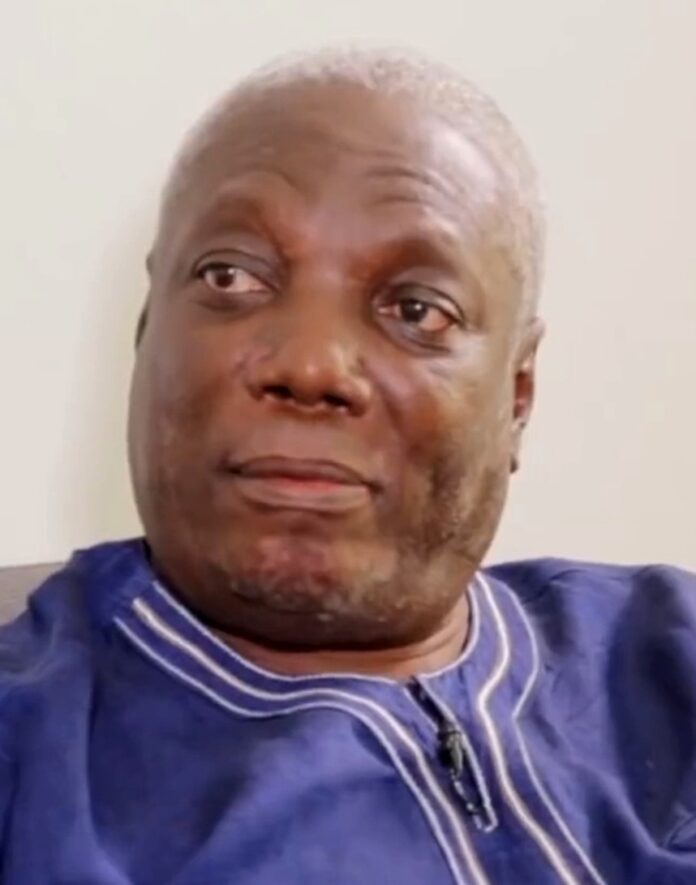

My boss, Christian Amoani Ohene affectionately called AC Ohene was the first to post about Joris Wartenberg’s demise on the Adom Editors’ Forum WhatsApp platform.
It was after that the General Manager of the Adom Brands of the Multimedia Group Limited, Abdulai Awudu reminded us to celebrate him.
Adom FM’s Programs Manager, Joshua Tigo, went on to provide further details about his life, and I became compelled to learn more about Joris Nana Benyin Wartenberg.
My search revealed that he was a man wrapped in mystery as a thinker, a writer, and a cultural force; a figure whose life straddles power, controversy, identity, and history itself.
Now, this is the story of Joris Nana Benyin Wartenberg, an enigmatic Ghanaian whose journey stretches from Sekondi to the global corridors of influence, and from colonial legacies to an ancient biblical identity.
A BEGINNING ROOTED IN HISTORY
Born in Sekondi in Ghana’s Western Region, Wartenberg’s early life was shaped by deep historical roots.
His family traced its origins to Elmina once a hub of European trade and cultural exchange before relocating to Sekondi in pursuit of commercial opportunities.
He began his education at Sekondi Methodist Primary School and, in 1964, earned admission into the prestigious Achimota School after passing the Common Entrance Examination.
His contemporaries are the venerable Ekow Ansah the Playwriter, Poet who set up TV Africa in Ghana and great musicians like Gyedu Blay Ambolley.
But his journey was far from straightforward.
Despite a suspension during his final years, Wartenberg returned with remarkable determination eventually emerging as the top A-Level student in West Africa.
The late Jerry John Rawlings was his senior at the Achimota school.
THE MAKING OF A CULTURAL FORCE
At the University of Ghana, Legon, where he studied Law and one of his mate is the revered now Professor Kwamena Ahwoi, another passion was quietly taking shape writing.
What began as an interest soon evolved into a defining legacy.
Wartenberg started crafting English-language drama, eventually authoring works that would gain academic recognition across Africa.
His intellectual curiosity extended beyond literature into physics, mathematics, and theology fields he boldly sought to connect.
He argued that creation itself could be explained through nuclear and atomic principles, positioning himself as a thinker far ahead of his time.
POWER, POLITICS, AND PERIL
Wartenberg’s brilliance brought him unusually close to power at a remarkably young age.
At just 21, he reportedly served as an advisor to then Head of State. General Ignatius Kutu Acheampong but proximity to power came at a cost.
He resigned from the Acheampong government on the advice of his father, who believed he was rising too quickly in life and that it could cut short his journey.
Nana Benyin Wartenberg then left for London and the United States.
Wartenberg later returned to Ghana and, in 1978, went straight to General Acheampong, the Head of State at the time, and advised him to resign and return the country to constitutional rule.
In a dramatic twist, he was subsequently arrested by the same regime and detained for two weeks over suspicions of involvement in a coup plot.
Though he was released, the experience marked the beginning of a series of controversies that would follow him across borders.
Upon his return to London, Wartenberg was again arrested this time by British authorities over alleged links to a cocaine dealer.
A GLOBAL ODYSSEY
From Ghana to London, and onward to Egypt and the Middle East, Wartenberg’s life unfolded like a global expedition.
He ventured into international business, navigating complex cultural and political landscapes.
Yet beneath these experiences lay a deeper, more personal discovery one that would redefine his identity.
THE REVELATION OF IDENTITY
Somewhere along his journey, Wartenberg uncovered what he describes as a profound truth: his Jewish ancestry.
This revelation reframed his understanding of history, culture, and self. He began to explore connections between West African heritage and ancient biblical lineages particularly the relationship between Judah and Joseph.
For Wartenberg, identity was no longer confined to geography. It became a bridge between continents, histories, and spiritual traditions.
SHAPING GHANAIAN MEDIA
Long before these revelations, Wartenberg had already left an indelible mark on Ghana’s cultural landscape.
While still a student at Legon, he was commissioned by a producer at the
Ghana Broadcasting Corporation
to script a television drama.
The result was Osofo Dadzie a groundbreaking Akan-language series that aired from 1972 to 1981. More than entertainment, the show was a cultural revolution.
It spoke directly to Ghanaian audiences in their own language, reflecting everyday realities with authenticity and depth.
Through this work, Wartenberg helped redefine Ghanaian television storytelling.
THE “JOSEPH PRINCIPLE” AND A BIGGER VISION
Never one to think small, Wartenberg later conceptualized what he called the “Joseph Principle.”
It was a bold ideological framework aimed at reconnecting the African diaspora with the continent linking history, identity, and destiny in a shared narrative with the then Tourism Minister and Diasporan Relations, Jake Obetstebi Lamptey and Kwamena Bartels who served under Kuffuor’s government from 2001 to 2008.
LEGACY OF A MYSTERIOUS LIFE
Former Channel Manager of Adom TV, Paa Kwesi Ackon, who worked with Wartenberg at Ghana Films, reflected on the late Wartenberg:
“He was a versatile figure in the creative arts industry.
We have lost a colossus whose footprints in the industry are indelible.”
Film Consultant, Ernest Abbeyquaye, also shared his thoughts:
“I’m shocked to hear that Wartenberg is gone. I spoke with him regularly, and it is sad that he is no more. He has many unpublished manuscripts, and it would be prudent for the family to preserve them for publication so that his works and legacy can endure.”
Joris Nana Benyin Wartenberg’s story is not easily categorized.
It challenges conventional narratives. It provokes difficult questions about history, power, and belonging.
And it offers a rare glimpse into a life lived at the intersection of cultures, ideas, and identities.
In the end, his journey is more than biography.
It is a mirror reflecting Ghana’s past, its global connections, and the enduring search for identity in a complex world.
