
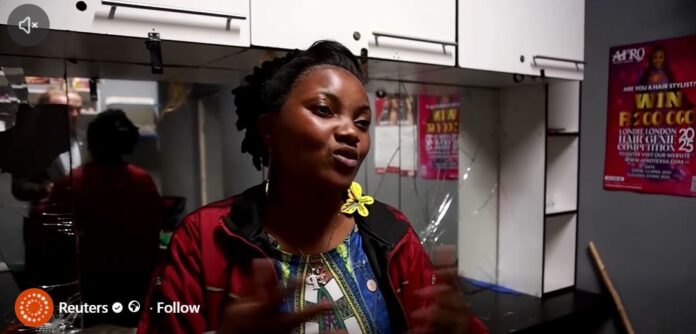

A Ghanaian woman who lives in Durban, South Africa, Princess Adjei, says that despite recent xenophobic attacks leaving her and her 14-year-old son homeless, she has no plans to leave the country, because it is the only place she has ever called home.
Princess Adjei moved to South Africa as a toddler. She did all her schooling there, speaks Zulu, and has friends she has known for years. Ghana, her country of birth, is a place she has visited only once.
On May 18, 2026, the place she called home and people she called friends turned against her.
Demonstrators at an anti-migrant march in Durban broke into the hair salon the 33-year-old had spent years saving to open and looted it. When she returned to her apartment afterwards, a neighbour she used to share tea and conversation with in the corridor frowned at her and asked when she was leaving.
“They took everything,” Adjei said, surveying the wreckage of her first-floor shop amid smashed mirrors and broken chairs.
She pointed to a wall of empty hooks. “Those were hair pieces I was selling here. There were acrylic nails, six hair dryers, a range of shampoos. All gone.”
In a report by reuters.com, she revealed she had spent 50,000 rand (more than $3,000) renovating the salon in February, and it had been open just a few months.
Without income from the salon, Adjei could no longer afford rent and was forced to move out of her central Durban apartment.
She is now sleeping on the street outside the Department of Home Affairs with her son, sharing a blanket among about 200 other displaced migrants camped there in the hope that officials can confirm their residency status.
“This is where I grew up. This is where my whole life is, and I’m documented. If I was not documented I would understand but I’m documented, so there’s nowhere that I can go. I’ll stay here in South Africa,” she said.
It is the third time xenophobic violence has disrupted her life. In 2008, classmates who had previously shown no interest in her nationality suddenly began bullying her during a wave of anti-migrant protests.
Adjei’s story is not unique.
Reuters spoke to a dozen migrants in Durban, four of whom, like her, had lived in South Africa since childhood. All of them now find themselves caught between a country that no longer wants them and another they barely know.
The violence, which has killed at least five people and triggered a diplomatic rift across the continent, has been driven by the anti-immigration movement March and March, whose founder Jacinta Ngobese denies that it amounts to xenophobia.
Analysts say migrants are increasingly used as scapegoats for unemployment and failing public services, with anti-migrant sentiment often amplified ahead of elections. South Africa has local elections due by November.
For Adjei, the politics are beside the point. The live and business she built in Durban were taken by strangers in a space of an afternoon.
ALSO READ:
I can’t boast of 100 members – ESPA boss raises alarm over collapse of waste management companies
Campus safety fears: Ghana records at least 13 university student non-natural deaths since 2024
