
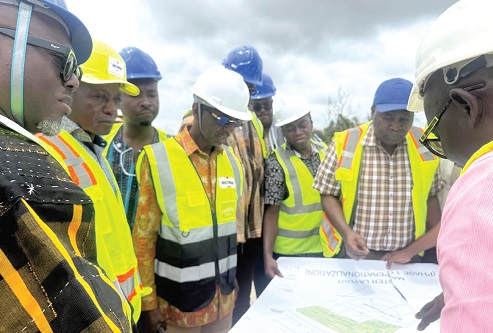

The Board Chairman of the Ghana Ports and Harbours Authority (GPHA), Johnson Asiedu Nketia, has underscored the need to complete the Boankra Integrated Logistics Terminal to improve revenue generation for the country and project partners.
He said enormous resources had been injected into the nearly 19-year-old construction phase and described the project as a game-changer that must be completed for it to generate the needed revenue to pay for itself.
“What is important now is to ensure the completion and operationalisation of the project so that it can start yielding dividends for the country.
“The main objective is for the Boankra Inland Port to become operational and beneficial to Ghanaians. This is not the time to apportion blame or politicise the project; Boankra must simply be completed,” Mr. Asiedu Nketia said when he paid a courtesy visit to the project site at Boankra in the Ejisu-Juaben Municipality in the Ashanti Region.
Among the delegation was the Chief Executive Officer (CEO) of the Ghana Shippers’ Authority, Professor Ransford Gyampo.
The project is being developed jointly by the Ghana Shippers’ Authority and GPHA, with Justmoh Construction Limited leading the construction.
The visit formed part of a joint inspection tour by officials from the GPHA and the Ghana Shippers’ Authority to assess progress and identify any bottlenecks.
Walking through sections of the facility, the delegation took a closer look at ongoing works, including key structures that will define the port’s operations.
Among them are parts of the container terminal and the container freight station, both expected to play a crucial role once the project becomes fully operational.
The Boankra Inland Port is a major dry port project near Kumasi aimed at bringing cargo handling services closer to central and northern Ghana.
It is designed to ease congestion at the Tema and Takoradi coastal ports, reduce transport costs, and support trade within Ghana and neighbouring landlocked countries, including Burkina Faso, Mali, and Niger.
The project’s completion is expected to have a significant impact on Ghana’s economy, creating jobs and stimulating growth in the transportation and logistics sectors.
With the government’s support and the expertise of local companies such as Justmoh Construction Limited, the Boankra Integrated Logistics Terminal is poised to become a critical component of Ghana’s economic infrastructure.
Its features include an inland clearance depot, customs-bonded and unbonded warehouses, a 413-acre site, and a light industrial zone.
The first phase is over 80 percent complete and accelerating towards a targeted completion.
Trade, logistics management
Speaking candidly about the country’s need to rethink how it drives growth, the GPHA Board Chairman said the inland port was not just another infrastructure project, but represented a shift in how the country managed trade and logistics.
Mr Asiedu Nketiah pointed out that Ghana could no longer depend solely on traditional economic pathways if it wanted to remain competitive.
He said projects such as Boankra offered a practical alternative, especially at a time when efficiency in cargo movement had become central to global trade.
Mr Asiedu Nketiah expressed satisfaction at the progress of work, particularly the pace and quality of execution, and commended Justmoh Construction Ltd., saying the delegation had realised how capital-intensive the project was, given the topography.
He gave an assurance that the state was ready to help to address any impediment to the smooth execution of the project.
Economic value
Also speaking during the visit, Prof. Gyampo highlighted the broader economic value of the project.
He described the inland port as essential to improving trade facilitation and positioning Ghana as a more efficient transit hub within the sub-region.
The CEO of Justmoh Construction Limited, Dr. Justice Amoh, used the opportunity to appeal for additional government support.
According to him, while steady progress had been made, more funding was needed to sustain the current momentum and to avoid delays.
He indicated that timely financial injections would allow contractors to scale up work and meet critical timelines.
Project consultant Dr. John Bernard Koranteng Yorke also provided a detailed update on the current state of the project, outlining significant progress made so far.
He explained that key phases of the project had reached advanced stages, with major structural works substantially completed and ongoing installations steadily progressing according to revised timelines.
Dr. Yorke said the technical team had maintained consistent supervision to ensure that all work met the required engineering and safety standards.
He further pointed out that in spite of earlier delays encountered due to logistical and funding challenges, the project had now gained steady momentum.
Dr. Yorke emphasised that coordinated efforts among contractors, consultants, and stakeholders had helped to resolve many bottlenecks that slowed implementation.
