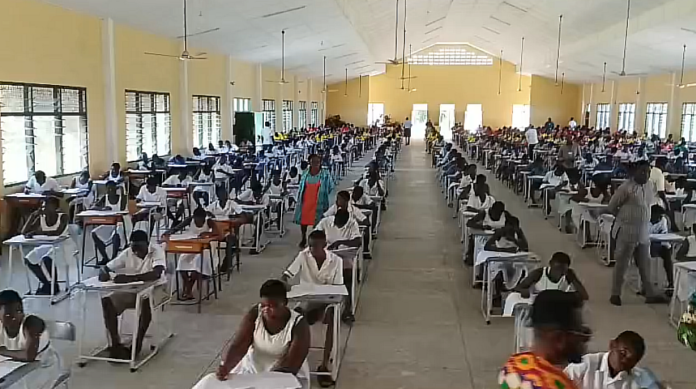

There is a quiet rhythm to every examination hall. Pens move. Minds stretch. Silence carries the weight of ambition. In that moment, every second matters. Every thought counts.
Now imagine that silence breaking, not because a student is done thinking, but because a door swings open.
A group walks in and automatically, heads begin to turn. The invigilator stiffens. And just like that, concentration is broken.
Across several Basic Education Certificate Examination (BECE) centres in Ghana, a growing concern is emerging: interruptions during active exam sessions, often in the name of “monitoring visits” or goodwill gestures. While supervision is essential to maintaining credibility, the manner in which some of these visits are conducted raises serious questions about focus and the overall integrity of the examination process.
The Unseen Disruption
For a candidate seated in an exam hall, the stakes are high. BECE is not just another test; it is a defining academic milestone. Students prepare for months, sometimes years, for these few hours.
So what happens when, in the middle of answering a question, a convoy of dignitaries enters the room?
In some instances, students are expected to pause, look up, or even acknowledge the presence of these visitors. It may last only a few minutes, but in an exam, minutes are not just time, but momentum.
Thought processes are delicate. A student solving a mathematics problem or structuring an essay relies on mental flow. Interrupt that flow, and the mind must restart. For some, that reset comes at a cost they cannot recover from within the limited time.
Monitoring or Misplaced Presence?
To be clear, monitoring is not the problem. In fact, it is necessary.
The West African Examinations Council (WAEC) explicitly states that it may deploy inspectors, supervisors, or authorised officers to ensure that examinations are conducted in strict accordance with regulations. These individuals are trained, expected, and, most importantly, non-disruptive.
But the growing trend of “monitoring visits” by individuals who fall outside this technical category is where the line begins to blur.
Yes, high-ranking officials; Ministers, Municipal Directors, or District Chief Executives, often conduct oversight visits. In some cases, traditional leaders and other public figures join in what is described as morale-boosting engagements.
But the question remains: must morale be boosted during the exam itself?
Encouragement is powerful, but timing is everything. A word of motivation before the paper begins or during scheduled breaks can inspire confidence. Walking into an exam hall mid-paper, however, risks doing the opposite.
A System Without Clear Boundaries?
One troubling gap is the apparent lack of a clearly defined structure for non-essential visitors during examinations.
WAEC regulations are detailed when it comes to candidates, invigilators, supervisors, and authorised inspectors. But when it comes to external visitors, especially those not directly involved in the conduct of the exam, the guidelines appear less explicit, at least in practice.
Does the system formally permit such visits during active writing periods? If so, under what conditions? And if not, why does it continue to happen?
Without clear enforcement or boundaries, what begins as a goodwill gesture can easily become a disruptive norm.
A Real Scenario
In one reported instance, a well-known individual (name withheld) entered an examination centre accompanied by an entourage of about ten people. The group moved through the centre while candidates were actively writing.
No matter how well-intentioned, such a presence inevitably shifts attention. It alters the environment. It reminds students that they are being watched; not just by invigilators, but by an audience. And from what I know, exams are not performances.
The Psychological Cost
Distraction in an exam is not just physical but deeply psychological.
A student who loses concentration may struggle to regain their train of thought. Anxiety can set in while the pressure of time intensifies. For candidates already dealing with exam stress, even a brief interruption can feel overwhelming. Then we have the issue of ‘chew and pour’ and the mind waiting for such an interruption to forget everything a candidate crammed last-minute.
Research in cognitive psychology consistently shows that task-switching, in this case, the shifting attention from the answer sheet to the visitor’s gaze, reduces efficiency and increases error rates. In an exam setting, that could mean the difference between a correct answer and a careless mistake.
Rethinking the Approach
The solution is not to eliminate oversight or community involvement. It is to refine it.
If monitoring visits are necessary, they should be strictly limited to authorised personnel trained to observe without interference. If dignitaries and well-wishers wish to support candidates, structured opportunities should be created before the exam begins or after it ends.
Examination halls should remain exactly what they’re meant to be: controlled, quiet and free from avoidable distractions.
Protecting the Moment That Matters
The BECE is a moment of transition. It’s a bridge between basic education and the future. For every candidate seated in that hall, it represents hope and possibility.
They deserve more than good intentions. They deserve focus.
Because in the end, success in an exam is not just about what you know; it is greatly about the environment in which you are allowed to show it.
Think about it.