
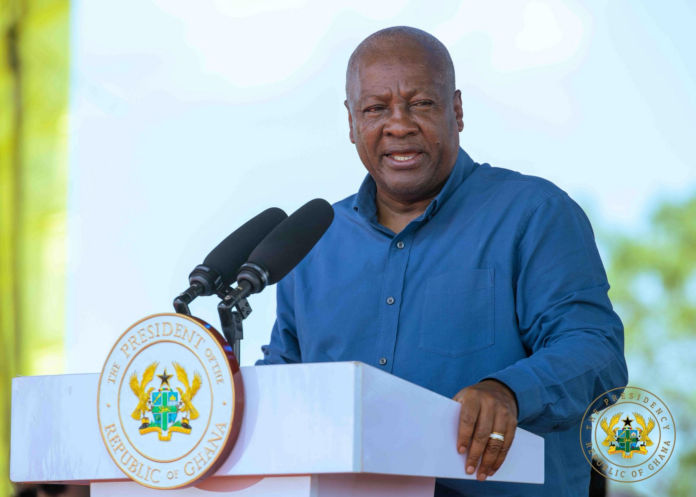

Most Ghanaians continue to approve of President John Mahama’s job performance, although public satisfaction has declined, according to a nationwide poll released on Wednesday, June 10, 2026, by the Institute of Economic Affairs (IEA).
The poll, conducted in May 2026 across all sixteen regions of Ghana and covering over 1,000 respondents, places President Mahama’s approval rating at 58.9%, down from 68% recorded in December 2025. About 28.4% of respondents disapprove of his performance, while 12.8% expressed no opinion.
The IEA noted that the gap between approval and disapproval suggests that positive assessments of the President’s performance still outweigh negative views, even though the decline reflects growing public expectations.
Economy remains key driver of approval
Among those who approve, the economy is the dominant factor. Nearly three in four respondents (73.5%) credited the government’s handling of the economy, followed by road infrastructure (16.0%) and energy and electricity (2.7%).
The findings reflect a period of notable macroeconomic improvement under the Mahama administration. Since January 2025, inflation has fallen from 23.5% to about 3.4%, while the cedi has appreciated by 26% against major currencies. The Bank of Ghana’s policy rate has also declined from 27% to 14%, with average commercial lending rates falling from about 32% to 20%. Ghana’s debt-to-GDP ratio dropped from 61.8% at the end of 2024 to 45.3% by the end of 2025.
These gains have attracted international recognition, with Fitch, Moody’s, and S&P upgrading Ghana’s sovereign credit rating, described by the IEA as a rare triple upgrade in recent years.
Electricity and cost of living concerns among disapprovers
Among those who disapprove, the economy still ranks highest at 30.9%. However, the IEA cautions that this may not necessarily reflect rejection of macroeconomic progress, but rather the lived experience of citizens, where improvements have yet to fully translate into lower living costs, job creation, and higher household incomes.
Electricity supply was cited by 29.9% of disapprovers, which the IEA links to a temporary power supply constraint in May 2026 that led to frequent outages in parts of the country. Corruption concerns accounted for 19.1% of responses, with the institute noting that government anti-corruption efforts have not fully convinced a section of the public.
Overall outlook
The IEA described the findings as a picture of broad support tempered by rising public expectations. It said Ghanaians remain largely supportive of the President’s leadership but expect macroeconomic gains to increasingly reflect in their daily lives.
The poll forms part of the IEA’s regular series tracking presidential job performance.
