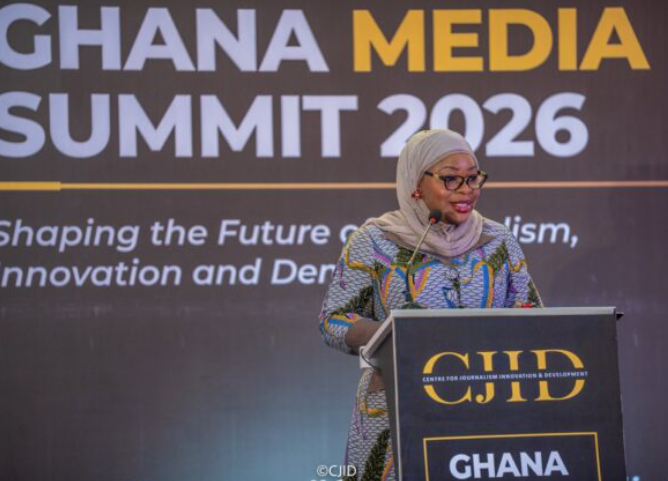

Deputy Presidential Spokesperson Shamima Muslim has reaffirmed the government’s commitment to combating misinformation while safeguarding press freedom, describing information integrity as both a governance and national security priority.
Speaking on behalf of the Minister of State for Government Communications, Felix Ofosu Kwakye, at the inaugural CJID Ghana Media Summit in Accra, Ms Muslim said the increasing spread of false information poses significant threats to democratic institutions, elections, public health and national cohesion.
“Information integrity is now a national security issue. It is also a governance issue and a democratic responsibility to protect,” she said.
She stressed that the government’s approach is not to censor information but to strengthen institutions, promote transparency and protect media freedom.
“The responsibility of government is not to censor, but to build stronger institutions through the promotion of transparency, protecting press freedoms and strengthening public trust,” she stated.
Ms Muslim said the government’s Resetting Ghana Agenda places emphasis on improving media freedom and promoting responsible digital communication.
She noted that President John Dramani Mahama had recently reaffirmed what she described as a “firm and irreversible commitment” to media freedom following Ghana’s improvement from 52nd to 39th position in the 2026 World Press Freedom Index.
The Deputy Presidential Spokesperson also disclosed that government is engaging stakeholders on the draft Misinformation, Disinformation, Hate Speech and Publication of Other Information Bill, adopting a clause-by-clause review process to ensure the proposed legislation strikes a balance between protecting public safety and upholding constitutional freedoms.
According to her, government is also implementing commitments under the Open Government Partnership to improve transparency and strengthen safeguards against misinformation on digital platforms.
Ms Muslim warned that misinformation and disinformation have the potential to influence elections, incite violence, erode public confidence and weaken national institutions without the use of force.
“These actions reflect the essence of our reset agenda—not a government that fears scrutiny, but one that understands that accountability, responsible journalism, access to information, digital literacy and public trust are essential foundations for democratic stability and national development,” she said.
READ ALSO:
Misinformation now one of biggest threats to democracy in West Africa – Shamima Muslim
Agenda 111: No hospital is operational despite GH¢4.8bn spent – Health Minister