
Educationist Dr Charles Obeng Sarpong has criticised Ghana’s categorisation of senior high schools(SHSs), arguing that the system is deepening class divisions and creating perceptions that some schools are inherently better than others.
Speaking on the debate over the placement of thousands of Basic Education Certificate Examination (BECE) candidates, Dr Obeng Sarpong said students should be given opportunities to thrive regardless of their academic performance, background or the school they attend.
“The categorisation of the schools also creates class systems and problems for the country,” he said.
He argued on Adom FM Dwaso Nsem that a more balanced distribution of students could help challenge the perception that academic excellence is concentrated in a few schools.
“We must find a way to bring everybody together regardless of their background or performance to avoid division and discrimination,” he noted.
Dr Obeng Sarpong pointed to the National Science and Maths Quiz (NSMQ) as an example of what can happen when students have access to opportunities across different schools.
“Look at the surprises happening at the NSMQ. You sometimes find popular schools being defeated by those we barely know, and it is because students were evenly distributed. So there is nothing like this school is good or not,” he said.
He said the performance of students from various schools should prompt a rethink of the notion that some institutions are simply “good” while others are not.
According to him, Ghana should explore ways of making school placement more equitable rather than allowing the categorisation system to reinforce existing social divisions.
“We must find ways to place the children in all schools because at the end of the day, it is the country that benefits,” he stated.
Dr Obeng Sarpong, however, stressed that his proposal should not be interpreted as a call to abolish academic standards.
“I am not talking about a wholesale system because everywhere, we have the procedure to determine how a person proceeds to the next level.”
He acknowledged that some programmes require particular academic strengths, citing engineering as an example where Mathematics is essential.
However, he argued that poor performance in English and Mathematics should not automatically become a permanent barrier to further education, particularly where students can benefit from remedial support and other interventions.
“So we shouldn’t limit our education to just English and Maths.”
He said students’ academic performance can also be influenced by their social and educational backgrounds, meaning that an initial poor result does not necessarily reflect their long-term potential.
Dr Obeng Sarpong recalled his experience teaching at Bantama SDA Senior High School, where he said a student from a village initially struggled to adjust and was mocked by colleagues over his appearance, demeanour and poor command of English.
He said the student later improved significantly, eventually ranking among the top 10 students in his year group and graduating with good grades.
For him, the experience demonstrates why students who struggle initially should be given opportunities and support to improve rather than being written off.
“We should look for remedial measures and other alternatives we can explore to their benefits to reintegrate them.”
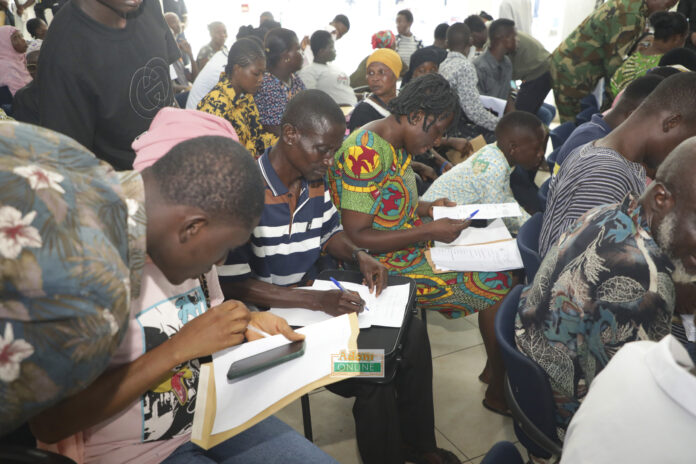
He questioned the consequences of leaving thousands of young people without placement and called for a rethink of the current approach.
“Why are we punishing ourselves such that 55,000 children cannot be placed?” he questioned.
Also read: