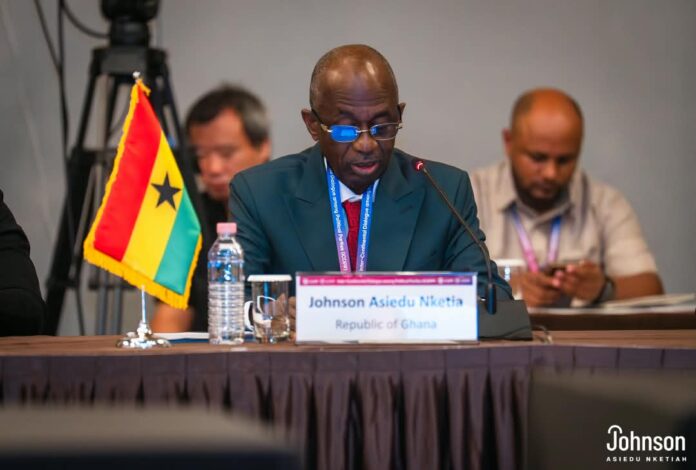

National Chairman of the National Democratic Congress (NDC), Johnson Asiedu Nketiah, has called for stronger political party institutions capable of producing quality leadership and sustaining public confidence beyond electoral victories.
Speaking on behalf of political parties participating in the African Political Parties Initiative (APPI) at the inaugural meeting of the Inter-Continental Dialogue among Political Parties in Seoul, South Korea, on Monday, September 7, he said the quality of governance is often determined long before political leaders assume public office.
Mr Asiedu Nketiah, who has spent decades in grassroots politics, Parliament and government, said political parties play a critical role in determining who gets opportunities, what qualities are rewarded and how seriously policy and conduct are treated.
“Long before people enter ministerial office or take seats in parliament, political parties have already decided who receives opportunity, which qualities are rewarded, what standards of conduct are accepted and how seriously ideas and policy are treated.”
He cautioned that political parties risk preparing themselves only to win elections when they fail to invest adequately in policy development, leadership training and institutional capacity.
“A country therefore pays a heavy price when its political parties become highly effective at winning elections but insufficiently serious about preparing people to govern.”
According to him, electoral victories can sometimes conceal institutional weaknesses, which become more apparent once a party assumes the responsibility of governing.
He stressed that parties must develop a broad pool of capable leaders rather than depend on a small circle of familiar personalities.
“The durability of a political party is ultimately found in its capacity to produce leadership beyond the generation that currently controls it.”
Parties must adapt to changing voter expectations
Mr Asiedu Nketiah also noted that the relationship between citizens and political parties is evolving, particularly as younger generations become more questioning of political authority.
He said political parties can no longer assume that support enjoyed by one generation will automatically be transferred to the next.
“Political relevance has to be renewed; it cannot simply be inherited.”
He therefore urged political parties to remain institutions where leadership is developed, policy is taken seriously, new ideas are introduced and capable people are given meaningful opportunities to enter public life.
The NDC National Chairman further stressed the importance of parties being able to function effectively both in government and in opposition.
He said opposition parties should use their time outside government to strengthen their policy, leadership and organisational capacity rather than merely wait for the governing party to fail.
“A serious party should understand opposition as a period in which it continues to develop policy, leadership and organisational capacity, rather than simply waiting for the governing party to fail.”
He added that governing parties must equally remain connected to the communities and constituencies whose confidence brought them into office.
“Elections can bring a party into government; only performance, organisation and continuing public confidence can sustain its political relevance.”
Calls for practical inter-continental political exchange
Mr Asiedu Nketiah said the newly established Inter-Continental Dialogue should go beyond formal statements and become a platform for political parties to share practical experiences.
He identified leadership renewal, rebuilding after electoral defeats, maintaining internal cohesion, developing policy capacity and adapting to changing political environments as areas where parties could learn from one another.
“Political institutions learn very little when they study only their victories.”
He said the different political histories, constitutional arrangements, economic conditions and political cultures represented at the Dialogue provide an opportunity for participants to learn from both the successes and failures of others.
Mr Asiedu Nketiah also expressed the hope that the initiative would develop into a sustained working relationship rather than become a succession of periodic meetings.
He said the success of the platform should ultimately be measured by whether political parties develop stronger relationships, exchange institutional experiences, expose emerging leaders to political traditions beyond their own countries and establish practical areas of cooperation.
Concluding his remarks, Mr Asiedu Nketiah congratulated the organisers and participants for establishing the Dialogue and called for sustained efforts to strengthen political institutions across continents.
“Political victories come and go. The lasting contribution of a political party is the quality of leadership, institutions and political culture it leaves behind.”