
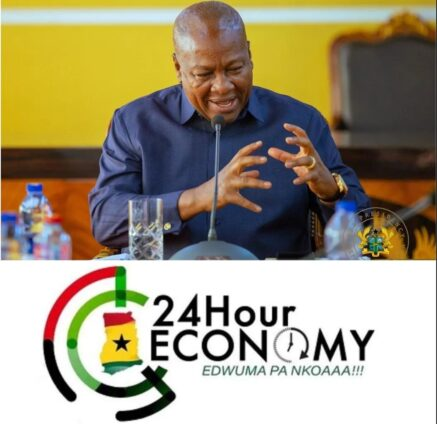

Ghana has achieved stability. Now every institution must be measured on productivity, jobs and growth.
Ghana stands at an important turning point.
After years of economic turbulence, painful reforms, and difficult sacrifices by businesses and citizens alike, the country is finally beginning to experience the benefits of macroeconomic stabilization. Inflation is easing, exchange rate volatility has reduced considerably, investor confidence is gradually returning, and fiscal discipline is becoming more visible.
These gains did not happen by accident.
The Ministry of Finance and the Bank of Ghana deserve recognition for implementing the difficult measures required to restore confidence in the economy. Through fiscal reforms, debt restructuring, tighter monetary management, improved reserve positions, and a renewed focus on stability, Ghana has successfully laid the foundation upon which future growth can be built.
However, stability alone does not create prosperity.
Stability alone does not create jobs.
Stability alone does not industrialize a nation.
Stability alone does not transform the lives of millions of young Ghanaians seeking opportunity.
The next national challenge is therefore clear: how do we convert economic stability into economic productivity?
The answer lies in the successful implementation of Ghana’s 24-Hour Economy.
The 24-Hour Economy Requires Institutional Discipline
The 24-Hour Economy cannot be achieved through speeches, slogans, or policy announcements.
It requires measurable action from every ministry, department, agency, regulator, district assembly, state-owned enterprise, utility provider, development finance institution, and public authority.
This is why President Mahama must demand quarterly Key Performance Indicator (KPI) reports from every public institution in Ghana.
Every institution must be able to demonstrate how its activities are contributing to:
– Job creation
– Industrial growth
– Export expansion
– Agricultural productivity
– SME development
– Youth employment
– Investment attraction
– Infrastructure readiness
– Digital transformation
– Business competitiveness
The era of measuring success by budgets spent and meetings attended must come to an end.
The new measure must be economic impact.
Every Institution Must Answer One Question
Every quarter, every public institution should be required to answer one simple question:
“What measurable contribution have you made towards Ghana’s economic productivity and 24-Hour Economy agenda?”
The Ministry of Trade, Industry and Agribusiness should report on factories activated, exports facilitated, and SMEs supported.
The Ministry of Finance should report on productive sector financing, investment incentives, and private sector mobilization.
The Bank of Ghana should track productive lending, financial inclusion, digital payments growth, and SME credit expansion.
The Ministry of Energy should report on industrial power reliability and support for shift-based operations.
The Ministry of Transport should demonstrate improvements in logistics efficiency and night-time movement of goods.
The Ministry of Education should show how technical institutions are preparing workers for modern industry.
District Assemblies should account for jobs created, industrial land prepared, business permits issued, and local investment facilitated.
Every institution must have a measurable role.
The Private Sector Must Feel the Difference
Ultimately, the success of the 24-Hour Economy will not be measured in government reports but in the experience of businesses.
Can a factory operate multiple shifts without power interruptions?
Can a farmer access processing facilities and markets?
Can an exporter move goods efficiently?
Can an SME obtain affordable financing?
Can a young entrepreneur start and scale a business without unnecessary bureaucracy?
These are the questions that matter.
The private sector must feel a visible improvement in the operating environment.
Building on the Foundation Already Created
The Bank of Ghana and the Ministry of Finance have already done much of the heavy lifting required to stabilize the economy.
The foundation is stronger than it was just a few years ago.
The cedi is more stable.
Inflation is moderating.
Investor confidence is improving.
The fiscal outlook is strengthening.
These gains must now be protected and amplified through growth-oriented policies.
The 24-Hour Economy offers the opportunity to transform economic stability into economic expansion.
But success will require discipline, coordination, and accountability across the entire public sector.
A National Scorecard for Growth
President Mahama should establish a national 24-Hour Economy Performance Dashboard monitored directly by the Presidency.
Every ministry, agency, district assembly, regulator, utility, and state-owned enterprise should submit quarterly KPI reports linked to national productivity targets.
Institutions that perform should be recognized and rewarded.
Institutions that fail to support the programme should be identified and assisted to improve.
Transparency will create urgency.
Urgency will create action.
Action will create results.
The Time for Delivery Has Arrived
Ghana has spent years fighting for economic stability.
The nation cannot afford to stop there.
The challenge now is to create jobs, grow industries, increase exports, strengthen local enterprises, and unlock opportunities for millions of young people.
The foundation has been laid.
The economy is becoming more stable.
The time for preparation is over.
The time for delivery has arrived.
President Mahama must therefore demand quarterly accountability from every institution because the success of Ghana’s 24-Hour Economy will depend not only on the strength of the policy itself, but on the readiness, commitment, and performance of the institutions responsible for delivering it.
History rarely remembers governments for the policies they announced. It remembers them for the results they delivered.
Ghana has won the battle for stability. The greater battle now is for productivity, jobs and shared prosperity. The success of the 24-Hour Economy will not be determined by promises made at launch ceremonies, but by measurable outcomes delivered in factories, farms, ports, offices and communities across the country.
If every institution is held accountable every quarter, urgency will replace complacency, performance will replace bureaucracy, and results will replace rhetoric.
Because economies do not grow because governments make declarations
They grow because institutions deliver.
And history will judge this era not by the ambition of its vision, but by the discipline with which that vision was executed.
ALSO READ:
