
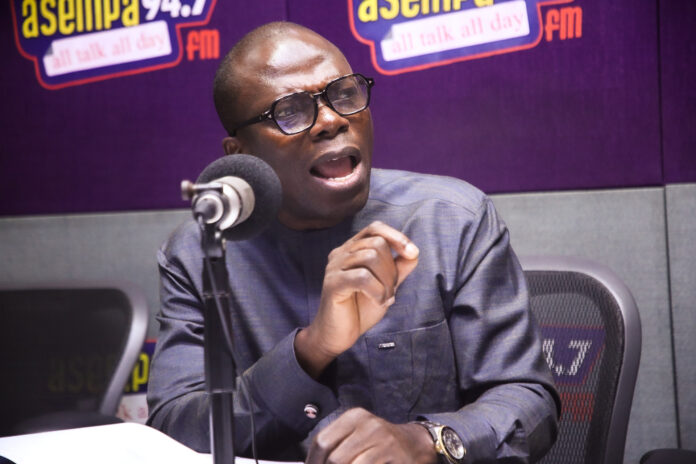

Executive Director of the Media Foundation for West Africa (MFWA), Sulemana Braimah, says recent developments around attempts to scrap the Office of the Special Prosecutor (OSP) raise serious questions about consistency and coordination within the government’s anti-corruption posture.
His comment comes amid the Accra High Court ruling that the Office of the Special Prosecutor (OSP) does not have independent authority to prosecute criminal cases, directing that all matters initiated by the anti-corruption body be referred to the Attorney-General’s Department.
The decision, delivered on Wednesday, has created uncertainty over ongoing prosecutions handled by the OSP, placing them effectively in abeyance pending further legal direction.
Speaking on Super Morning Show on JoyFm, Mr. Braimah referenced earlier efforts in Parliament to abolish the office, noting that the move was reportedly halted following presidential intervention.
“The Majority Leader and Leader of Government Business attempted to introduce a private member’s bill to scrap it, and the President intervened,” he said.
He, however, expressed concern that despite that intervention, the Attorney General is now in court pursuing a case that appears to question the legal foundation of the same office.
“But of course, he is an appointee of the president. He is a minister under the president. I would wonder that the Attorney General would decide to just go ahead like this without any engagement or conversation with the president,” he stated.
Mr. Braimah warned that such developments, if not properly coordinated, could undermine public confidence in the fight against corruption.
He further argued that dissatisfaction with an institution’s performance should not automatically lead to its dissolution, drawing parallels with other state agencies.
“If we are not satisfied with the performance of the OSP, it’s a different matter. But who says all Ghanaians are satisfied with the Ghana Police Service? Do we say we have scrapped the Police Service?” he questioned.
According to him, the more appropriate response to institutional weaknesses is reform and strengthening, rather than abolition.
“So the question is, do we strengthen it? Is there something we can do to further improve it, rather than just saying it must go?” he asked.
Mr. Braimah maintained that the creation of the OSP was driven by long-standing concerns about the ability of the Attorney General to independently prosecute corruption cases involving members of government.
He explained that the traditional structure of the Attorney General’s office has often raised questions about potential conflicts of interest, particularly in politically sensitive prosecutions.
“The whole essence of the OSP is to address the limitation where the Attorney General, being an appointee of the President, may face difficulties prosecuting persons within the same government,” he said.
He added that past experiences and perceptions surrounding prosecutorial decisions have strengthened the argument for an independent anti-corruption office.
“In some cases, whether justified or not, it creates a perception problem about the Attorney General’s independence, and that further strengthens the case for the OSP,” he noted.
Mr. Braimah cautioned that any actions that appear to weaken or undermine the OSP risk reversing gains made in Ghana’s anti-corruption architecture.
“As I said from the beginning, the actions of the Attorney General appear to reinforce the very concerns that led to the establishment of the OSP,” he said.
He concluded that the current situation is “problematic” and called for greater coherence in the government’s approach to anti-corruption institutions.
