
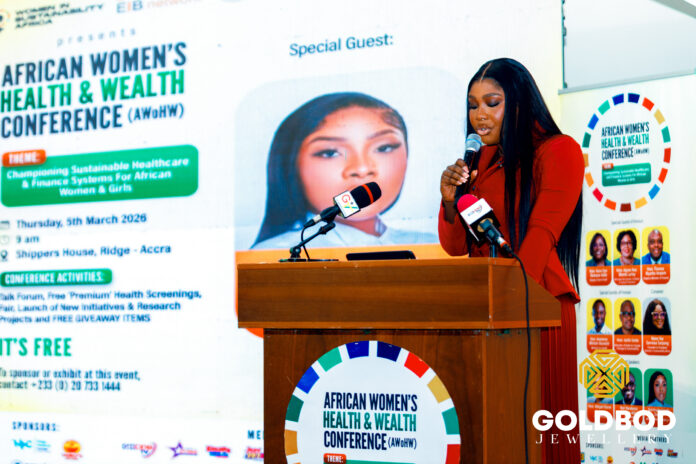

The Managing Director of GoldBod Jewellery Limited, Gertrude Emefa Donkor(Esq.) has encouraged African women to take advantage of opportunities in the extractive sector and gold investment as practical pathways to long-term wealth creation.
Speaking at the African Women’s Health and Wealth Conference, she emphasised that the mining, oil and gas industries present significant opportunities for women to build financial independence and generational wealth.
Addressing participants at the conference held under the theme “Championing Sustainable Healthcare and Finance Systems for African Women and Girls,” Ms Donkor said women historically depended on men for financial security, limiting their autonomy and economic participation.
She cited the landmark legal case Quartey v. Martey as an example of how women were once excluded from property ownership, noting that domestic contributions by wives were not recognised as a basis for sharing marital property upon divorce or death.
“Women managed homes and supported families but often had no ownership or control over resources. This limited their voices and their ability to secure a better future,” she said.
According to her, Ghana has made significant progress over the decades through policies that promote gender equality and economic inclusion, including the National Gender Policy, which integrates women’s empowerment into national development.
She also highlighted initiatives promoting financial inclusion and entrepreneurship, as well as the National Action Plan on Gender Mainstreaming in Energy Access, which seeks to ensure women benefit from opportunities in the energy sector.
Ms Donkor noted that Ghana’s extractive sector—particularly gold mining—remains a major contributor to the economy through exports, government revenue and employment, yet women remain underrepresented in technical and leadership roles.
She urged women to pursue education in science, technology, engineering and mathematics (STEM) fields, especially mining-related programmes at institutions such as the University of Mines and Technology, to qualify for high-paying professional roles in the sector.
Beyond formal employment, she said women could also build wealth through participation in artisanal and small-scale mining, supply chain businesses, and community development initiatives connected to mining projects.
“These industries offer high-value opportunities—from well-paid jobs to procurement contracts and community investments—that can create generational wealth,” she said.
Ms Donkor further encouraged women to diversify their investments, highlighting gold as a reliable asset that protects wealth against inflation and currency fluctuations.
According to her, Ghana’s growing gold investment market offers accessible opportunities for women to build savings through both traditional jewellery and modern investment products.
She pointed to government-backed GoldBod jewellery tablets, which are minted in pure 24-karat gold and sold in various sizes, as a simple and secure option for individuals seeking to invest in physical gold.
The tablets, she explained, are available in sizes ranging from one gram to one ounce, allowing investors to start small and gradually build valuable portfolios over time.
“Start small but consistently. Treat investing as paying yourself first. Over time, these assets can grow into powerful financial security for families and future generations,” she advised.
Ms Donkor also called on women to form networks, support one another and challenge stereotypes that discourage female participation in sectors traditionally dominated by men.
She stressed that by embracing education, entrepreneurship and strategic investments, women across Africa can transform natural resource wealth into sustainable prosperity for themselves and their communities.
“With intentional action, resilience and solidarity, women can turn the riches beneath our soil into lasting prosperity above ground,” she said.
Sources:
Speech by Gertrude Donkor at the African Women’s Health and Wealth Conference; Government of Ghana – National Gender Policy; Ghana extractive sector overview reports.
