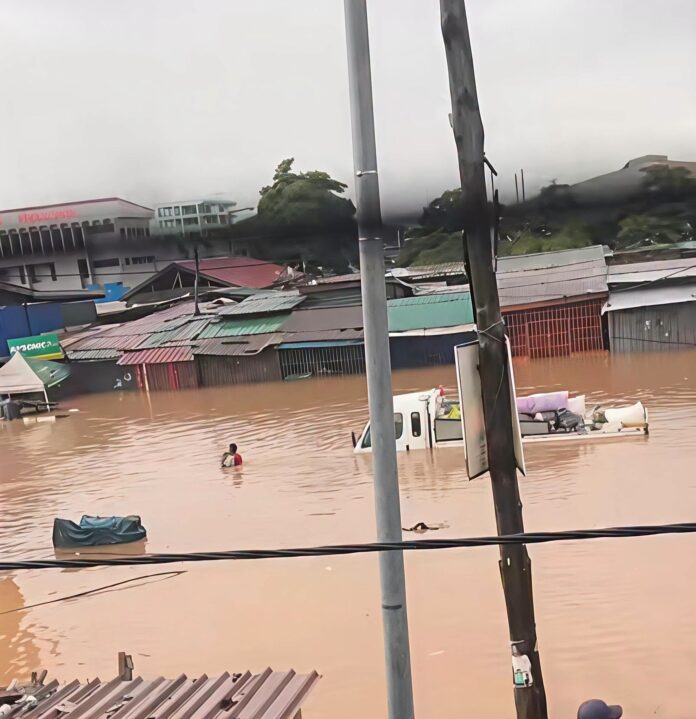

Heavy rains that began late Sunday night and continued into Monday, June 29, 2026, have triggered widespread flooding across several parts of Accra, submerging major roads, inundating homes and shops, and throwing the morning rush hour into chaos.
The prolonged downpour left commuters stranded, and streets turned into rivers, with vehicles crawling through heavily waterlogged sections of the city while others were abandoned altogether by motorists who could not proceed.
Areas Affected
The flooding was widespread across both sides of the city.
Among the worst-hit areas were the N1 Highway, Apenkwa towards Tesano, the Accra–Kasoa stretch, Weija, Mallam, Achimota, Spintex, Atomic in Madina, Kaneshie, Darkuman Junction, portions of the Kwame Nkrumah Interchange, and other surrounding communities.
In the south-western part of Accra, commuters from Kasoa moving towards Accra on the N1 Highway, through the Weija barrier and Mallam, experienced heavy disruptions as floodwaters took over the road. Abeka, Lapaz, Achimota, Dzorwulu, Tesano and their environs were also heavily flooded.
The section under the rail line overpass from the Spintex Road roundabout towards the Polo Grounds and Hajj Village area was flooded, causing severe vehicular traffic congestion. The Shangri-La Hotel area through to the Tetteh Quashie interchange was also choked with vehicles stuck in immovable traffic.
In low-lying communities, the situation was more desperate.
Floodwaters took over homes and shops, forcing residents to move their belongings and the vulnerable to safer locations as water levels continued to rise.
On social media, residents shared distressing videos of the situation.
NADMO Issues Alert
The National Disaster Management Organisation issued a flood alert for parts of Accra, Tema and Kasoa at 7:30 a.m. on Monday, urging the public to exercise caution and avoid unnecessary travel until conditions improve.
NADMO advised motorists and pedestrians not to attempt to drive or walk through flooded roads, warning that such actions could put lives at risk. The organisation also called on residents in affected areas to move to higher ground immediately if water levels begin to rise around their homes, and urged that children and the elderly be kept away from drains, waterways, and flooded areas.
Members of the public were urged to report stranded persons and emergencies to NADMO’s emergency lines or the national emergency number 112.
Security Services Deploy Rescue Teams
Rescue teams from the Ghana National Fire Service responded to several incidents in areas including Ningo, Miotso, Ridge Hospital, Kasoa, Gomoa Nyanyano, and Tema New Town following the morning floods. The GNFS urged affected residents to reach out and share their locations so that rescue teams could reach those in need quickly.
Other security agencies such as the Ghana Armed Forces and the Ghana Police Service, also deployed teams to assist people affected by the rains.
The Ministry of the Interior, in a statement, said the security and emergency agencies had been tasked to monitor the situation, undertake rescue operations and provide assistance to affected persons while reiterating the caution for people to remain at home until the weather conditions improve.
GMet Had Warned of the Risk
Monday’s flooding did not come without warning. Earlier this month, the Ghana Meteorological Agency warned that Accra faced heightened flood risk in June, with rainfall totals projected between 100 and 150 millimetres across the Coastal Zone, and noted that Accra’s flood vulnerability had worsened over the years, with as little as 30 millimetres of rainfall now enough to flood parts of the city.
GMet’s Deputy Director and Head of Research and Applied Meteorology, Francisca Martey, explained that flooding in Accra was not caused solely by rainfall within the city but also by runoff from surrounding communities on higher elevations.
“When it rains in Accra, Accra rains do not collect only in Accra. It counts Berekusu and other surrounding areas. All of them come to Accra,” she said.
She also noted that natural flood retention areas that previously held excess rainwater had largely been taken over by development.
A Recurring Crisis
Accra’s recurring flooding challenges are widely linked to inadequate drainage systems, poor waste disposal practices, and rapid urban expansion.
Experts say the city has done things the wrong way for decades, building over wetlands and waterways that once absorbed rainfall, replacing permeable land with concrete and accelerating surface runoff that overwhelms the city within hours of a heavy downpour.
The Ghana Meteorological Agency has predicted continued rainfall of varying intensity across parts of southern Ghana, including coastal areas, with conditions expected to persist. Residents and commuters have been advised to remain alert.
ALSO READ:
GRIDCo, ECG temporarily shut down Mallam and Achimota substations over flood risk
Flooding: Emergency contacts to call as rains wreak havoc across Ghana
More rain expected in Southwestern Ghana as GMet issues alert