
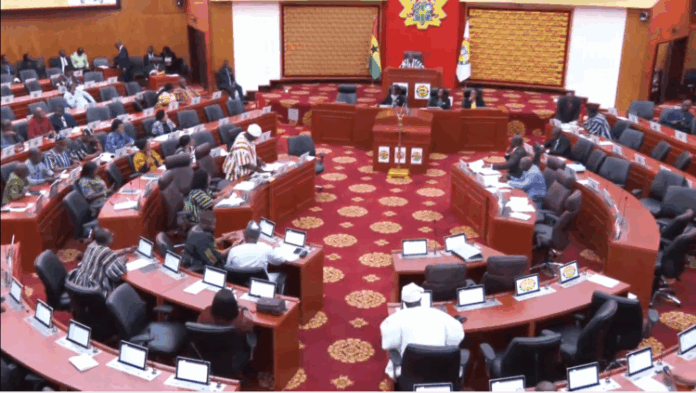

The Ranking Member of Parliament’s Health Committee, Dr Nana Ayew Afriye, has questioned whether political considerations are influencing delays in the full operationalisation of major health facilities in the Ashanti Region.
He argued that the government is focusing on suspending officials instead of addressing the root causes of the “No Bed Syndrome” at the Komfo Anokye Teaching Hospital (KATH).
This comes as medical doctors at KATH in Kumasi announced an indefinite withdrawal of services in protest against the Health Minister’s directive to suspend the hospital’s Chief Executive Officer, Dr Paa Kwesi Baidoo.
The doctors say the minister’s decision, which directed the hospital’s Board to suspend the CEO for two weeks, is unjustified and undermines efforts to safeguard patient care. They took the decision following an emergency meeting on Friday, June 5, 2026.
In a statement, the Minority Caucus described the suspension as “unfortunate, reactionary, and failing to address the underlying structural failures confronting Ghana’s health sector.”
Dr Ayew Afriye argued that while every preventable death must be investigated, blaming a single hospital administrator ignores long-standing systemic challenges within the health sector.
He said the pressure on KATH is largely due to delays in bringing key health infrastructure projects into full operation, including the 500-bed Afari Military Hospital and the 250-bed Ashanti Regional Hospital, which were intended to ease congestion at KATH.
“It is therefore difficult to understand why a government that inherited these critical facilities would choose to suspend a hospital CEO rather than accelerate the full operationalisation of these hospitals and strengthen referral arrangements,” he stated.
The lawmaker noted that the government’s own 2026 Budget acknowledges that the Sewua Hospital remains among key health infrastructure projects requiring urgent attention.
He questioned whether political considerations were influencing the delay in completing such projects.
“Is the government’s failure to fully operationalise these hospitals due to political considerations?” he asked.
“Many Ghanaians are beginning to wonder whether the apparent lack of urgency in bringing critical facilities such as the Sewua Hospital into full operation is influenced by the fact that the Ashanti Region is not considered a major electoral stronghold of the governing NDC,” he added.
Dr Ayew Afriye called on government to provide clear answers and ensure that access to healthcare is not influenced by partisan considerations.
He also referenced the 100-bed Trede District Hospital and the 100-bed Kokoben-Oforikrom District Hospital, both commissioned in 2024, noting that they were intended to reduce pressure on KATH but remain largely non-operational.
Despite significant public investment, he said KATH continues to face congestion, overstretched staff and severe bed shortages.
“It is therefore difficult to understand how government can justify suspending the CEO of KATH for challenges arising from excess demand when two fully completed 100-bed hospitals, specifically built to absorb that demand, remain unable to provide the services for which they were constructed,” he said.
Dr Ayew Afriye maintained that the “No Bed Syndrome” is fundamentally a capacity, infrastructure, referral and resource allocation issue rather than a leadership problem at KATH.
“Punishing one hospital administrator may create headlines, but it will not create additional beds, equip emergency wards, recruit specialist staff, or decongest referral centres,” he stated.
He called for the reinstatement of the KATH CEO, urgent operationalisation of completed hospitals in the Ashanti Region, and broader stakeholder consultation in addressing the crisis.
“The health sector requires solutions, not scapegoats,” he added, stressing that while the suspension may align with a political narrative, it does little to resolve the deeper challenges facing healthcare delivery in Ghana.
