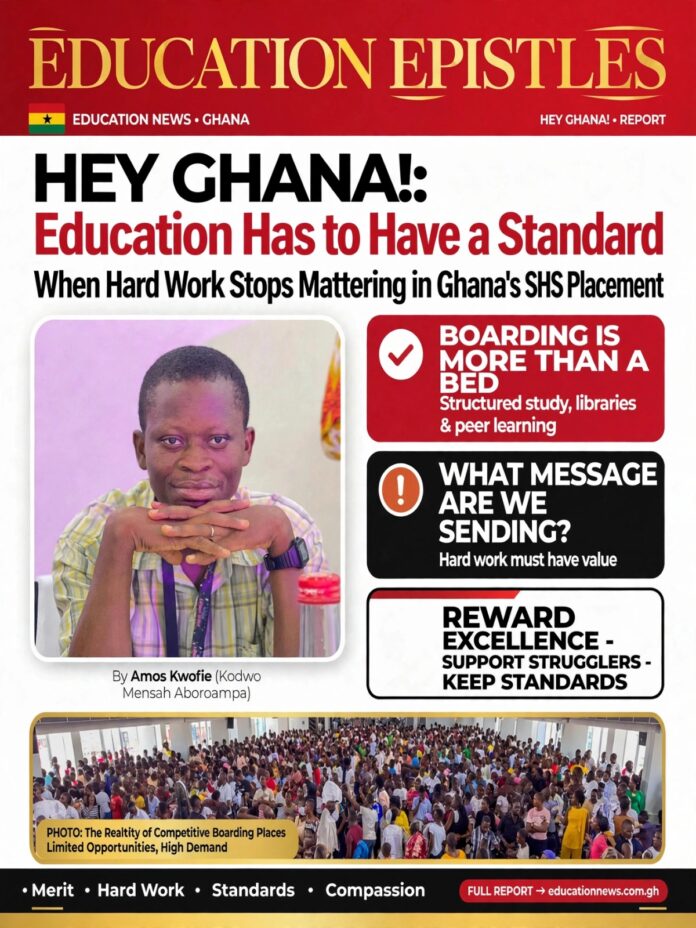

Hey Ghana! We need to have an honest conversation about education.
Education is not simply about getting a school placement.
It is about preparing young people for life, building discipline, rewarding hard work, and creating an environment where every student understands that effort has consequences.
But today, an important question needs to be asked: What happens when students who perform poorly academically are able to secure places in some of the country’s most sought-after Senior High Schools (SHSs), including coveted boarding spaces, while students who worked extremely hard struggle to get the same opportunity?
This is not about humiliating students who obtained lower grades. Every child deserves an opportunity to learn, improve, and build a future.
A student’s examination result should never become a permanent judgment on their worth or potential. However, education must still have standards.
When admission into highly competitive schools becomes disconnected from academic performance, we risk sending a dangerous message to students: “You don’t necessarily have to work that hard; somehow, you may still get the opportunity you want.”
And that message can have consequences.
What Are We Teaching Our Children?
Imagine a student who wakes up every morning before sunrise, attends classes, completes assignments, studies late into the night, sacrifices entertainment, and pushes through difficult subjects because they believe their hard work will earn them an opportunity.
Now imagine that same student watching someone who put considerably less effort into their studies receive an opportunity they desperately wanted.
What happens to motivation? What happens to the belief that hard work matters?
For some students, it may create frustration.
For others, it may gradually destroy the determination to study harder.
A society that wants excellence must make sure that effort, achievement, and opportunity have a meaningful relationship.
Boarding Is More Than a Bed
The desire to attend a top SHS is not only about wearing a particular school uniform or having a prestigious name attached to one’s education.
For many families, boarding provides access to structured study periods, libraries, teachers, academic competition, peer learning, and an environment designed around education.
That makes boarding places especially valuable.
When these limited opportunities are allocated without sufficient consideration for academic performance and merit, we should ask whether we are using those opportunities in the way that best supports educational excellence.
This does not mean that grades should be the only consideration.
Students come from different backgrounds. Some face poverty, inadequate learning resources, difficult family circumstances, disabilities, health challenges, or schools with fewer educational resources.
A fair system should recognize such realities and provide support where necessary.
But supporting disadvantaged students is different from removing academic standards altogether.
We Must Not Punish Students for Working Hard
Ghana must be careful not to create an education system where excellence becomes meaningless.
If a student spends years working hard because they believe good academic performance will open doors, the system should not repeatedly teach them that their effort makes little difference. We should encourage students to dream big.
We should tell them:
Study hard.
Ask questions.
Read.
Practice.
Improve.
Your effort matters.
And when students succeed, society should recognize that achievement—not necessarily with privilege, but with meaningful opportunities to continue developing their potential.
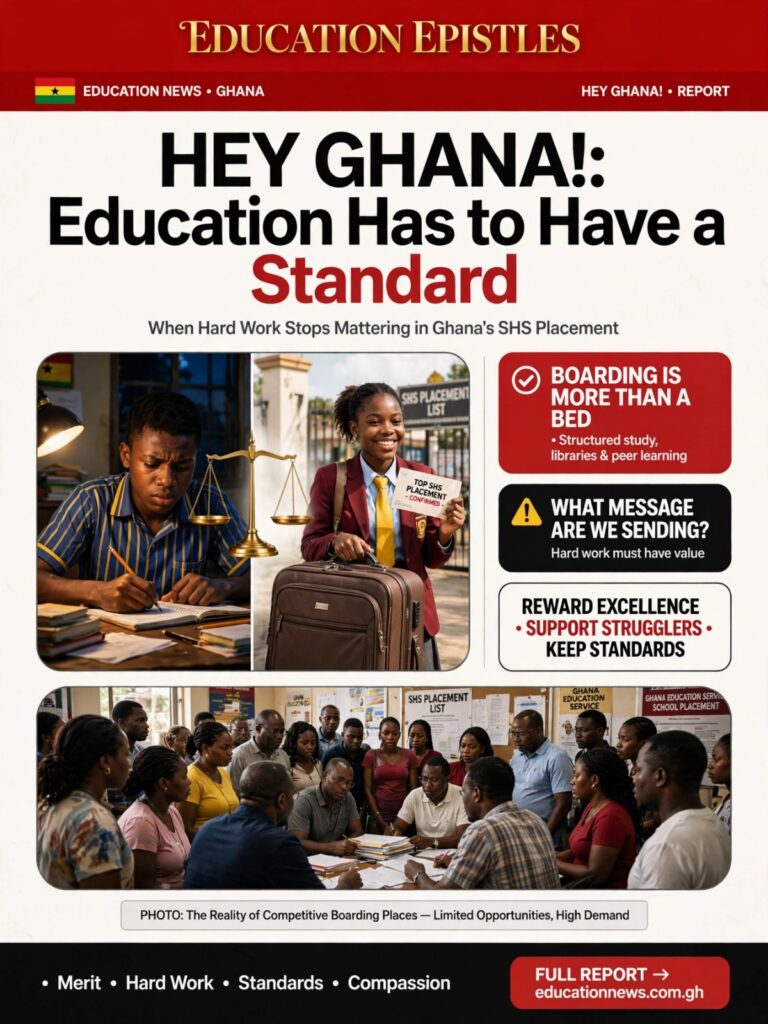
But Let Us Also Help Those Who Struggle
There is another side to this conversation. A student with poor grades should not be written off. A low examination score can be a reflection of many things, and it does not necessarily determine a child’s intelligence or future.
Instead of simply placing every struggling student into a highly competitive environment and assuming the problem has been solved, we should invest in remedial education, academic counselling, vocational pathways, teacher support, tutoring, and stronger basic education.
Let struggling students know: “You can still succeed—but you have to grow.”
That is a much healthier message than either abandoning them or pretending that academic standards do not matter.
Ghana Needs Both Opportunity and Standards
The debate should not be:
“Should students with lower grades have opportunities?”
Of course they should.
The better question is: “How do we create opportunities without destroying the culture of hard work and academic excellence?”
That is the conversation Ghana needs.
Our education system should be compassionate enough to give students a second chance, but disciplined enough to maintain standards.
It should reward excellence without mocking those who struggle.
It should create alternative pathways without making achievement irrelevant.
And most importantly, it should make every child believe that hard work is worth it.
Dear Ghana, Our Children Are Watching
Students are watching how we distribute opportunities.
They are watching who succeeds.
They are watching whether grades matter.
They are watching whether discipline is rewarded.
And eventually, they will respond to the incentives we create. If we want a generation that studies harder, dreams bigger, competes fairly, and takes education seriously, then our policies must communicate a clear message: Your background should not determine your destiny—but your effort, growth, and achievement should matter.
Ghana does not need an education system that simply moves children from one level to another. We need an education system that builds capable, disciplined, confident, and knowledgeable citizens.
So, Hey Ghana!
Let us give every child a chance.
But let us also give standards a chance.
Because when we make hard work meaningless, we do not only disappoint today’s hardworking students.
We risk weakening the ambition of tomorrow’s Ghana.