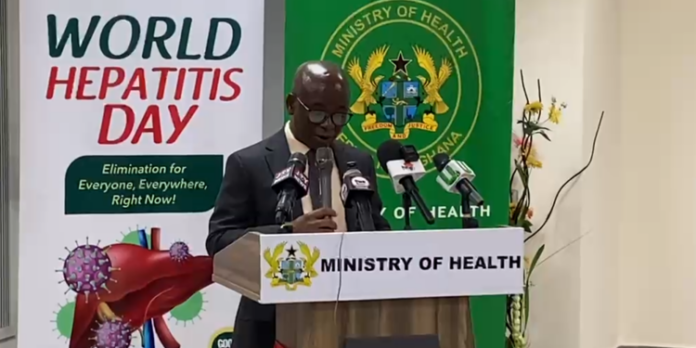

The Ministry of Health has intensified its campaign against viral hepatitis, urging Ghanaians to get tested, vaccinated and seek early treatment as the country battles a growing burden of hepatitis B and C infections.
The renewed call was made during the commemoration of World Hepatitis Day and the inauguration of the National Viral Hepatitis Technical Working Group in Accra. The newly inaugurated body is expected to coordinate national efforts to strengthen prevention, improve access to diagnosis and treatment, and accelerate Ghana’s progress towards eliminating viral hepatitis as a public health threat.
Speaking on behalf of the Minister for Health, Kwabena Mintah Akandoh, the Ministry’s Chief Director, Desmond Boateng, described viral hepatitis as one of Ghana’s most pressing public health challenges.
He disclosed that an estimated three million Ghanaians are living with hepatitis B, while another 500,000 are believed to have hepatitis C, with many unaware of their condition because the disease often develops without noticeable symptoms.
According to him, the silent nature of the infection means many patients only seek medical attention after developing serious complications such as liver cirrhosis or liver cancer.
Mr. Boateng noted that liver cancer has become the third most commonly diagnosed cancer in Ghana and the second leading cause of cancer-related deaths, with chronic hepatitis B and C infections accounting for a significant proportion of cases.
He said the inauguration of the National Viral Hepatitis Technical Working Group marks an important step in translating the government’s commitment into coordinated and measurable action.
“Viral hepatitis remains a major public health challenge in Ghana. About three million Ghanaians are estimated to be living with hepatitis B, while roughly half a million may be living with hepatitis C. Many do not know their status because the infection can remain silent for years, even as it progressively damages the liver,” he said.
The Chief Director stressed that hepatitis B is preventable through vaccination and can be effectively managed with treatment, while hepatitis C can now be cured with highly effective medicines.
He therefore encouraged Ghanaians to take advantage of available screening and vaccination services, stressing that early detection and prompt treatment are essential to preventing severe liver disease and reducing hepatitis-related deaths.
The Ministry said the Technical Working Group will play a key role in driving policy implementation, strengthening surveillance, expanding public education and improving access to quality hepatitis care across the country.
READ ALSO:
Fake nurse and disease control officer at KATH convicted and fined GH₵12,000 each