
Government is preparing to link rice import permits to investment in the country’s local rice farms and mills, in a major policy shift aimed at boosting domestic production and reducing Ghana’s rising import bill.
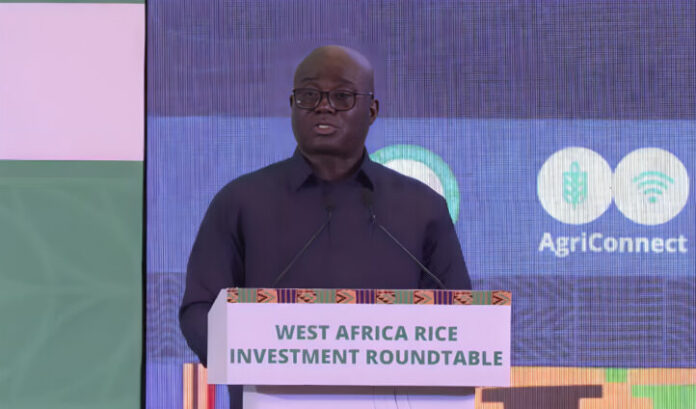
The initiative was announced by the Minister of Food and Agriculture, Eric Opoku, at the West Africa Rice Investment Roundtable in Accra, organised in partnership with the World Bank, ECOWAS Commission and the African Development Bank.
The announcement was met with loud applause from participants, including Vice President Prof. Jane Naana Opoku-Agyemang, President of the ECOWAS Commission Dr Omar Alieu Touray, World Bank Vice President for Planet Guangzhe Chen, and Deputy Finance Minister Thomas Nyarko Ampem.
Under the policy, importers will be required to show verifiable partnerships with local rice producers before securing permits to import rice into the country.
“Government will implement an import quota policy that directly links the privilege of importing rice to the growth of domestic production,” Mr Opoku said.
He explained that importers must provide evidence of procurement agreements or investment arrangements with local rice farmers before approval is granted.
The minister assured consumers and traders that the policy is not intended to create shortages or increase prices.
“We are not raising tariffs that punish consumers. We are not imposing bans that create shortages,” he said, adding that the goal is to channel value from imports into strengthening domestic production capacity.
Ghana continues to rely heavily on imported rice despite growth in local production. Last year, the country consumed about 1.71 million tonnes of rice, while local milled production stood at about 960,000 tonnes, leaving a gap of roughly 751,000 tonnes. This resulted in about $320 million spent on imports.
Self-sufficiency currently stands at about 56 per cent, up from around 45 per cent earlier in the decade. Government says the pace must accelerate to achieve full self-reliance.
Mr Opoku said the share of imports will be reduced gradually over the next decade, with each reduction tied to verified increases in domestic production.
“We will not create a gap we cannot fill,” he assured stakeholders.
Government modelling suggests that achieving 100 per cent rice self-sufficiency within ten years could save about $2.1 billion in foreign exchange, attract over $400 million in private investment, and create more than 200,000 jobs across the value chain.
Beyond the import reforms, government is deploying satellite-based geospatial mapping technology, developed with support from the World Bank and NASA Harvest experts, to identify land suitable for rice cultivation across the country.
The data is expected to guide investors on production locations and irrigation potential.
The policy forms part of the broader Feed Ghana Programme, which includes investments in irrigation, mechanisation, improved seeds, post-harvest infrastructure and value addition, as well as efforts to curb rice smuggling and promote local consumption under the “Buy Ghana First” initiative.
ALSO READ: