
An Urban Development Planner has raised concerns that protected lands and designated green zones are increasingly being taken over by influential individuals.
Urban Planner Kofi Kekeli Amedzro warns that political interference is undermining Ghana’s land-use and spatial planning system.
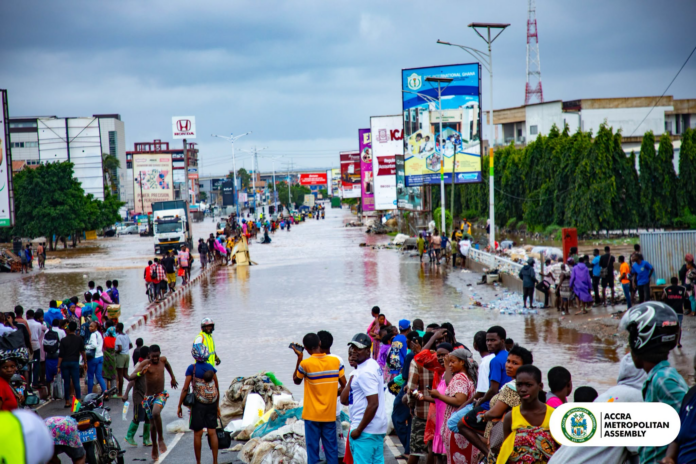
The concerns come in the wake of Monday’s devastating floods that hit parts of Accra and the Central Region, leaving at least 18 people dead and causing extensive property damage running into millions of cedis.
Speaking on Joy News’ PM Express on Tuesday, Mr Kekeli Amedzro said development in Ghana is meant to follow approved land use plans, but enforcement has been weakened by political influence and gaps at the local level.
“Ideally, before anyone should build, as the Land Use and Spatial Planning Act says, any form of development before it comes up, that development must conform with the land use plan of the area.”
He explained that land ownership alone does not determine how land is used, stressing that approvals are supposed to go through technical planning structures.
“And if you are talking about the ownership alone, does it not determine the land use? so once an area has been designated or planned for a particular zone, the district assembly, what we call the special planning committee, that is made up of planners, engineers, EPA, other professionals, geologists, and what have you, who sit on the panel to decide on the permit, do that based on the plan that has been prepared for that specific area,” he said.
However, he said the system breaks down when local-level planning documents are missing or incomplete, making enforcement difficult.
“But the challenge is that at some time when you are looking at it from a point of skill at the regional perspective within those areas, they might be zoned as green areas or green belt buffers, but if it comes to the local assembly level, where it’s supposed to cascade down to the local plans for them to designate those places as green areas or nature reserves and what have you, sometimes there are gaps.
“You go there, and you request the local plan, specifically for those areas, and they are absent.”
According to him, these gaps create opportunities for politically connected landowners to bypass regulations and develop on restricted lands.
“So, in the absence of these things, sometimes the landowners, through their politics and what have you, get their way, and they do what they want to do, and as you indicated, sometimes it is these big men, people who are well-to-do politicians, who capture these land areas.”
He warned that even when land is clearly unsuitable for construction due to terrain and environmental risk, development still proceeds unchecked.
“So, it’s very difficult for the district assembly sometimes to enforce this, as you’ve rightly pointed out, and as you are aware of.
“So, when you go to these areas, even when you do analysis, the gradient again from a planning perspective, from where they are to build, is far beyond the normal expectations. Yet you go there, and they are building,”
He said these “technicalities and the politics behind the scenes” are weakening the implementation of planning laws and contributing to unregulated development in high-risk areas.
ALSO READ: