
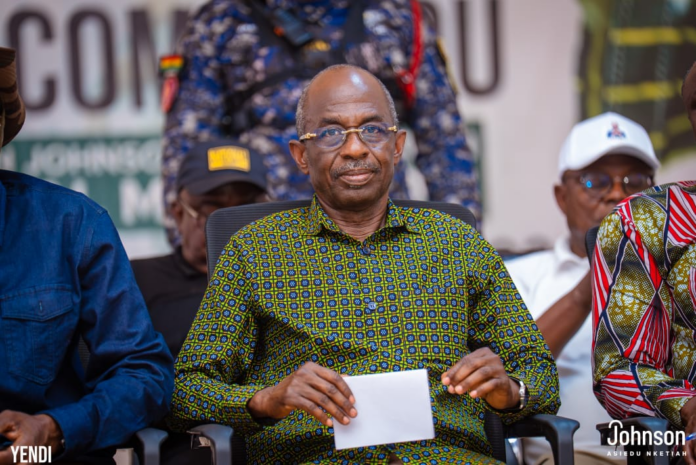

The National Chairman of the National Democratic Congress (NDC), Johnson Asiedu Nketia, has urged African leaders to back their strong speeches on economic development with concrete action, stressing that this is the only way the continent can achieve meaningful progress.
He said the fight against neocolonialism cannot be won through rhetoric alone, but through competent governance, industrial development, technological capacity, effective regional integration and the ability of states to negotiate from positions of strength rather than dependency.
Mr. Nketia made the remarks at the 3rd Meeting of the Standing Committee of the International Movement for the Freedom of Nations, held in St. Petersburg, Russian Federation, on June 25, 2026.
According to him, the struggle against neocolonialism will only succeed when African countries move beyond exporting raw materials to creating value, become producers rather than consumers of technology, and build strong institutions capable of turning political sovereignty into economic independence.
He added that the task ahead is to ensure that sovereignty is matched with capability, and that freedom is translated into shared prosperity for African nations.
Citing Ghana’s first President, Osagyefo Dr. Kwame Nkrumah, Mr. Nketia noted that the warning that political independence without economic independence is incomplete remains as relevant today as ever, given the changing nature of global power.
He said the outcome of Africa’s efforts in this direction will determine not only the continent’s future but also the shape of the international order inherited by future generations.
Mr. Nketia also criticised the current global economic system, calling for reforms that give developing countries a stronger voice in global decision-making.
He explained that influence in today’s world is not only defined by military or political power, but also by control over the rules governing finance, trade, technology, intellectual property, investment and development funding.
According to him, this makes representation in international institutions critical, not just in terms of presence but in the ability to meaningfully shape global rules and policies.
“A world in which some nations consistently write the rules while others are expected merely to comply with them cannot indefinitely claim to embody genuine equality among sovereign states,” he stated.
ALSO READ:
Accra floods: NADMO, Zoomlion launch multi-site drain clearing exercise
GMTF advances rollout of Medicines List to improve access to specialised…