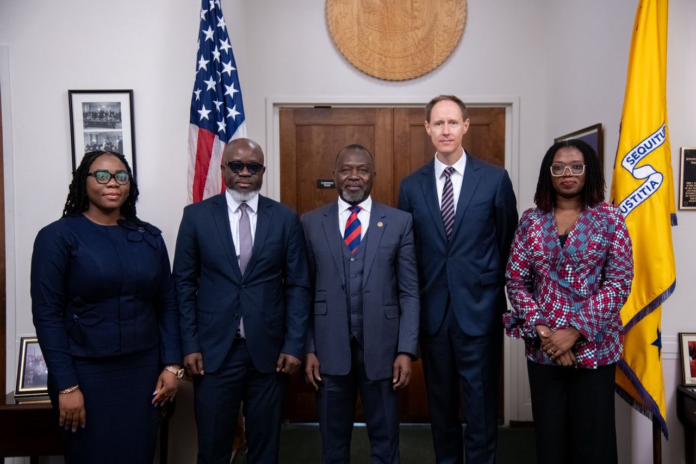

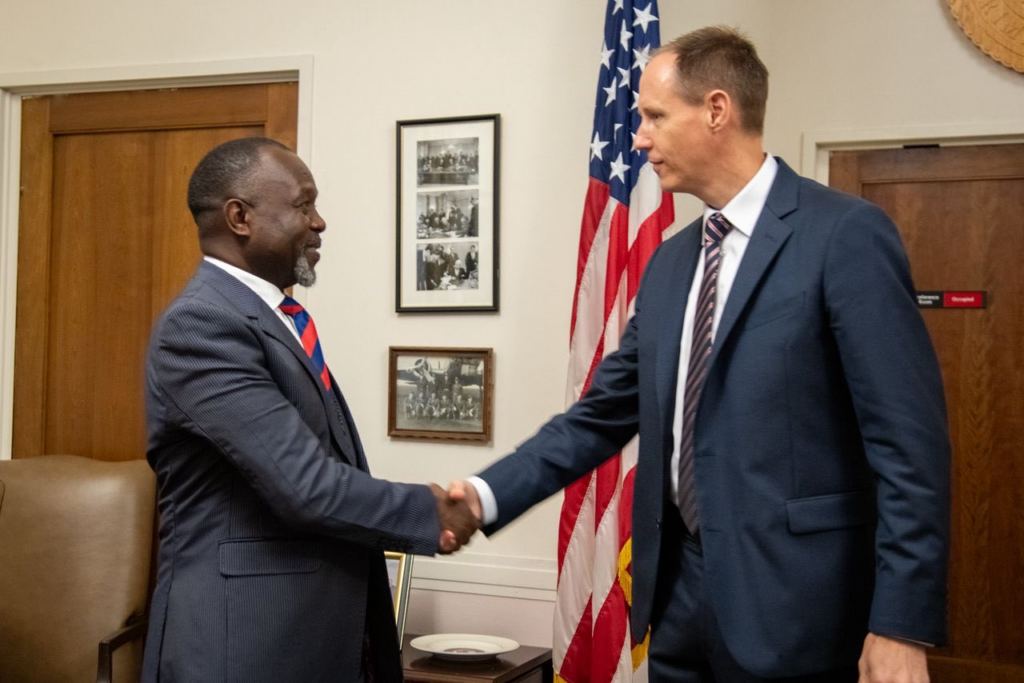
Ghana’s Attorney-General, Dominic Ayine, and the Executive Director of the Economic and Organised Crime Office (EOCO), Raymond Archer, have held high-level meetings with officials of the United States Department of Justice (DOJ) to discuss ongoing extradition proceedings involving former Finance Minister Ken Ofori-Atta and Ghanaian businessman Frederick Kumi, also known as Abu Trica.
The engagements also focused on strengthening cooperation between both countries in tackling fraud, corruption, money laundering, and transnational organised crime, including cyber-enabled financial offences.
At the centre of the talks are:
Ken Ofori-Atta extradition case
The extradition discussions involving Ken Ofori-Atta centre on his legal status and ongoing corruption-related investigations in Ghana. The government has formally submitted an extradition request seeking his return to face 78 corruption and procurement-related charges.
According to officials, the case has been complicated by developments in the United States, where he was previously detained by U.S. Immigration and Customs Enforcement (ICE) over his immigration status. His legal team has indicated that a U.S. immigration court subsequently granted him lawful permanent residency, reportedly after finding aspects of the Ghanaian state’s charges politically motivated.
However, Ghana’s Office of the Special Prosecutor (OSP) and the Attorney-General have rejected interpretations that the U.S. immigration ruling shields him from prosecution. They maintain that immigration decisions are separate from criminal extradition proceedings under existing treaties.
Authorities say the ongoing DOJ engagement is aimed at processing the formal extradition package and ensuring he is returned to Ghana to face trial in Accra.
Frederick Kumi (Abu Trica) extradition case
Frederick Kumi, widely known as Abu Trica, is also at the centre of extradition proceedings following his arrest in Ghana. He is accused by the U.S. Attorney’s Office for the Northern District of Ohio of orchestrating an $8 million romance fraud and wire laundering scheme targeting elderly victims in the United States.
He is facing multiple federal charges, including conspiracy to commit wire fraud and money laundering.
In Ghana, a lower court in Gbese has already granted approval for his extradition to the United States. However, his legal team, supported by activists, has filed a certiorari application at the Accra High Court seeking to overturn the ruling.
They argue that his constitutional rights are being violated and have raised concerns about identity verification procedures used during investigations and prosecution.
The case has triggered widespread public debate, with civil rights advocates questioning the consistency of enforcement actions. They argue that Ghana shouldn’t “rush” to hand over an ordinary citizen to the U.S. while wealthy political figures like Ofori-Atta remain abroad.
Broader Ghana–U.S. law enforcement cooperation
Beyond the two extradition cases, the meetings between EOCO and the U.S. Department of Justice also underscored a broader strategic shift in Ghana’s approach to international crime fighting.
Under Raymond Archer’s leadership, EOCO is prioritising global partnerships to trace illicit financial flows, recover stolen assets, and strengthen prosecution of cross-border criminal networks.
The operational framework discussed with the U.S. DOJ focuses on three key areas: cyber-fraud crackdowns, cryptocurrency-related crime enforcement, and asset recovery and forfeiture.