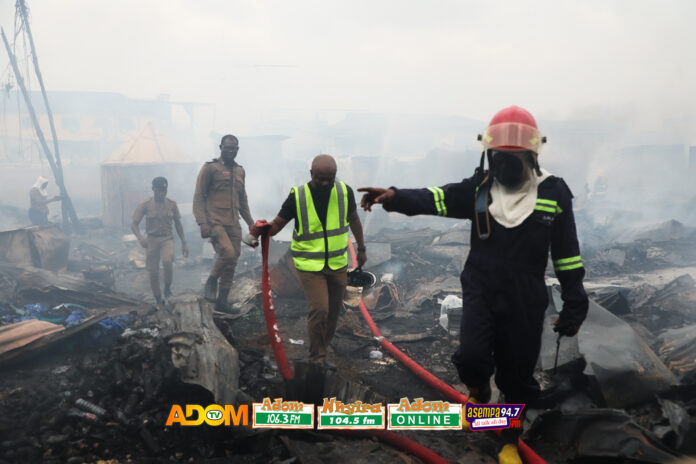

The recent floods that paralysed parts of Accra have reignited a long-standing conversation about whether the Ghana National Fire Service has outgrown its name.
As firefighters traded hoses for rescue boats, life jackets and search operations, saving lives, retrieving victims and leading emergency responses, the disaster exposed a reality many have long overlooked: the Service is no longer just fighting fires; it is rescuing a nation.
The fires they battle are visible. The rescues they perform are often overlooked.
That reality has become even more evident following the recent floods that submerged communities across Accra and parts of the Greater Accra Region.
While many Ghanaians instinctively associate the Ghana National Fire Service (GNFS) with extinguishing fires, the events of the past few days have demonstrated that the institution has evolved into a full-scale rescue and emergency response agency whose mandate stretches far beyond firefighting.
Time to Rethink the Name: Why Ghana Needs a National Rescue and Emergency Service
When floodwaters engulfed homes, stranded motorists on major roads, trapped families in submerged buildings and swept away lives, the familiar sight across affected communities was not only firefighters carrying hoses.
It was rescue personnel in life jackets navigating dangerous waters, pulling victims from flooded homes, retrieving bodies, evacuating children, pumping water from buildings and coordinating emergency operations.
These are not traditional firefighting duties.
They are rescue operations.
From Alajo and Adabraka to Odawna, Kaneshie, Weija, Ablekuma and Alogboshie, personnel of the Ghana National Fire Service worked alongside the military, police, National Disaster Management Organisation (NADMO), National Ambulance Service and volunteers to save lives.
Some officers spent hours in floodwaters searching for missing persons while others rescued residents trapped in rapidly rising water.
As heartbreaking reports emerged of bodies being recovered from floodwaters, it became increasingly clear that the Fire Service is often the nation’s first line of response whenever disaster strikes.
Beyond Fire
The public still largely identifies the GNFS with fire outbreaks because that is reflected in its name. Yet its daily operations tell a different story.
On any given day, personnel respond to:
Flood rescues
Road traffic crashes
Building collapses
Confined-space rescues
High-angle rescues
Industrial accidents
Gas leak emergencies
Animal rescues
Recovery of drowning victims
Hazardous material incidents
Medical first response in some situations
Increasingly, climate change and rapid urbanisation are making floods more frequent than major fires in some parts of the country.
This changing risk landscape demands a service recognised not only for fighting fires but also for managing emergencies in all forms.
The Psychological Impact of a Name
Names shape public perception.
Many people call the Fire Service only when they see flames, unaware that the same officers are trained and equipped to conduct water rescues, technical rescues and emergency evacuations.
A more representative name—such as the Ghana National Rescue and Emergency Service—would better communicate the institution’s broader role and encourage the public to engage it during all emergencies.
Countries around the world have adopted similar models, with emergency services integrating firefighting, rescue and disaster response under one identity.
The Floods Have Told the Story
The recent flooding has become a defining moment.
Images of firefighters carrying children through chest-deep water, rescuing stranded commuters, pumping floodwater from homes and recovering victims have dominated television screens and social media.
In many instances, they reached affected communities before other agencies.
These scenes have reinforced a simple truth: modern emergency response is no longer just about extinguishing fires.
More Than a Cosmetic Change
Renaming the institution would not simply involve changing signage or uniforms.
It would acknowledge the transformation that has already taken place within the Service.
It would strengthen public awareness, support advocacy for better funding, justify investment in specialised rescue equipment and reinforce the need for continuous training in disaster management.
More importantly, it would honour the sacrifices of officers who increasingly place themselves in danger not just against flames, but against floodwaters, collapsing structures, hazardous chemicals and countless other life-threatening situations.
The Way Forward
As Ghana confronts increasingly complex emergencies driven by urban growth, poor drainage, climate change and industrial expansion, the nation’s emergency institutions must evolve in both function and identity.
The Ghana National Fire Service has already demonstrated that it is much more than a firefighting organisation.
Its actions during the recent floods, alongside its countless rescues during road crashes, building collapses and other emergencies, have provided perhaps the strongest argument yet that the time has come to consider a new identity, one that reflects the realities of its work and the expectations of the public.
If names are meant to describe purpose, then the Ghana National Fire Service may already be living up to a different one: the Ghana National Rescue and Emergency Service.