


The Tree Crops Development Authority (TCDA) has directed all development partners, government agencies, non-governmental organisations, individuals, and other stakeholders involved in the distribution of tree crop seedlings to source planting materials exclusively from TCDA-certified suppliers.
The directive, which takes effect on July 3, 2026, applies to six regulated tree crops: cashew, coconut, oil palm, mango, rubber, and shea.
According to the Authority, the measure is aimed at strengthening quality assurance, traceability, and productivity within Ghana’s tree crop sector by ensuring that only certified planting materials are distributed to farmers and beneficiaries.
The TCDA explained that the directive is grounded in the Tree Crops Development Authority Act, 2019 (Act 1010), and supported by Regulation 46 of the Tree Crops Regulations, 2023 (L.I. 2471), which mandates the Authority to ensure that planting materials come from verifiable sources.
Under the new rules, organisations and individuals distributing seedlings must source their planting materials only from TCDA-approved stocks. They are also required to keep records detailing the origin and approval status of the seedlings and make such records available to the Authority upon request.
In addition, all seedlings must meet TCDA standards and be presented for inspection, verification, and certification before distribution.
The Authority cautioned that once the directive comes into force, “no person or entity will be permitted to distribute, supply, or circulate uncertified or unapproved tree crop planting materials without TCDA approval.”
It further warned that failure to comply with the directive will attract sanctions under the Tree Crops Regulations, 2023 (L.I. 2471).
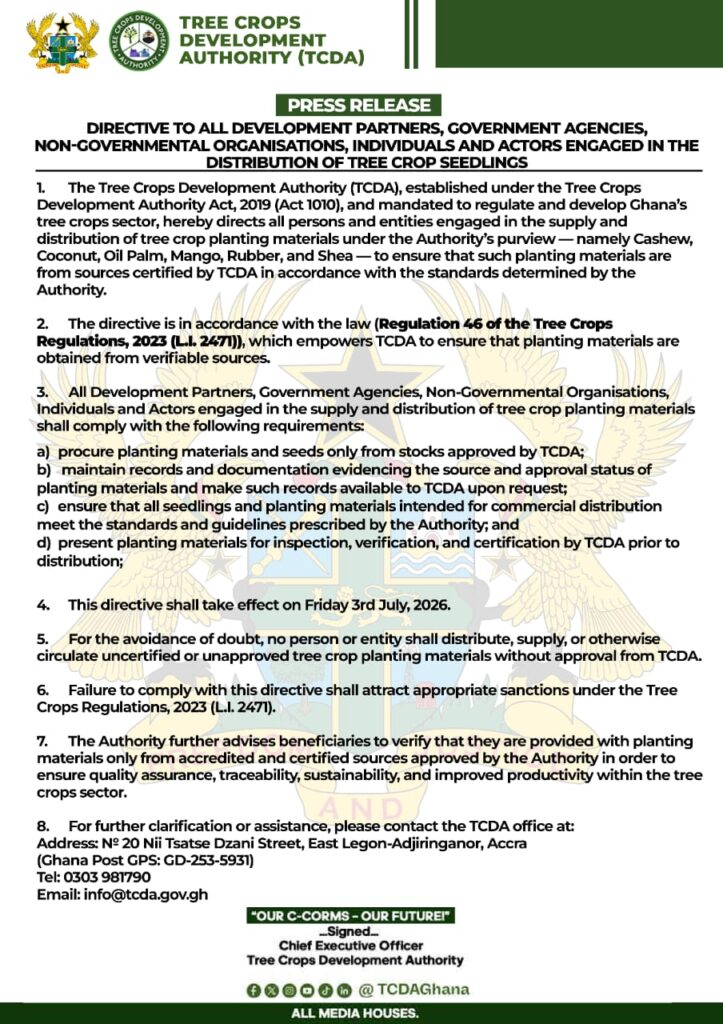
The TCDA also encouraged farmers and other beneficiaries to verify that seedlings supplied to them come from accredited and certified sources approved by the Authority.
According to the regulator, this will help guarantee quality planting materials, improve traceability, promote sustainability and ultimately boost productivity across Ghana’s tree crops industry.
ALSO READ:
