
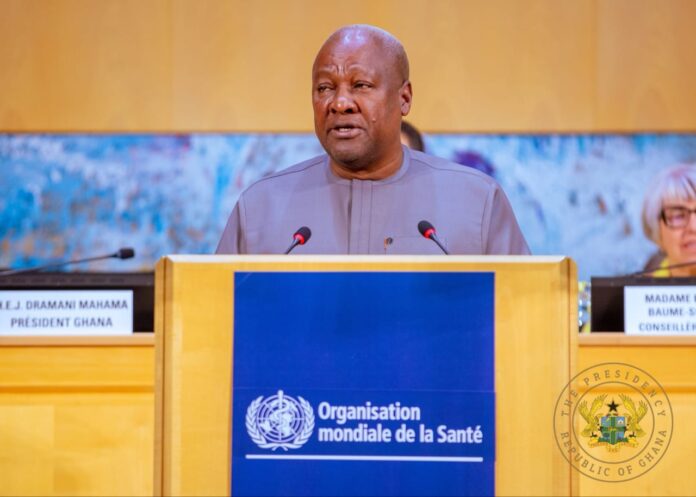

President John Dramani Mahama has announced that Ghana is on course to exit financial support from Gavi, the Vaccine Alliance, by 2030 as the country intensifies efforts toward self-reliance in healthcare financing and vaccine delivery.
Delivering the keynote address at the 79th World Health Assembly in Geneva, Switzerland, President Mahama said Ghana’s progress in healthcare financing and vaccine access demonstrates the country’s commitment to health sovereignty and long-term reforms in the global health system.
“Ghana is also on track to exit Gavi funding for vaccines by the year 2030, and we hope to transition into a donor in the not-too-distant future,” he announced.
Gavi, the Vaccine Alliance is a global public-private partnership that works to expand access to vaccines and immunisation in lower-income countries. Since its establishment in 2000, it has helped immunise more than 1.2 billion children and is credited with preventing over 20 million future deaths worldwide.
President Mahama said Ghana’s healthcare achievements form part of the broader “Accra Reset Initiative,” which seeks to reform the global health architecture and strengthen health systems across developing countries.
“These domestic achievements are the foundation of my leadership of the Accra Reset Initiative,” he stated.
The President welcomed discussions at the World Health Assembly on proposals to reform the global health system, noting that Ghana had co-chaired the Working Group for the Lusaka Agenda.
However, he expressed concern over attempts to preserve existing institutional arrangements instead of pursuing meaningful reforms.
“As a committed apostle of reform of the world health architecture, I’m concerned about whispers I have heard that the current draft resolution seeks to protect existing organisational mandates and prohibits the recommendation of measures or consolidations,” he said.
Quoting a proverb from Mali’s Dogon people, he cautioned against reforms that fail to produce real change.
“In Mali, the Dogon people warn that: ‘Do not let the sight of those eating roasted maize force you to cook your maize seeds,’” he said.
“If we launch a process of reform that is prohibited from recommending actual reform, we are merely performing a ritual.”
Mr. Mahama stressed that the global health system must prioritise human survival over institutional interests.
“We cannot prioritise institutional comfort over human survival. The WHO’s legitimacy is not served by protecting silos. It is served by a fearless analysis of what works,” he stated.
The President also recalled hosting the Director-General of the World Health Organization, Tedros Adhanom Ghebreyesus, former Nigerian President Olusegun Obasanjo, and other global leaders in Accra in 2025 to advance discussions on health sovereignty.
According to him, health sovereignty means countries must have the practical ability to finance healthcare systems, regulate quality standards, produce medicines locally, and govern their own health data.
“A continent that manufactures less than one per cent of its vaccines while carrying 25 per cent of the global disease burden is not sovereign,” he stated.
“It is vulnerable. It is, at best, a ward of the international system.”
President Mahama clarified that health sovereignty should not be interpreted as isolationism but rather as building strong and resilient domestic healthcare systems.
He said the Accra Reset Initiative, supported by a Presidential Council of leaders from the Global South, is being implemented through three key pillars, including reform coordination, institutional alignment, and investments in local pharmaceutical manufacturing and bio-innovation.
READ ALSO:
Mahama urges Africa to reduce donor dependence in healthcare
