
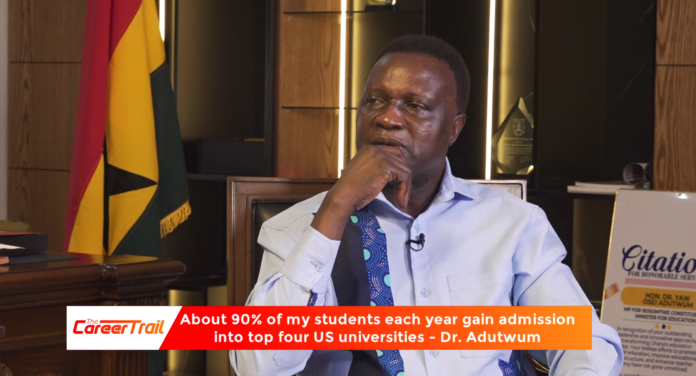

Member of Parliament for Bosomtwe Constituency and educationist, Dr Yaw Osei Adutwum, has recounted how his journey in the United States evolved from classroom teaching into building multiple successful schools through a charter school system.
In an interview on The Career Trail program on Joy Learning TV and Joy News, he explained that the turning point came in his ninth year in the US when he came across an advert inviting individuals to submit proposals to establish schools.
“At that time, the American government was concerned that some public schools, especially in urban areas, were not performing well. So they put out a call for people interested in setting up schools,” he explained.
Dr Adutwum noted that these schools were known as charter schools, where approved applicants are granted a licence by the government to operate independently while receiving funding per student.
“You submit a proposal, and if it is approved, they give you a charter. The government then funds the students who attend your school,” he said.
He described the opportunity as a turning point that aligned both education reform and entrepreneurship.
“So I put in my first grant application. That was the first grant I ever wrote,” he recounted.
One Sunday morning, just before heading to church, he checked the California Department of Education website and discovered his application had been approved.
“My grant had been approved, about $500,000. I later received the first $50,000 cheque,” he revealed.
He recalled his amazement at holding such a large amount of money for the first time.
“I placed the cheque on the passenger seat of my car and kept looking at it. I had never seen a $50,000 cheque before,” he mentioned.
Following the approval, Dr Adutwum successfully established his first charter school in an urban community, beginning with about 100 students.
He noted that the school quickly gained attention due to its strong academic structure and discipline, attracting more families.
He noted that the school expanded rapidly, attracting strong interest from parents.
“Many parents came to us saying they wanted their children in our school because Africans are serious about education,” he shared.
With growing demand, he later expanded the model, raising funds from Wall Street investors to scale up operations.
“I went to Wall Street and raised about $20 million to build my first permanent campus,” he disclosed.
The educationist explained that the success of the first school led to the establishment of two more institutions, building what he described as a strong education network.
Over time, his schools recorded high academic outcomes, with nearly 90 percent of students gaining admission into four-year universities annually, far above the urban average at the time.
“My students were succeeding. Up to about 90% of my students every year were getting accepted into four-year top universities, Harvard, Yale, MIT, and Stanford,” he expressed with excitement.
He further established that his success was driven by an intentionally structured academic system designed to push students beyond the standard curriculum.
“Well, how I got them to do that was to make the school day longer. My school was from junior high to high school. In junior high, you would leave school at 3:45, so I had additional time for extra English and extra mathematics,” he noted.
“What it meant was that every day you did additional mathematics coursework and additional English coursework. So at the end of the year, you would have completed about 1.5 math classes and 1.5 English classes. That was how I set it up,” he highlighted.
He further noted that learning extended beyond weekdays, as Saturdays were also incorporated into the academic schedule.
“Saturdays, you had to come to school. Every other Saturday, they were in school. And besides that, we had counselling and intervention,” he added.
Reflecting on his journey, Dr Adutwum pointed to the “hero’s journey” as a framework that helped him understand his transformation from a classroom teacher in the United States to an education entrepreneur who went on to build three schools.
“Every one of us starts an ordinary life, then an idea comes, what Joseph Campbell calls the call to adventure. Most people refuse it because of fear or circumstance, but when you accept it, you meet mentors, face challenges, go through setbacks, and eventually you transform. That was my journey in America, from a teacher in difficult classrooms to building schools, raising funds, and impacting thousands of students,” he underscored.
ALSO READ:
