


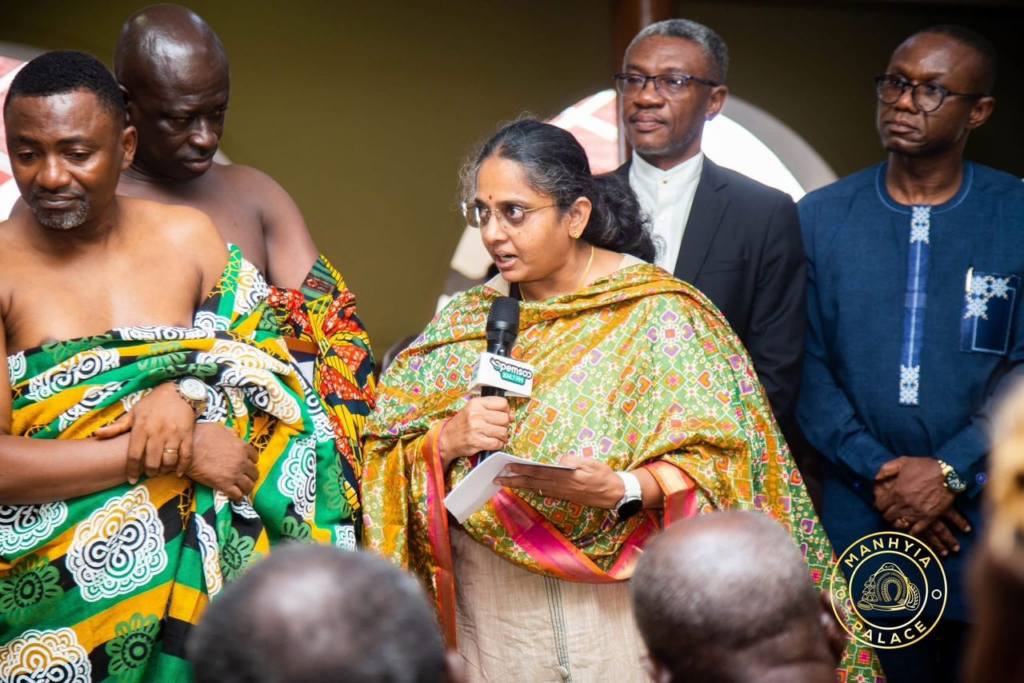
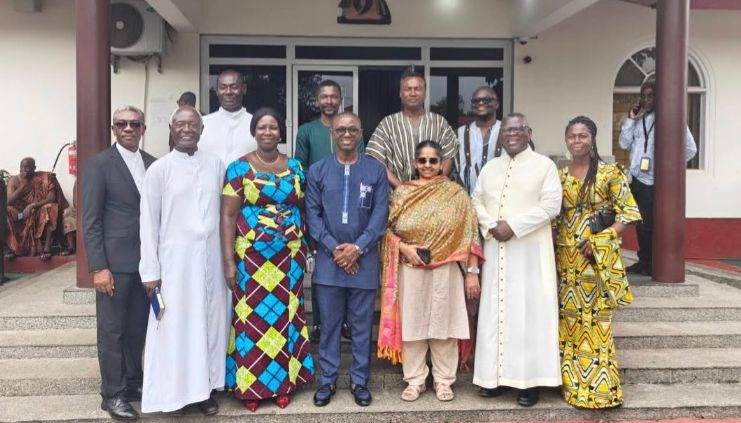
Arima Farms Ghana has paid a courtesy call on the Otumfuo Osei Tutu II to seek his royal blessing for Ghana’s emerging wheat project.
During the visit to Manhyia Palace, the team formally requested that the best-performing wheat variety under development be named in honour of the Asantehene.
The proposed name “Opemsuo Wheat” is expected to reflect both royal endorsement and the symbolic beginning of wheat cultivation in Ghana, where the Ashanti Region is being anchored as a key starting point for national expansion.

The engagement forms part of a broader national effort to reduce Ghana’s heavy dependence on imported wheat, as a landmark public–private research partnership continues to identify climate-resilient varieties suitable for local production.
The initiative, launched in 2025 after two years of collaborative research, has introduced improved wheat varieties, including Wheat Pride 999 from India and additional lines from the International Maize and Wheat Improvement Center (CIMMYT). These varieties have been selected for their heat and drought tolerance, high yields, and enhanced nutritional value.
Ghana currently spends over $450 million annually on wheat imports, with consumption exceeding 1.2 million metric tonnes, figures that underline the urgency of efforts to build local capacity.
At the centre of the project is Arima Farms Ghana, serving as the lead private sector sponsor and strategic partner, working alongside the Crops Research Institute of the Council for Scientific and Industrial Research (CSIR-CRI), the Indian Government, traditional authorities, and the Catholic Church.
Managing Director of Arima Farms Limited, Ms. Saalai Manikam, said the project is grounded in science and adapted to Ghana’s ecological realities.
“I’m from South India, which has similar climatic and ecological conditions to Ghana, and we have successfully cultivated wheat there. If it can be done in that climate, then why not in Ghana?
“We brought in tropical wheat varieties specifically suited for this climate. Research by the Crops Research Institute has taken into consideration the ecological zones and the right cultivation patterns,” she said.
She explained that the project will begin with smallholder farmers before scaling up nationwide.
“As a starting point, we can work with at least 500 smallholder farmers because the demand for wheat in Ghana is huge. Gradually, over five to ten years, we can reach full self-sufficiency,” she added.
At the scientific level, researchers say long-held assumptions about wheat production in Ghana are being challenged through extensive field trials across multiple ecological zones.
Director of CSIR-CRI, Professor Maxwell Darko Asante, confirmed that several promising varieties have already shown strong adaptation potential.
“We have been able to find heat-tolerant wheat varieties and tested them across regions, and we can assure that many of these lines are well adapted to our environment, with plans to officially release them onto the market next year,” he said.
Beyond reducing imports, stakeholders believe the initiative could unlock new economic opportunities, particularly in the Ashanti Region, where expanded wheat cultivation is expected to stimulate investment in flour milling, agro-processing, and related industries.
Business Development Director of Arima Farms Limited, Nana Barima Acheampong Sarpong II, emphasized that national unity and institutional collaboration will be critical to success.
“We are making history where we have brought wheat and we’re starting from the Ashanti Kingdom. We are requesting that the government, political parties, traditional authorities, the private sector and the church all come together. If we forge this partnership, in the next five to ten years Ghana should not be importing wheat,” he said.
He added, “I am hopeful that by the end of the year, we would get a very good variety, even better than what we get from Burkina Faso. That is our focus.”
READ ALSO:
We have food, but… – CHASS National Secretary clarifies
Young man in critical condition after chopping off his genitals
