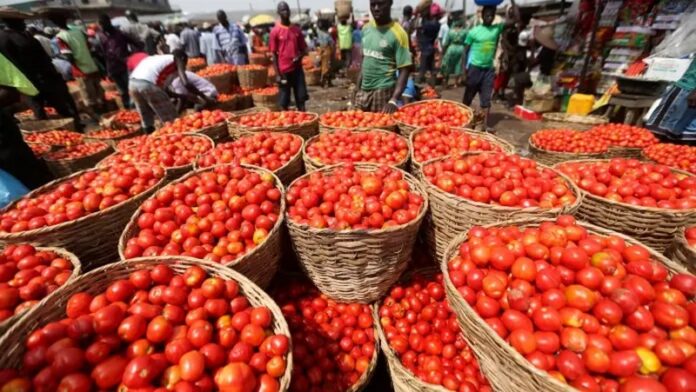

The Peasant Farmers Association of Ghana has described the tomato import ban by Burkina Faso as an opportunity for Ghana to boost local production and achieve self-sufficiency.
In a statement issued on March 24 and signed by National President Wepia Awal Addo Adugwala, the Association said while government’s engagement with Burkinabe authorities is necessary, urgent steps must be taken to support farmers to increase output and avert a potential shortage.
It warned that failure to act could result in sharp price increases, rising inflation, and a possible food security crisis.
The Association noted that tomato production in Ghana is challenged by heavy reliance on rain-fed agriculture, high input costs, weak market systems, and significant post-harvest losses, which discourage farmers.
It also pointed to broader pressures, including rising costs of fuel and agricultural inputs due to global developments, as well as existing market challenges affecting other staple crops.
The group is urging government to implement immediate support measures for tomato farmers, particularly those at irrigation sites, through the provision of improved seeds, fertilisers, and mechanisation services.
It further called for the development of an emergency response plan to address potential supply gaps if talks with Burkina Faso fail.
In the medium to long term, the Association is advocating increased investment in irrigation infrastructure, expansion of farmland, improved storage systems, and the revival of tomato processing facilities.
The statement reaffirmed the Association’s readiness to partner with government to strengthen production and improve food security.
Read the statement below:
FOR IMMEDIATE RELEASE
24th March 2026
TOMATO IMPORT BAN BY BURKINA FASO IS A BLESSING IN DISGUISE: SUPPORT FARMERS TO
DELIVER
The Peasant Farmers Association of Ghana (PFAG) has taken notice of the directive by officials of Burkina
Faso banning the trade of tomatoes from that country, and the subsequent response by the government
of Ghana through the Ministry of Trade, Industry and Agribusiness. While the Association understands
the government’s decision to engage Burkinabe officials on this matter, it sees this as an opportunity for
government to develop home-grown strategies and support farmers to increase production and ensure
self-sufficiency. Failure to do so will result in an acute shortage of tomatoes, leading to drastic price
hikes, increased inflationary pressures, and an escalation into a full-blown food security crisis.
Tomato production in Ghana has been characterized by a massive reliance on rain-fed agriculture, high
input costs, and weak market linkages. This situation is further exacerbated by high post-harvest losses,
which create a major disincentive for farmers during the major planting season. While these challenges
are well known and documented, successive governments have failed to take a transformative and well
coordinated approach to address them, despite spending millions of cedis in the sector. Investments in
irrigation development, inputs, storage, and processing facilities have failed to bring about significant
change over the years, as we are still reeling from the inadequacy of these interventions.
This situation is happening at a time when geopolitical conflict is leading to higher costs of energy, fuel,
and agricultural inputs, which will increase production costs for farmers. This is in addition to the
unresolved market glut for other staples such as rice, maize, soya, cassava, and pepper, which has
already caused stress and frustration for farmers. The overall effect is a massive disincentive for farmers
to produce enough to meet the country’s demand, which will have a significant effect on our food
security. The agricultural sector is on the brink of a heightened food security crisis, and the sooner we
act pragmatically, the better.
The PFAG therefore urges government to provide LEADERSHIP, DIRECTION, and a clear STRATEGY to
permanently address this challenge in the short, medium, and long term.
- In the short term, the PFAG urges the government of Ghana to, as a matter of urgency, extend
support to tomato farmers at irrigation sites to increase their production. This should be in the form of
provision of improved seeds, fertilizers, and mechanization services to enhance production. The tomato
farmers within the Peasant Farmers Association of Ghana (PFAG) are ready and available to work with
government in this regard. Within this period, government should quickly set up an emergency strategic
response plan together with stakeholders to address the looming shortage of tomatoes, in the event
that engagements with the Burkina Faso authorities prove futile. - In the medium term, government must establish more land banks, increase land availability at
irrigation sites, and enroll and empower additional farmers for tomato production. Government should
address market linkages by establishing storage facilities (cold store infrastructure) and facilitating an
output market system with traders and transporters to ensure optimum and efficient delivery of produce. - In the long term, government must aim at expanding irrigation infrastructure by establishing at least
one major irrigation dam in every region. We should aim at increasing our percentage of irrigable land
from the current 10% to over 50% by 2028. Government must also expedite its plans to establish,
rehabilitate, or revamp existing tomato processing facilities to enable them to process and operate at
full capacity.
Current developments in the agricultural sector, both locally and externally, and their impact on food
security, have shown that Ghana cannot continue to provide lump-sum and generalized support for
staple foods, given their unique importance in the Ghanaian diet and their implications for food security.
We need a strategic plan, direction, approach, and a special vehicle to unlock their respective potentials.
The PFAG believes that government must set up specific programs with clear financing, monitoring, and
accountability mechanisms for value chains such as rice, tomato, onion, cassava, and maize. This will
provide targeted and dedicated support to these value chains and especially to farmers to enhance their
productivity.
The Association assures government of its support and readiness to partner to enhance production and
improve the food security situation within the country. We also urge government to play its part and
leave a legacy of providing a permanent solution to the perennial challenges affecting effective food
production by farmers.
We are heading toward a crisis, and the time to act is now.
Signed
Wepia Awal Addo Adugwala
National President
ALSO READ: