
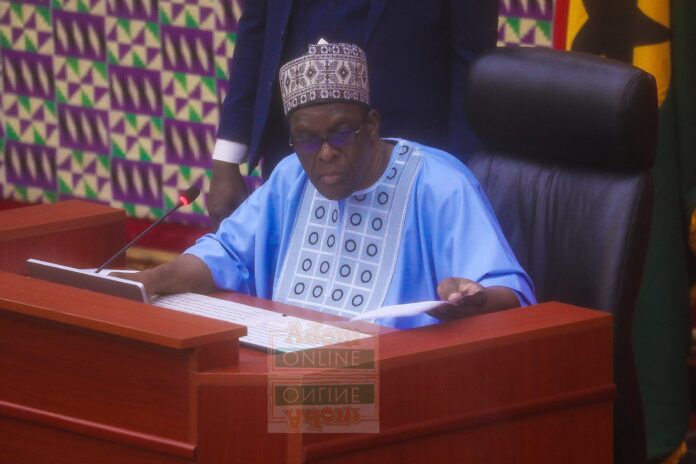

The Speaker of Parliament, Alban Sumana Kingsford Bagbin, has clarified that security agencies do not require his permission to arrest a Member of Parliament (MP) suspected of wrongdoing.
He said the law only required the security agencies to notify him of the circumstances surrounding the arrest or invitation of an MP for investigations.
Addressing the House on Thursday [May 21, 2026] at the opening of the Second Meeting of the Second Session of the Ninth Parliament, Mr Bagbin said there was a misconception that the Speaker’s approval was needed before an MP could be apprehended.
“That is not the state of the law,” he said.
Notification requirement
Mr Bagbin explained that once informed, he would assess the situation in line with the law to determine whether the MP involved enjoyed any parliamentary privilege or immunity.
“They must only inform me of incidents involving MPs as to whether they had gone on the wrong side of the law or not,” he said.
The Speaker added that the notification must include the allegations or circumstances that had led to the arrest or invitation for questioning.
Key bills before House
Touching on the business before the House, Mr Bagbin said the Human Sexual Rights and Family Values Bill, 2025, although passed by the Eighth Parliament, would have to be reintroduced and go through the full legislative process again.
He explained that as a Private Member’s Bill, due process had to be followed.
“It is taking time because we have to abide by the law,” he said.
On the Property Rights of Spouses Bill, 2025, the Speaker noted that the proposed legislation had been before Parliament for several years.
He said despite challenges delaying its passage, the House continued to give the bill special attention because of its importance in promoting fairness and protecting family stability.
Transition and conduct bills
Mr Bagbin also highlighted the Parliamentary Transition Bill, which has been pending before the House since 2022.
He described the bill as crucial to ensuring smooth transitions from one Parliament to another.
“We passed a law for Executive transition but left that for Parliament,” he said, recalling the tensions that characterised the election of the Speaker in 2021.
“We do not want to experience this kind of bad precedent again,” he added.
The Speaker further referenced the Parliament Bill, 2025, saying it contained provisions aimed at regulating the conduct and behaviour of MPs.
According to him, the bill would help instil ethics and decency in public office.
He urged committees and MPs to treat the various bills with seriousness and cooperation.
Minority criticism
The Minority Leader, Alexander Afenyo-Markin, in a speech read on his behalf, criticised the government over the state of the economy and governance.
In a speech read on his behalf, he accused the administration of President John Dramani Mahama of presiding over “failure, scandal and deepening suffering”.
Mr Afenyo-Markin said the recess period had been marked by the return of power outages, popularly known as dumsor, and increasing public anxiety.
He also accused the government of targeting members of the New Patriotic Party (NPP) through arrests.
Seal of global approval
The Majority Leader, Mahama Ayariga, said the final apocalyptic collapse of Ghana’s economy witnessed in 2022, with all macroeconomic indicators “gasping for air,” was entirely avoidable.Ghana Investment Opportunities
On what had changed with the exit plan from the IMF, he said the government had opted for the Fund’s policy coordination instrument (PCI), which was a non-financial advisory and monitoring tool provided to allow Ghana to design and implement its own economic reforms without receiving a financial bailout.
“It acts essentially as a global seal of approval for the government’s fiscal arrangement.
“This master stroke in economic diplomacy could not have been achieved without the backing of the President, whose mission this time around is legacy and respect,” he said.
