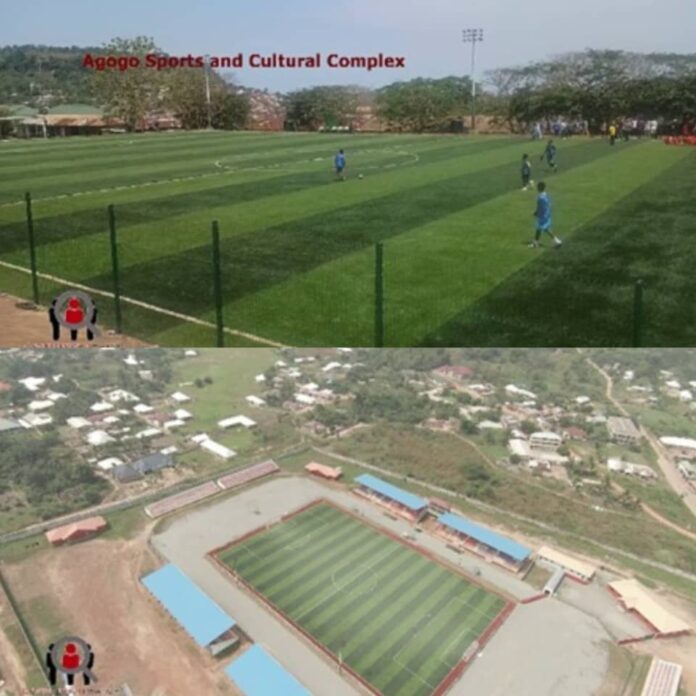

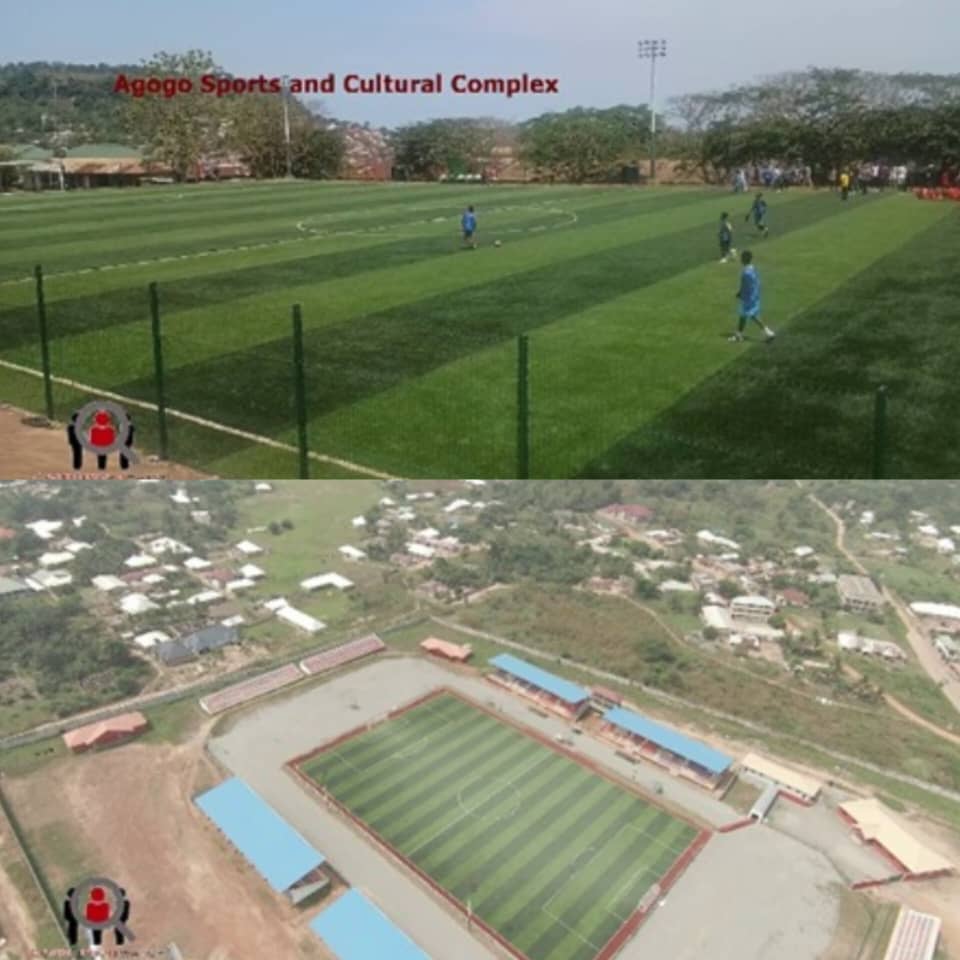
The Agogo Sports and Cultural Complex (T) and Hohoe Sports Stadium in the Volta region
The One Constituency, One Astroturf programme that began in 2017 as one of President Nana Akufo-Addo’s administration’s most celebrated sports infrastructure initiative was welcomed across Ghana as a transformative investment in youth development and community sports.
Nearly a decade later, however, Corruption Watch’s investigation has uncovered evidence of a troubling pattern; ownership disputes, procurement irregularities, privatization of stadium lands, abuse of office and conflict of interest.
The investigation has found that two senior officers who served under former President Nana Akufo-Addo’s administration, former Minister of Energy, John Peter Amewu and former Ghana Gas Communications Director, Ernest Owusu-Bempah, are at the center of ownership dispute of sports facilities at Hohoe and Agogo respectively, constructed largely with public funds valued at more than GHS17 million.
This exposé is the first in a nationwide investigative series which Corruption Watch started back in February 2025 to examine 169 Astroturf and sports infrastructure projects constructed across Ghana, representing public investments estimated to exceed GHS1 billion.
This edition focuses on three key anti-corruption issues including procurement irregularities, abuse of office and conflict of interest.
The construction of the Hohoe Sports Stadium in the Volta Region and the Agogo Sports and Cultural Complex in the Ashanti Region were initiated by the Hohoe Municipal Assembly and the Asante Akim North Assembly respectively and funded by state agencies under their respective Corporate Social Responsibility programmes.
The state agencies that provided funding are the Ghana National Petroleum Corporation (GNPC Foundation), Ghana National Gas Company Limited (Ghana Gas), Volta River Authority (VRA), GOEnergy Company Limited (GOE) and the Hohoe Municipal Assembly.
Procurement Irregularities and Circumvention of Competitive Tendering
Corruption Watch’s investigation uncovered serious procurement irregularities in the execution of the Hohoe Sports Stadium project and the construction of the Agogo Sports and Cultural Complex.
The findings reveal a pattern of procurement Irregularities, including the circumvention of competitive bidding requirements, the use of procurement procedures to legitimize predetermined decisions, and the submission of inaccurate information to the Public Procurement Authority (PPA).
Corruption Watch established that the contract for the construction of the Agogo Sports and Cultural Complex, which was fully funded by Ghana Gas for GHS 3,444,524.85, was awarded directly to Wembley Sports Construction Company Limited (Wembley) through a single-source contract.
The Hohoe Stadium project presents even more serious concerns. Documentary evidence obtained by Corruption Watch indicates that Wembley had already been selected, mobilized to site, commenced work, and received substantial public payments before the Hohoe Municipal Assembly sought the required approval from the PPA to depart from the default competitive procurement process.
Procurement Experts Question Legality of the Process
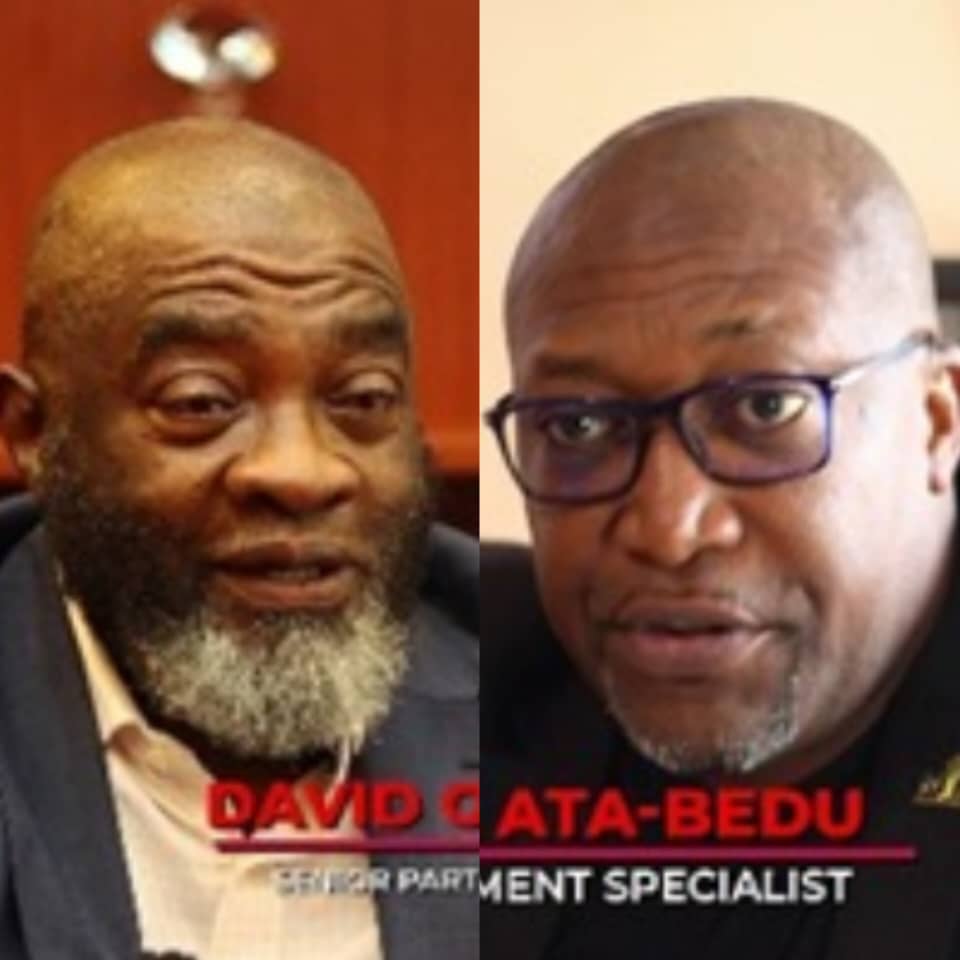
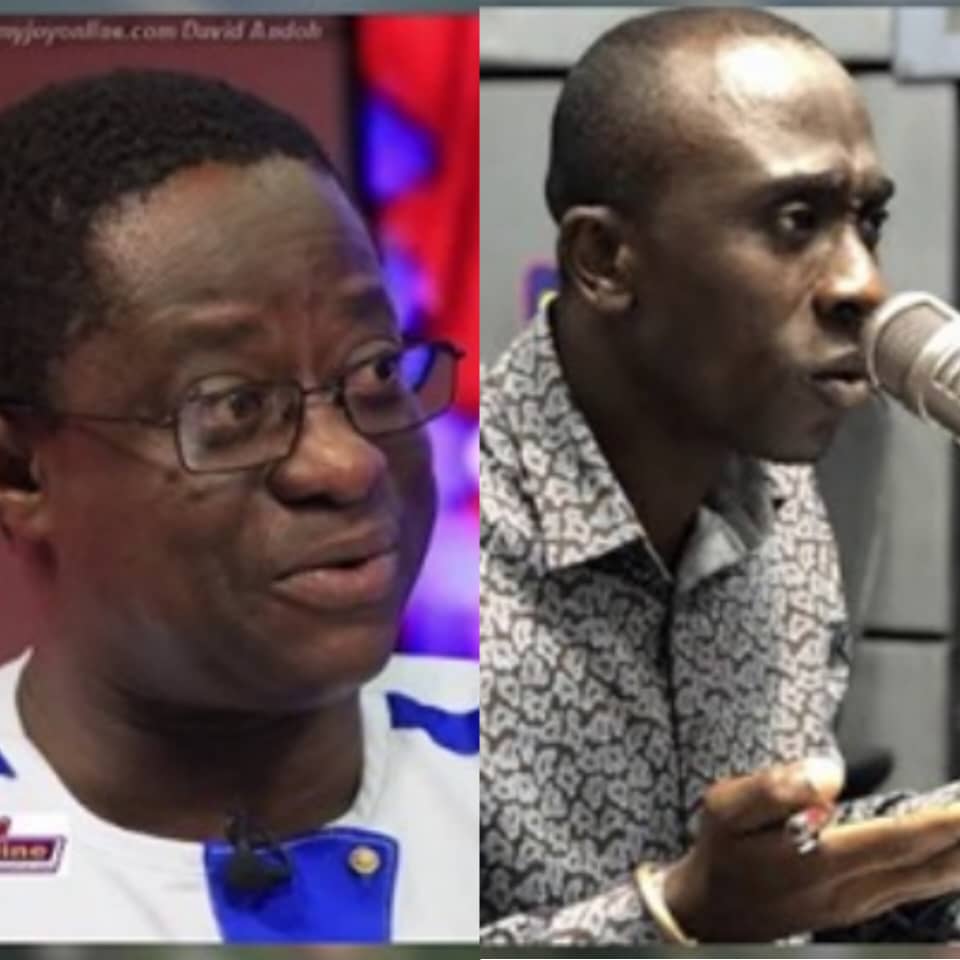
David Ofosu-Dorte (L), Senior Partner at AB & David Africa and Ata-Bedu, a procurement specialist and management consultant
To independently assess the procurement records obtained by Corruption Watch, the investigation sought the views of two procurement experts – Kobina Ata-Bedu, a procurement specialist and management consultant, and David Ofosu-Dorte, Senior Partner at AB & David Africa.
According to Mr Ata-Bedu, under Ghana’s Public Procurement Act, competitive tendering is the default procurement method.
“So, once you are going through the default, in accordance with the provisions of the Act, you don’t need to go to PPA. It is when you need to deviate from the standard, which is competitive bidding that you need to go and get prior approval, it means, approval before you do it.”
Mr Ofosu-Dorte similarly explained: “When it comes to public procurement, normally, it is when you are using public funds to procure goods, works or services so once these three apply and you are using public funds, under Ghanaian law, in that instance, you need to comply with the law.”
A Restricted Tender in Name Only
Official records from the Hohoe Municipal Assembly indicate that the contract was awarded through a Restricted Tender process. However, former Member of Parliament for Hohoe, and Minister of Energy and Railways, Peter Amewu, provided a different account.
According to him, he personally identified Wembley as the contractor, prepared the Bill of Quantities, and submitted it to the Assembly for implementation: “So, I again did the estimate, did the bill of quantities, everything else, and then gave it to the Assembly so that if the Assembly can support, collectively, we can do this.”
Commenting on Mr Amewu’s account, Mr Ata-Bedu stated that preparing the bill of quantities is ordinarily the responsibility of the procuring entity and not an individual.
“Pre-contract work which has to do with everything before a tender is launched is supposed to be done internally, but where there isn’t capacity internally, third parties can be hired through a procurement process to execute the pre-contract works. They will be paid for it and then, the procurement department can take that document and use it to prepare the tender document and execute the tender process.”
He added: “The MP has basically usurped the powers or obligations of the Assembly because the MP is not supposed to prepare the bill of quantities and present it to the Assembly. The Assembly is supposed to do that.”
Wembley’s own account also contradicted the Assembly’s official position. Although the company’s contract documents referred to a tender process, Wembley informed Corruption Watch that the project had been awarded through sole-sourcing.
Manipulating the Procurement Process
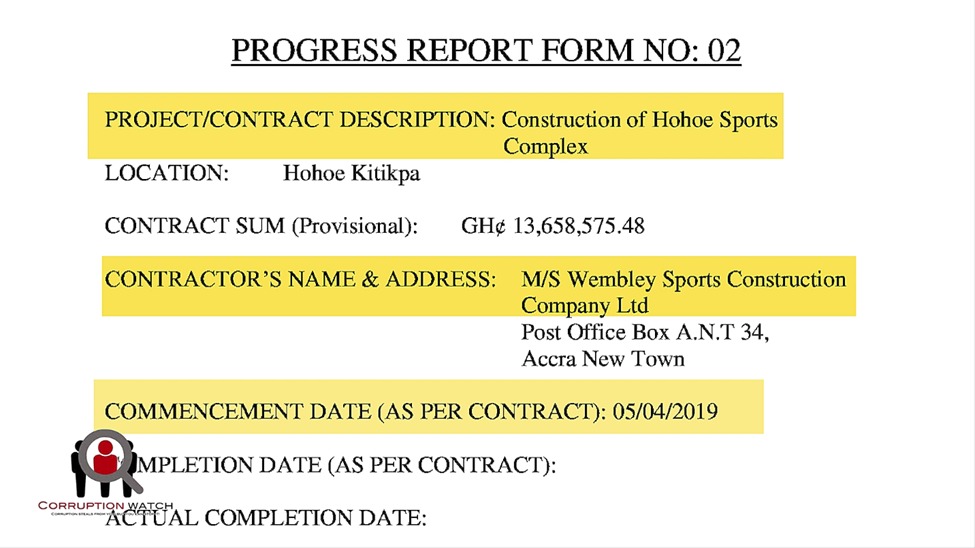
The chronology established by Corruption Watch raises fundamental questions about the integrity of the procurement process. On March 24, 2019, during the sod-cutting ceremony, Wembley was publicly introduced as the contractor for the project. Project records further show that construction officially commenced on April 5, 2019.
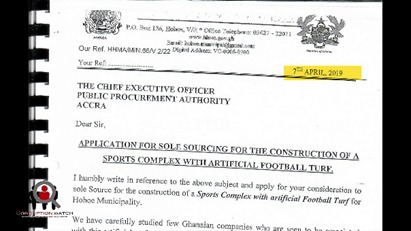
Yet, on April 7, 2019, two days after work had commenced, the Hohoe Municipal Assembly wrote to the PPA requesting approval to use the Single-Source procurement method. The implication is significant:
The contractor had already been publicly identified and had commenced work before the Assembly sought approval for the procurement method that was supposed to determine how the contractor would be selected.
Mr Ata-Bedu explained the implication: “So the question then is, when the application went to PPA, what level of due diligence did PPA do? Because, one, anybody who discloses information to a public officer or a public entity and conceals information is in violation of our criminal code.
You have lied to the state. So, they not declaring that they have already awarded and all that is concealment and that one they should forward it to the right people who can prosecute based on criminal lines and then they prosecute them.”
The Public Procurement Authority’s response
The PPA in response to Corruption Watch’s Right to Information (RTI) request on the Hohoe Sports Stadium disclosed that the processes followed procurement process the Authority approved.
On June 21, 2019, the PPA rejected the Assembly’s request and directed it to use National Competitive Tendering.
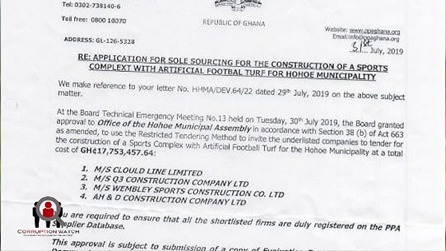
Rather than conduct an open competitive process, the Assembly returned to the Authority on July 29, 2019, requesting approval to use a Restricted Tender, citing time constraints and the specialized nature of the works.
The Assembly submitted four companies as prospective bidders:
• M/S Cloud Line Limited
• M/S Wembley Sports Construction Company Limited
• M/S AH & D Construction Company Limited
• M/S Q3 Construction Company Limited
The PPA approved the Restricted Tender on July 31, 2019. However, Corruption Watch established that by the time that approval was granted, Wembley had already received GHS 2.355 million in public payments.
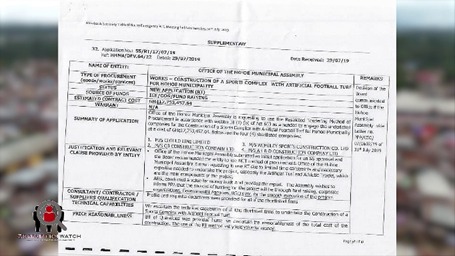
The Restricted Tender process only commenced afterwards. Invitations to tender were issued on August 2, 2019, tender documents were sold at GHS 300, and bids were received between August 5 and August 19, 2019.
Despite this exercise, Wembley had already been publicly announced as the contractor, mobilized to site, commenced work, and received millions of cedis in payments.
On 18th December, 2019, the Assembly formally awarded the contract to Wembley.
According to procurement expert Kobina Ata-Bedu, paying a contractor before the award and execution of a contract is inconsistent with both the Public Procurement Act and the Public Financial Management Act.
“As soon as you do that, you go against the Public financial Management Act, as well as the PPA because what are you paying for If you haven’t contracted yet?”
Mr Ofosu-Dorte had this to say : “It’s not proper to be announcing a contractor when you have not gone to PPA. That means you have pre-selected a contractor and the rest of the process becomes irrelevant.”
He also questioned the legality of announcing Wembley as the contractor before completion of the procurement process.
According to him, “the law is specific, if there is emergency or what they call extreme emergency, let’s say there is public disaster, let’s talk of the recent floods, let’s assume there is a place blocked and we needed a contractor to unblock it, in that state of extreme urgency, you can actually go ahead and award the contract before going for approval but you cannot make payment before the approval.”
Referring specifically to the Hohoe Stadium project, Mr Ofosu-Dorte rejected any suggestion that the project could reasonably qualify as an emergency: “I will not consider a situation where there is a formal sod-cutting as urgent. If the thing is urgent there wouldn’t be sod-cutting. A stadium cannot be constructed under emergency… I cannot relate to it.”
Questionable Tender Participants
Corruption Watch also identified significant irregularities in the list of companies submitted to the PPA to justify the Restricted Tender.
Searches at the Office of the Registrar of Companies could not confirm the registration of AH & D Construction Company Limited and Q3 Construction Company Limited, raising questions about whether they legally existed at the time.
Cloudline Limited, another company listed by the Assembly as a participant, denied ever receiving an invitation or submitting a bid.
Its owner, Ms. Roberta Huppenbauer, told Corruption Watch:
“Cloudline Limited did not participate in bidding in building Astroturf in Hohoe, neither did Cloudline Limited receive any letter of invitation from the Municipal Assembly. Cloudline has been in existence since 2017 but it never did any operations till recently. So, from 2017, Cloudline has been dormant; it wasn’t operating. So, this comes to me as a surprise because I have no idea about it.”
According to Mr. Ata-Bedu, verifying the legal status of bidders is one of the most basic due diligence checks in any public procurement process.
“Before approval, if PPA’s due diligence office had done its job, because when you are doing pre-qualification the first thing you do is company registration. The law says that you can’t partake in public tenders if you are not a registered company. So any company that comes, the first thing you need is to go and check if it is a registered company?
“What it means is that, as soon as PPA says approved, go and do it, they will go and create a tender, do an evaluation, and make sure that the one who is on the ground has won. That is rigging! It’s bid rigging,” he stated.
Mr Ofosu-Dorte likewise emphasized that under the Public Procurement Act, legal responsibility ultimately rests with the Head of the Procurement Entity.
According to him, “the law is very specific in several sections, that the head of the entity, in this case, the District Chief Executive (DCE) is responsible for decisions of procurement including sanctions under the law. So, it’s not that you can be DCE and go and chair Entity Tender Committee and something happens you say I didn’t know anything about it, no! if the law takes its course, the Chief Executive of every public organization is the head of the Entity Tender Committee and the assembly has one.”
Response of the Former Municipal Chief Executive
Former Municipal Chief Executive, Andrews Teddy Ofori, denied approving payments before the execution of the contract, notwithstanding documentary evidence obtained by Corruption Watch indicating otherwise.
He nevertheless acknowledged that Wembley had commenced work while procurement processes were still ongoing.
“No, that was the problem between me and some people because I insisted that we signed the contract before payment started. Because I wrote the letters per the instruction of the then Minister , John Peter Amewu, I wrote to the various agencies, GNPC, VRA and all those institutions so when the funds started coming, there was the issue that we should release the money to the contractor. Because he has already started work and I said until we signed the contract, I was not going to allow any payment.
“The contractor was putting pressure on us that he has been doing the work and for that matter, he needed to be paid. And I said since we have not yet signed the contract, we cannot take it for granted that he has gotten any contract with the assembly. So until we signed the contract, based on the instruction from the Regional Tender Committee and then the PPA and the Value Audit and all those things, so until those documentations were completed, we were not able to release any money to him and that was signed before we started payment to the contractor.
“There is a contract register which should indicate the date, amount and who was paid. That’s where the cheques were issued, I don’t sign the cheques so please go to the contract register.”
Call for Accountability
Transparency International Ghana’s Executive Director, Mary Addah
Commenting on Corruption Watch’s anti-corruption findings, Transparency International Ghana’s Executive Director, Mary Addah, described the findings as a disturbing example of abuse of public office.
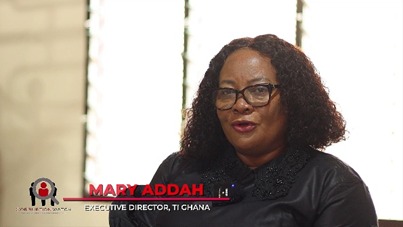
“You see in all these, we see the murky nature of self-interest, personal interest, abuse of power and abuse of office play out. When people have political power, or when people are given authority to serve, they use it to serve their personal interest and those of their cronies and I believe this is one of those cases where you should ensure that we all hear about and speak against.”
Abuse of office for private gain
The investigation established that while serving as Minister for Energy and Member of Parliament for Hohoe, Mr Amewu played a central role in mobilizing financial support for the project from state-owned agencies under the Ministry of Energy where he was the minister and had oversight responsibility of those institutions that provided funding for the construction of the Hohoe Sports Stadium.
Documentary evidence reviewed by Corruption Watch shows that requests for financial contributions were sent to several state agencies through official correspondence from the Hohoe Municipal Assembly. However, interviews with key officials indicate that these requests were initiated at the direction of the Minister.
Former Municipal Chief Executive, Mr Ofori, confirmed that Mr Amewu advised the Assembly to seek financial support from agencies under his ministry because of their corporate social responsibility programmes: “At that time, John Peter Amewu was the Minister for Energy, so I think he knew that those people had social responsibilities to do something for communities so from his Ministry, he gave that advice. That’s why I wrote to those companies. He gave that advice, and I wrote and signed on behalf of the Assembly.”
Mr Ofori maintained that the stadium was an assembly project rather than a personal initiative.
“It is a state property. For me, since we signed the contract on behalf of the Assembly and the payment was being made through the assembly to the contractor, after I left, whoever took over from me is supposed to continue the payment and supervise the work until it’s completed so its assembly’s property.”
Mr Amewu, however, presented a different account of how funding for the project was secured.
According to him, he personally negotiated financial support from the state agencies and only used the Assembly as the institutional channel through which the funds could be received and managed.
“I personally went and spoke to those people. I signed the agreement with the intention of using the Assembly. I thought the Assembly would have the resources, but when it didn’t, I approached the agencies to support.”
Referring specifically to Ghana Gas, he stated:
“When I solicited GHS1 million from Ghana Gas, I went to Teddy and said, ‘Please let’s prepare these request letters.’ It doesn’t mean the money came from the Assembly.”
Mr Amewu further acknowledged that his position as Minister significantly influenced the willingness of the agencies to support the project.
“Maybe if I was not a Minister, some of these institutions would not even have supported me. The fact remains that most of that support may not have come if I was not a Minister, and that is why I was extremely careful in saying that, yes, of course, I used my position as anybody would to support my community.”
While Mr Amewu described his actions as using his office to attract development to his constituency, he wrote a letter to the VRA to solicit for funds for the construction of the Hohoe Sports Stadium and subsequently the VRA provided GHS 300,000 in response to his request letter dated February 26, 2019.
Mary Addah, the Executive Director of Transparency Internal Ghana, said, “again, we talk about abuse of office or abuse of power. And remember the definition of corruption for Transparency International is abuse of entrusted power for private gains. And so, the person is an MP, that’s a public officer number one, number two, he was a Minister of State.
“I see issues, number one around conflict of interest, I say conflict of interest because it is a phenomenon that showcases itself when a public offer puts his interest in the performance of his duty over and above the interest of the common good or the state. And in this case, it is evident that, there are things that have gone on which showed that the gentleman or Hon.
“Amewu then, who was a Minister of State used the powers of his office to facilitate a process of getting a project to his community. In this case, it means the personal interest superseded the interest of the common good.”
The Agogo Project
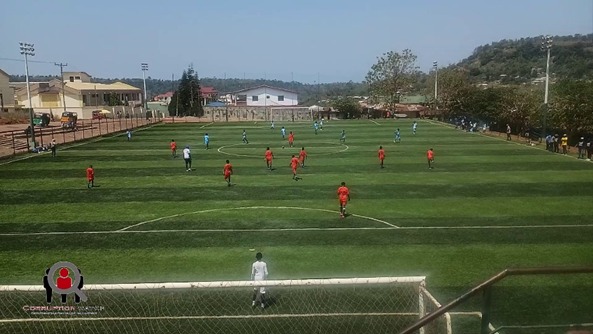
The investigation identified similar concerns in the Agogo Astroturf project.
Evidence gathered by Corruption Watch indicates that Mr Owusu Bempah, who served as Director of Communications at Ghana Gas and a native of Agogo, actively facilitated engagements between Ghana Gas and the Asante Akyem North Municipal Assembly throughout the implementation of the project until its commissioning.
The findings underscore the importance of establishing clear conflict-of-interest rules, strengthening disclosure requirements, and enacting the long-delayed Conduct of Public Officers legislation to ensure that public officials exercise their powers solely in the public interest and avoid situations that create actual or perceived conflicts between their official responsibilities and personal or political interests.