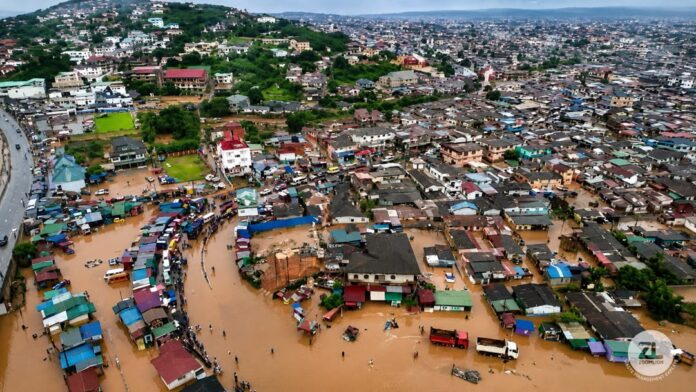

The Ghana Institution of Engineering (GhIE) has called for bold and long-term reforms to address Ghana’s recurring flood disasters, warning that emergency responses alone are insufficient to protect lives and property.
In a strongly worded position statement issued on June 30 following the recent floods in Accra and other parts of the country, the institution said Ghana already has the technical expertise to solve the problem, but lacks the political will to implement proven solutions.
GhIE noted that the recent heavy rains, which recorded the highest rainfall levels for the month of June, overwhelmed already strained drainage systems in the capital.
Among its key recommendations, the institution urged government to prioritise the rehabilitation of the Odaw River and Korle Lagoon drainage systems as national projects of critical importance. It also called for an independent audit of previous restoration works to identify engineering and implementation challenges.
On waste management, GhIE emphasised the need for reliable waste collection services and strict enforcement of sanitation by-laws.
“Get established collection back on a dependable schedule in every community, so that households are not forced to choose between costly informal collectors and the nearest gutter,” the statement said.
“This is a problem we can actually solve, but only if we treat collection as an essential service and enforcement as a standing duty, not a seasonal campaign,” it added.
The engineers also urged that the Department of Urban Roads and the Ghana Highway Authority be fully integrated into national flood management planning, ensuring that all road projects include properly designed drainage systems with dedicated maintenance funding.
“A road built without a working drain is just a future flood channel,” the statement warned.
On urban development control, GhIE called for stricter enforcement of planning regulations, including a halt to construction on waterways and wetlands.
“Stop building in the wrong places, and mean it,” the engineers urged.
“This is the hardest step, because it touches powerful interests and uncomfortable permits. It is also the one that matters most, because no amount of engineering can save a city that keeps building over its own rivers.”
The institution further advocated nature-based solutions such as detention ponds, rain gardens and bioswales to support flood control in rapidly expanding urban areas.
GhIE concluded that Ghana’s challenge is not a lack of technical knowledge, but a lack of action.
“Ghana does not have a knowledge problem. We have an action problem,” the statement declared.
It added: “Today’s floods were not caused by rain alone. They were the result of how we plan, enforce laws, manage waste, design roads and channel water through our cities. Every one of these factors is within our control. We are simply choosing, year after year, not to change.”
The institution reaffirmed its readiness to work with government agencies to translate its proposals into practical solutions ahead of the next rainy season.
ALSO READ:
Read the full statement below: