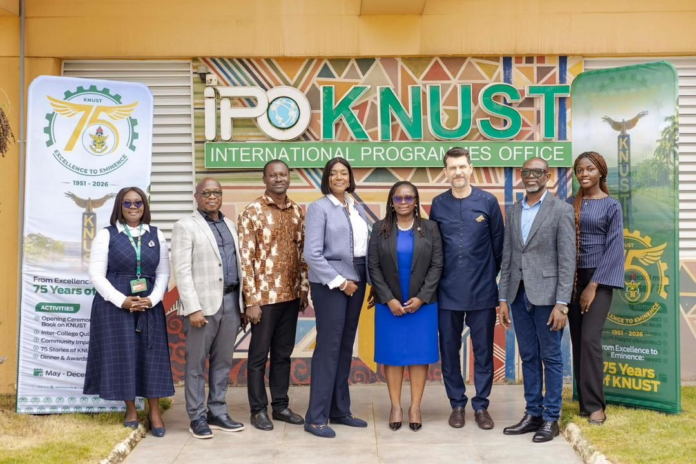

An economist at the Kwame Nkrumah University of Science and Technology (KNUST), Professor Eric Oteng Abayie, says Ghana must build strong and sustainable economic policies that will transform the economy rather than rely on repeated support from the International Monetary Fund (IMF).
He observed that the country’s continuous return to the IMF has largely focused on finding short- and medium-term solutions rather than implementing lasting measures for economic stability and transformation.
Ghana is currently under the IMF’s Policy Coordination Instrument (PCI) after successfully concluding its $3 billion Extended Credit Facility (ECF) programme.
The PCI allows the country to commit to economic policies aimed at preventing future crises and ensuring macroeconomic stability.
Prof. Oteng Abayie believes Ghana’s economic turnaround will only be possible if government implements resilient policies that create jobs, improve labour productivity and promote inclusive growth.
“It looks like the IMF is looking at short- and medium-term solutions but not economic transformation. If we are not stable and we are not building resilience into our policies, we will always go back and never take off into economic transformation — which is where real development, sustainable job creation, increased labour productivity, economic growth leading to inclusive economic development will happen,” he said.
He made the remarks in an interview with the media after a session with the IMF Resident Representative, Dr Adrian Alter, and faculty members and students of the Department of Economics at KNUST.
Prof. Oteng-Abayie identified low labour productivity, limited adoption of technology and inefficiencies in public spending — particularly in infrastructure, education and healthcare — as major constraints affecting Ghana’s economic progress.
The economist further highlighted the need for a coordinated national effort to integrate Artificial Intelligence (AI) into Ghana’s education system, warning that failure to prepare students for an AI-driven economy could worsen graduate unemployment.
“Students are going into a world driven by artificial intelligence. If we are not upskilling them in AI, we risk a mismatch. Those who can match up will get the jobs, and those who cannot may remain unemployed for years,” he noted.
The engagement with the IMF included a presentation on the economic outlook for the Sub-Saharan African region, providing insights into Ghana’s economic reform efforts and the IMF’s approach to engaging local stakeholders in economic policy discussions.
The IMF Resident Representative, Dr Adrian Alter, said aligning tertiary education with labour market demands and easing some financial constraints facing small and medium-sized enterprises (SMEs) are key to building a stronger economy.
“What is key is to merge graduates with the demand for jobs in the labour market. Tertiary education should be tailored to the job demands from the private sector. Diversifying the economy is crucial. Start-ups are required to provide collateral when seeking financial aid. Relaxing some of these financial constraints is key for developing start-ups and creating jobs,” he said.
ALSO:
CSA warns of surge in online investment scams as victims lose…