
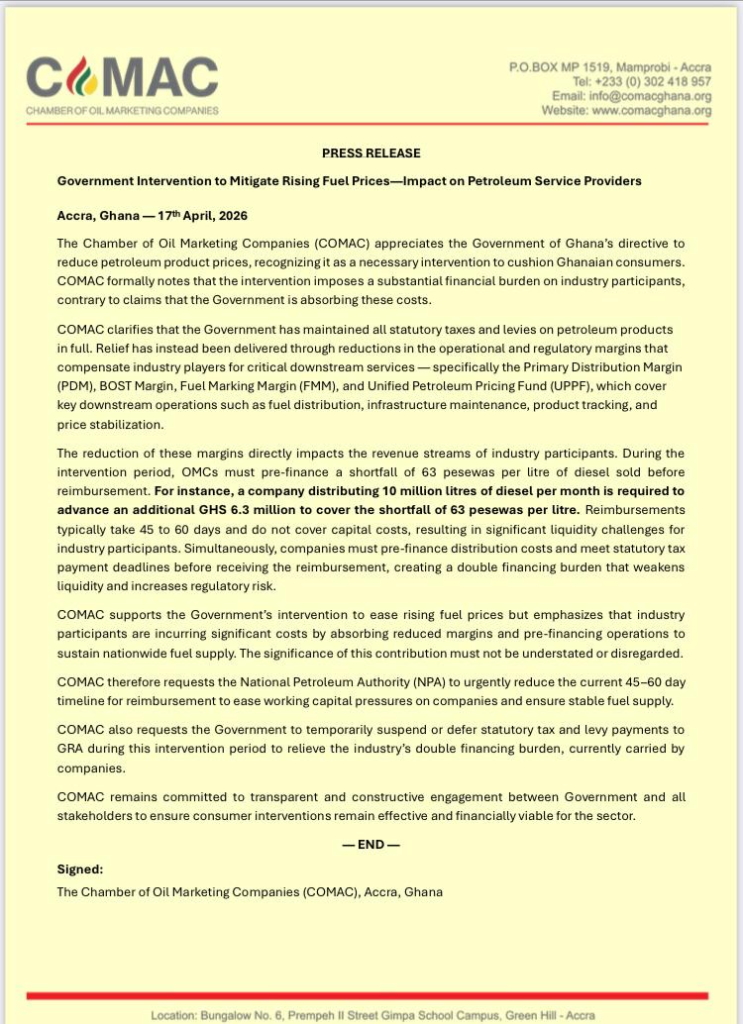
The Chamber of Oil Marketing Companies (COMAC) has expressed concern over the financial impact of government’s recent intervention to reduce fuel prices, warning that the measure is placing a heavy burden on petroleum service providers.
In a statement issued on April 17, COMAC acknowledged the government’s directive as a necessary step to cushion consumers amid rising global petroleum prices. However, it noted that the intervention shifts significant costs onto industry players rather than the state absorbing them directly.
According to COMAC, while statutory taxes and levies on petroleum products remain unchanged, relief is being achieved through reductions in operational margins within the downstream sector.
These include the Primary Distribution Margin (PDM), Bulk Oil Storage and Transportation (BOST) margin, Fuel Marking Margin (FMM), and the Unified Petroleum Pricing Fund (UPPF).
The Chamber explained that the reduction in these margins is affecting the revenue streams of oil marketing companies, forcing them to pre-finance shortfalls. It cited an example where a company distributing 10 million litres of diesel monthly would need to advance about GH¢6.3 million to cover a 63 pesewa per litre shortfall before reimbursement.
COMAC further indicated that reimbursements typically take between 45 and 60 days, creating liquidity challenges and increasing financial risks for companies, especially as they are also required to meet tax obligations before receiving refunds.
While reaffirming its support for government’s efforts to stabilise fuel prices, the Chamber stressed that the contribution of industry players should not be overlooked.
It has therefore called on the National Petroleum Authority to reduce the reimbursement period to ease pressure on companies. Additionally, COMAC urged government to consider temporarily suspending or deferring certain taxes and levies during the intervention period to reduce the financial strain on the industry.
The Chamber reiterated its commitment to working with government and stakeholders to ensure sustainable and effective measures for both consumers and the petroleum sector.
READ ALSO:
NDC will wrestle Asante Akyem Central seat from NPP – Asiedu Nketia
GTEC warns public against unaccredited institutions over invalid certificates