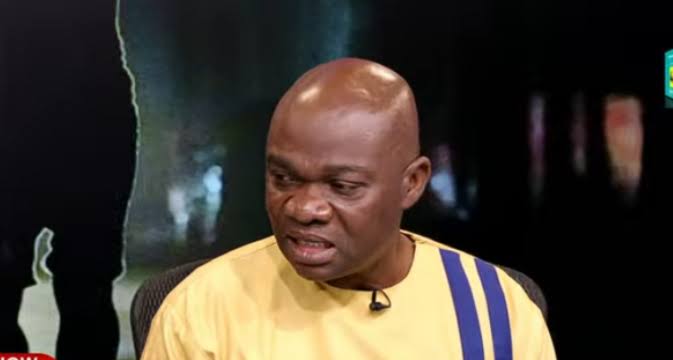

Political analyst Dr Bernard Tutu-Boahene has urged Chief Justice Paul Baffoe-Bonnie to retract and apologise for his recent comments on state-owned enterprises if he accepts that he was wrong to make them, adding that doing so would earn him greater respect rather than diminish his standing.
Speaking on Adom TV’s ‘Nnawotwe Yi’, Dr Tutu-Boahene said the Chief Justice should look at the rules governing his position and, if he realises he has faulted, he should apologise.
“If he looks at the rules governing his position and realises he has erred, nothing stops him from coming out to retract his comments and apologise. That would even earn him greater respect,” he said.
His comments follow controversy sparked by remarks Justice Baffoe-Bonnie made during visits to the Minerals Income Investment Fund (MIIF) and the Social Security and National Insurance Trust (SSNIT) on 2 September, where he praised the performance of both institutions and questioned what Ghana had been doing “in the past eight years.”
Dr Tutu-Boahene said chief justices, judicial services and lawyers worldwide are bound by the Bangalore Principles, which centre on impartiality and propriety, and argued the Chief Justice should have kept such observations to himself.
He said the Chief Justice was entitled to share his views as a Ghanaian citizen, but questioned whether doing so was wise given his office.
“What the Chief Justice said isn’t wrong because he’s a Ghanaian and is allowed to share his thoughts. But as the Bible says, ‘Everything is permissible, but not everything is beneficial,'” he said.
Dr Tutu-Boahene also argued that the comments undermine the very standard the Chief Justice is meant to enforce.
“The Bangalore Principles are what the Chief Justice uses to hold other judges and lawyers to account. Imagine if someone committed an offence abroad and the Chief Justice was asked to pass judgement on the situation, I don’t think he would have the moral standing to do that,” he said.
Measured against the principles guiding his office, he said, the Chief Justice’s integrity and credibility are now in question.
He argued that the Judicial Service’s response to the controversy had made matters worse rather than better.
The Service had said the Chief Justice’s remarks were made “in good faith” and not intended to undermine judicial independence. But Dr Tutu-Boahene said this came across as defensive.
“The response from the Judicial Service also didn’t help. It came across more as defensive. They should rather have told Ghanaians that no matter what has happened, they will work with fairness, truth and the law. That would have been better than defending what the Chief Justice said,” he said.
Wider concerns over political neutrality
Dr Tutu-Boahene linked the episode to a broader erosion of political neutrality among public office holders in Ghana.
He noted that Article 276 of the 1992 Constitution bars chiefs from partisan politics, yet this is routinely defied without consequence. He said public servants who are also barred from active politics face similar disregard for the rules.
He said Ghanaians now think they know democracy too well and understand human rights laws, adding that “people are just doing as they please.”
He, however, warned that failure to protect political neutrality could expose the country’s democracy, politics and national security to danger.
Dr Tutu-Boahene appealed to heads of public institutions to abide by the rules guiding their offices.
“Once you are appointed head of an institution, there are some things you can only say in private, not in public,” he said.