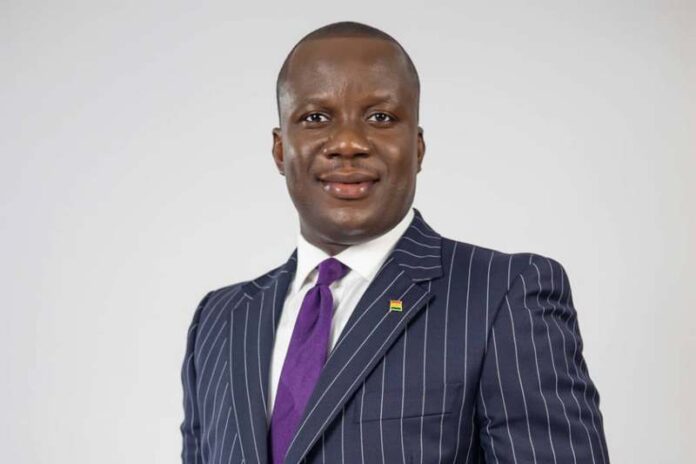

Ranking Member of Parliament’s Foreign Affairs Committee, Samuel Abu Jinapor, has cautioned the government to carefully assess the potential risks and benefits of Ghana’s decision to join BRICS, warning that the move could have implications for the country’s national interests.
The Damongo MP said while membership of the emerging economic bloc could provide Ghana with new opportunities, including access to funding and diversified international partnerships, the country must not assume that the benefits would come without consequences.
His comments come after Foreign Affairs Minister Samuel Okudzeto Ablakwa announced that Cabinet had approved Ghana’s decision to formally apply to join BRICS, as part of efforts to diversify the country’s international partnerships and deepen South-South cooperation.
Speaking on Joy FM’s Super Morning Show, Mr Jinapor said Ghana’s foreign policy must first and foremost serve the country’s national interest.
“All foreign policy must be near to national interests. So there’s absolutely no benefit in a foreign policy move if it does not inure to the national interest of a particular country.”
He acknowledged that joining BRICS could offer Ghana important benefits, particularly by expanding its partnerships beyond traditional allies.
However, he insisted that the possible implications of the decision must be thoroughly examined. “There’s absolutely no free lunch,” he said.
‘What is the implication?’
Mr Jinapor said the government’s argument that BRICS membership could open up new sources of funding, particularly through the New Development Bank (NDB), required further scrutiny.
He questioned whether Ghana would actually gain significant financial independence if access to such funding came with conditions involving existing international institutions.
“We are told that we may be in a position to source some new funding from the New Development Bank of BRICS,” he said.
“But we are also told that even to access funding from that bank, there’s a condition precedent that the IMF has to give authorisation. So if that is the case, what is the implication?”
The former Lands and Natural Resources Minister said Parliament must also examine the possible impact of increased economic and political influence from major BRICS countries such as China and Russia.
He said questions surrounding the extent of Chinese influence on Ghana’s economy and national life, as well as the implications of closer relations with Russia, should form part of the assessment.
Ethiopia’s experience
Mr Jinapor further urged the government to study the experiences of countries that have already joined BRICS before Ghana proceeds with its application.
He cited Ethiopia as an example, saying its experience had produced both benefits and challenges. According to him, Ethiopia had benefited from assistance and funding opportunities through the New Development Bank but had also faced concerns over its trade imbalance and increased imports from BRICS countries, particularly China.
“We need to take a look at what has been the experience of some of those countries which have joined,” he said.
He argued that Ghana could learn valuable lessons by examining how membership has affected the economies and international relationships of the countries that have already joined the bloc.
BRICS currently has 11 full members, including Brazil, Russia, India, China, South Africa, Egypt, Ethiopia, Iran, Indonesia, Saudi Arabia and the United Arab Emirates.
South Africa relationship
Mr Jinapor also questioned how Ghana’s existing relationship with South Africa could affect its participation in the bloc.
South Africa is one of the founding members of BRICS, but the MP said Ghana’s bilateral relationship with the country was currently poor.
“Our bilateral relationship with South Africa is almost at the bottom’s end,” he said. He therefore argued that the government must consider what the current state of Ghana-South Africa relations could mean for Ghana’s participation in a grouping in which Pretoria remains an important player.
‘We need a lot more reflection’
Mr Jinapor said Parliament’s Foreign Affairs Committee had only received a general briefing from the Foreign Affairs Minister on the government’s intention to pursue BRICS membership and had yet to fully interrogate the decision.
“We need a lot more reflection on this particular move,” he said.
He acknowledged the government’s stated objective of diversifying Ghana’s international partnerships and strengthening cooperation with developing countries.
However, he stressed that Ghana’s long-standing policy of non-alignment must also be considered. “It is all good to diversify our partnerships, but without doubt, this will come with some implications as well, some of which may be adverse to our national interest as a country,” Mr Jinapor said.
The government says the BRICS bid is intended to give Ghana greater options for development financing, trade, investment and industrialisation while complementing, rather than replacing, its existing relationships with traditional development partners.
READ ALSO:
GRA sets up committee to probe alleged missing containers at Tema Port