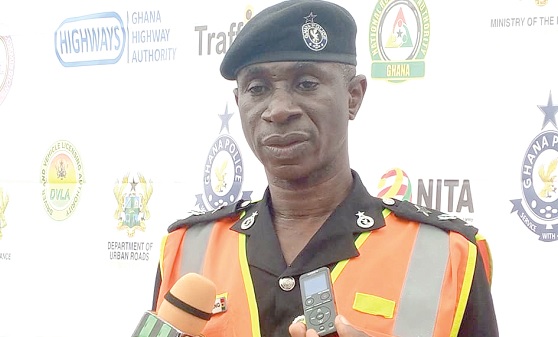

The Motor Traffic and Transport Department (MTTD) of the Ghana Police Service has acknowledged concerns over alleged bribery and extortion involving some traffic police officers.
Director of Education, Research and Training at the MTTD, ACP Alexander Kwaku Obeng, said the Police Service was undertaking a series of reforms to improve professionalism and reduce opportunities for officers to solicit money from motorists.
According to him, the reforms are focused on strengthening training, improving the conduct of officers and deploying technology to limit direct interactions between motorists and traffic police.
Speaking in an interview on Accra-based Citi FM, ACP Obeng admitted that some officers engage in inappropriate conduct while carrying out traffic enforcement duties, including allegedly demanding money from motorists.
He described such behaviour as unacceptable and said it did not reflect the standards the MTTD was working to establish.
“We don’t accept that sort of behaviour and the conduct of our police officers in white,” he said.
ACP Obeng explained that the MTTD was restructuring its operations to place greater emphasis on professionalism and the use of technology in traffic enforcement.
He said the transition to automated enforcement would be particularly important in reducing situations where motorists and police officers have to negotiate over alleged traffic offences.
Under the new approach, he explained, certain offences, including speeding, would be captured electronically, with the evidence transmitted to a back office for verification before an electronic notice of violation is issued.
The system, he said, would help eliminate situations where motorists could be threatened with arrest or court action and subsequently pressured to pay money to avoid enforcement action.
“Many of the behaviours or the infractions that lead to crashes that normally also [require] enforcement are the very ones that are on the knife’s edge,” he said.
ACP Obeng said the Police Service was also developing additional electronic devices that would allow officers on patrol to document traffic violations as they occur.
He said the technology would complement the work of camera teams and improve the ability of officers to enforce traffic regulations transparently.
“Gradually we are going to train a lot of our police officers, issue them with equipment so that as the camera teams are working, they will also be on their beat delivering traffic control service.”
ACP Obeng said the Ghana Police Service had existing disciplinary procedures for officers who violate professional standards.
He disclosed that several officers had already faced sanctions, with some interdicted while others had been dismissed or subjected to rank reductions following disciplinary proceedings.
“Many are sanctioned, many are on interdiction, many cases have been adjudicated, some are being dismissed, some ranks have also been reduced, among others,” he said.
He added that some officers accused of misconduct were also facing criminal proceedings before the courts.
According to ACP Obeng, the disciplinary measures form part of broader efforts to restore public confidence in traffic policing and ensure that officers adhere to the highest professional standards.
He acknowledged that the conduct of some traffic officers had contributed to negative perceptions of the Police Service, stressing the need for reforms to address such concerns.
ACP Obeng said the MTTD was therefore seeking to recruit and equip officers who could deliver traffic enforcement with professionalism, integrity and a strong sense of public service.
He said the department was looking for “very smart, public-spirited, well-trained police officers” who would be capable of supporting the new approach to traffic enforcement.
The reforms, he noted, are expected to make traffic policing more transparent, reduce opportunities for corruption and strengthen public trust in the work of the MTTD.
Also read: