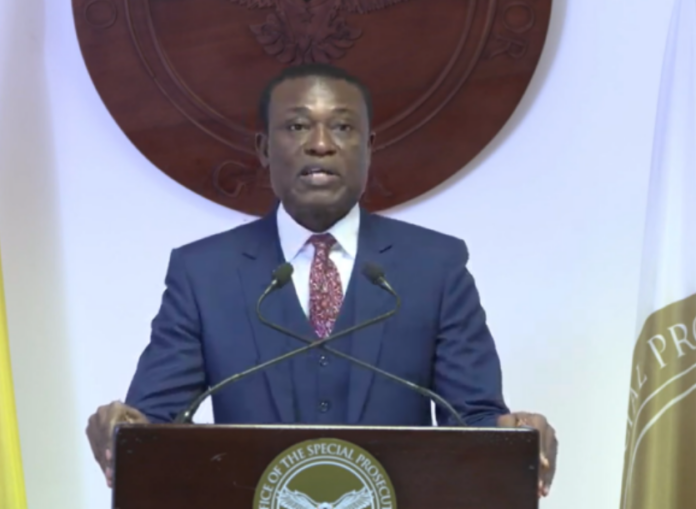

Special Prosecutor Kissi Agyebeng says an April 15, 2026 High Court ruling declaring parts of the Office of the Special Prosecutor (OSP) Act unconstitutional brought the institution’s investigative and prosecutorial work to a near standstill.
According to Mr Agyebeng, the ruling, which limited the OSP’s prosecutorial powers, created significant uncertainty for the office and affected ongoing cases across the country.
Speaking at a press conference, the Special Prosecutor said the High Court’s decision resulted in the invalidation of prosecutions undertaken by the OSP, as well as convictions and assets secured through its work.
He said the court also directed that all OSP cases be handed over to the Attorney General.
Mr Agyebeng said the development was particularly concerning because a related case challenging the constitutionality of the OSP’s prosecutorial mandate was already pending before the Supreme Court.
“This development brought the investigative and prosecutorial work of the OSP nationwide to a standstill and uncertainty,” he said.
He explained that most courts subsequently adjourned cases involving the OSP while awaiting the Supreme Court’s determination, with only one court continuing proceedings.
“Therefore, prosecutions stalled, investigations were gravely hampered, and corrupt actors became emboldened in their opprobrious conduct,” he stated.
The Special Prosecutor said the disruption had come at a significant cost to the country and urged stakeholders to consider the consequences of the uncertainty surrounding the OSP’s prosecutorial mandate.
Mr Agyebeng also disclosed that the OSP had sought to join a Supreme Court case filed by Noah Ephraim Tetteh Adamatey against the Attorney General, which challenged provisions of the OSP Act.
He said the application was prompted by intelligence received by the OSP suggesting that the Attorney General might not actively defend the case.
The OSP applied to join the case on January 27, 2026, but the Supreme Court dismissed the application.
Mr Agyebeng acknowledged that intelligence available to the OSP could not be treated as evidence before the court.
“We admit that our intelligence is not evidence, and so the Supreme Court dismissed our application for joinder,” he said.
He said the Supreme Court held that the state, represented by the Attorney General, was the proper defendant and that the OSP was not a necessary party to the proceedings.
The Supreme Court subsequently delivered its ruling on July 29, 2026, on the constitutionality of the OSP’s prosecutorial mandate.
Mr Agyebeng maintained that the OSP’s attempt to join the case demonstrated that the institution had taken proactive steps to protect its statutory mandate rather than simply waiting for the outcome.
“History may be kind to us for trying to join the suit and not merely sitting back,” he said.
He further rejected claims that the OSP had been ineffective, pointing to recoveries made for the state as evidence of its impact.
Among the examples, he cited a shake-up in the government payroll which, according to him, resulted in the recovery of GH¢100 million for the state.
READ ALSO:
OSP announces “rebirth” amid calls for its abolition – Kissi Agyebeng
Kissi Agyebeng alleges coordinated efforts to weaken or abolish OSP