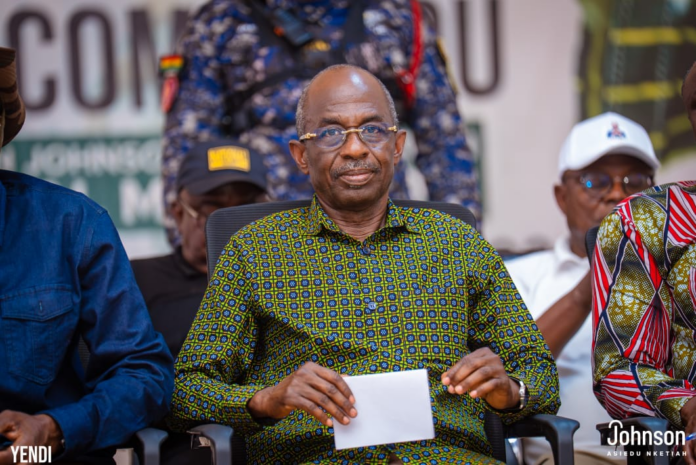

National Chairman of the National Democratic Congress (NDC), Johnson Asiedu Nketiah, has called for reforms within political parties and the judiciary to strengthen democratic governance and rebuild public trust across Africa.
He said political parties and the judiciary have critical roles to play in protecting democracy but cautioned that neither institution could effectively perform that role without credibility, accountability, competence and public trust.
Mr. Asiedu Nketiah made the remarks on Tuesday, August 11, 2026, at the 2026 Goodluck Jonathan Foundation Democracy Dialogue in Bauchi, Nigeria, on the theme: “Beyond Elections: Can Political Parties and the Judiciary Save African Democracy?”
Speaking on the panel on political parties and the judiciary, he argued that democracy should not be judged solely by the conduct of elections but also by how political authority is exercised between elections.
“Elections determine who receives the authority to govern. They do not, by themselves, determine whether that authority will be exercised lawfully, whether constitutional limits will be respected, whether the opposition will remain legitimate or whether government will improve the lives of the people,” he said.
Mr. Asiedu Nketiah cited Ghana’s democratic experience under the Fourth Republic as an example of democratic institutionalisation, noting that the country has conducted nine consecutive general elections since 1992.
He highlighted the peaceful transfers of power recorded in 2000, 2008, 2016 and 2024 as evidence that governing parties in Africa can lose power and transfer authority peacefully through elections.
He particularly referenced the 2008 presidential election, which was decided by less than half a percentage point, saying political leaders, institutions and citizens prevented the closely contested election from becoming a national crisis.
He also cited former President John Dramani Mahama’s concession after the 2016 election and Vice-President Mahamudu Bawumia’s concession ahead of the formal declaration of the 2024 election results.
According to him, such concessions should be viewed as important contributions to constitutional democracy rather than mere political courtesies.
However, Mr. Asiedu Nketiah warned against complacency, pointing to election-related violence during the 2020 elections as a reminder that democratic gains could be reversed.
The NDC National Chairman called for major reforms within political parties, insisting that they should not operate merely as electoral machines or vehicles for individual political ambitions.
He said parties must strengthen internal democracy, tolerate legitimate dissent and create opportunities for women, young people, persons with disabilities and people without significant financial resources to participate meaningfully in politics.
Mr. Asiedu Nketiah also identified the rising cost of political campaigns as a threat to internal party democracy.
He argued that when political participation becomes heavily dependent on wealth, political parties risk selecting candidates based on their financial capacity rather than competence.
He therefore called for measures to reduce financial barriers to political participation and strengthen party institutions responsible for policy development, research, civic education and leadership training.
On women’s participation, he noted that women currently occupy 40 of Ghana’s 276 parliamentary seats, representing 14.5 per cent.
He also called for practical pathways to increase youth participation in policy development, party leadership, Parliament and executive responsibilities.
Mr. Asiedu Nketiah also stressed the importance of an independent and credible judiciary in resolving political disputes and protecting constitutional democracy.
He referenced Ghana’s presidential election petitions following the 2012 and 2020 elections as examples of how political disagreements can be transferred from the streets to the courts.
He said respect for judicial decisions does not prevent political actors from criticising judicial reasoning, noting that legitimate criticism is part of constitutional democracy, while intimidation and threats are unacceptable.
However, he said judicial independence must be accompanied by transparency, consistency, ethical standards and public accountability.
Citing public perceptions of Ghana’s judiciary, he said concerns about access to justice, affordability and delays could undermine confidence in the institution.
“Judicial authority cannot depend only on constitutional text; it must also rest on citizens’ confidence that justice is accessible, impartial and timely,” he said.
He urged African judiciaries to remain strong enough to restrain governments, protect opposition parties, defend fundamental rights and enforce constitutional limits.
At the same time, he cautioned that courts should not become “alternative political chambers” or replace decisions that constitutionally belong to elected institutions and citizens.
Mr. Asiedu Nketiah proposed enforceable standards for political parties covering internal democracy, campaign financing, audited accounts, candidate selection and leadership succession.
He also called for transparent criteria for judicial appointments and promotions, timely publication of constitutional judgments, stronger legal aid and improved public access to information on court performance.
He urged political parties, courts, electoral bodies, civil society organisations, the media and academia to engage in dialogue before political crises emerge.
In his closing remarks, Mr. Asiedu Nketiah said African democracy would not be secured merely by holding more elections.
“The future of African democracy will not be secured merely by conducting more elections. It will be secured by institutions that make elections meaningful, government accountable, constitutional limits effective and peaceful transfers of power normal,” he said.
He stressed that political parties must recognise that political power is temporary and belongs ultimately to the people, while the judiciary must protect its independence through integrity and public confidence.
According to him, when political parties respect constitutional limits, courts administer justice fairly, governments deliver development and citizens remain engaged beyond elections, democracy can evolve into a durable system of public trust, peaceful competition and accountable governance.
Read the full speech below:
READ ALSO:
Prof Bokpin warns against political recruitment into civil service
I’ll miss Mahama Ayariga’s candid, easygoing nature – Afenyo-Markin