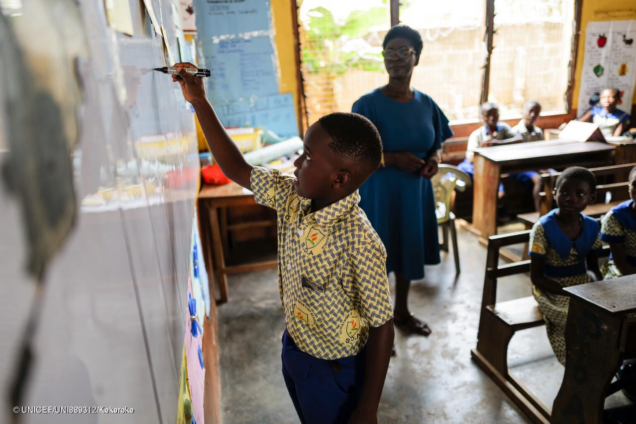

Government has launched a new report revealing significant inequalities in the deployment of teachers across public basic schools, warning that staffing gaps are undermining learning outcomes despite the country’s near-universal school enrolment.
The Teachers for All (T4A) Ghana Report, launched by the Ministry of Education with support from UNICEF, the UK Foreign, Commonwealth and Development Office (FCDO), and other partners, provides fresh evidence on teacher distribution and proposes reforms to improve nationwide deployment.
According to the report, Ghana has made substantial progress in expanding access to education, with gross enrolment rates reaching 99.6% at the primary level and 98.4% at the junior high school level during the 2022/23 academic year.
However, learning outcomes remain a major concern. Results from the 2024 National Standardised Test showed that 45.27% of learners performed below the basic proficiency level in Mathematics, while 50.33% fell below basic proficiency in English.
The report identifies unequal teacher deployment as a key factor affecting classroom learning across the country.
Rural schools hardest hit
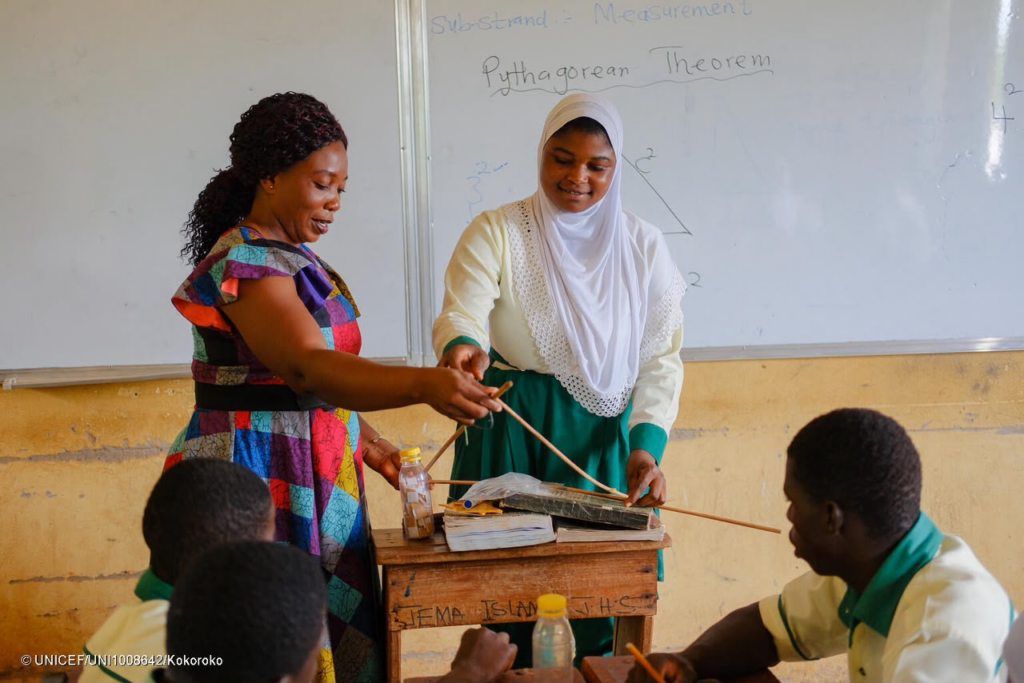
The study found that about 20% of districts are experiencing severe teacher shortages, with average primary school pupil-teacher ratios exceeding the Ministry of Education’s target of 35 pupils to one teacher.
The shortages are most acute in rural communities, where schools also struggle to attract and retain female teachers.
The report highlights particularly high pupil-teacher ratios in the northern parts of the country, including North-East Region (48:1), Savannah Region (41:1), and Northern Region (39:1).
It warns that unequal teacher distribution contributes to overcrowded classrooms, negatively affecting literacy and numeracy outcomes.
The study also notes that women teachers face additional challenges when posted to rural communities, including concerns over safety and security, transportation difficulties, and inadequate hygiene and sanitation facilities.
Recommendations
To address these disparities, the report recommends strengthening evidence-based teacher deployment by using detailed data to identify districts and schools with the greatest staffing needs.
It also calls for improved incentives to attract and retain teachers in underserved and difficult-to-staff communities.
In addition, the report urges government to promote a more equitable teaching workforce by providing targeted support for women teachers through incentives, family-friendly policies, leadership opportunities and stronger measures to eliminate discrimination and gender-based violence.
Why it matters
According to the report, teacher deployment goes beyond filling vacancies. It directly influences the quality of education children receive every day.
It argues that better deployment can reduce class sizes, improve foundational learning and strengthen girls’ education by ensuring more female teachers serve in communities where they are needed most.
The report also stresses that improving teacher deployment is critical to ensuring value for money, noting that approximately 84% of the Ministry of Education’s 2026 budget has been allocated to teacher compensation. Proper deployment, it says, will help maximise the impact of that investment.
Adom Brands formally petitions GAF over assault on reporter in Nkwanta…
It’s impossible for Dennis Miracles Aboagye to meet GH¢50m bail –..