
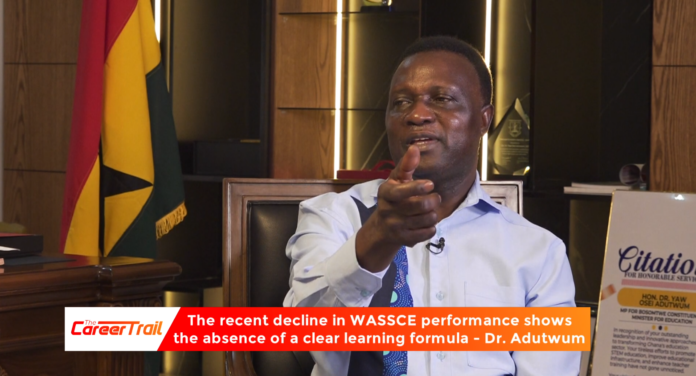

Former Education Minister, Yaw Osei Adutwum, has attributed the drop in the 2025 West African Senior School Certificate Examination (WASSCE) results to what he describes as the absence of a clear and structured education formula guiding the system.
In an interview on The Career Trail Season 4, aired on Joy Learning TV, the Member of Parliament for Bosomtwe Constituency argued that sustained improvement in education depends on a deliberate method backed by data, consistent execution, and continuous academic support.
“I believe that for you to succeed in everything, whether as a businessman or in public service, you need a formula. When you apply the formula, you may not get 100 per cent, but you will get 80 or 90 per cent. Things go wrong when there is no formula,” he noted.
Dr Adutwum explained that during his tenure, reforms were driven by structured data analysis from the West African Examinations Council (WAEC) to identify learning gaps.
He revealed that WAEC reports were reviewed annually to determine areas where students consistently struggled, particularly in mathematics and science.
“We would analyse the results at the end of the year using WAEC data. Their reports would show the difficult areas, and we could see where students were weak,” he indicated.
According to him, this information was used not only to diagnose problems but also to train teachers through targeted interventions involving examiners and subject specialists.
“Once we identified the gaps, we brought in examiners to train teachers so that when similar questions came again, students would be better prepared,” he explained.
He further revealed that additional instructional time played a key role in improving performance, including structured extra classes beyond normal school hours.
“We used to pay teachers to run extra classes to prepare students better. That additional time made a difference in strengthening understanding,” he disclosed.
Dr Adutwum added that reforms were also guided by regional performance tracking to ensure interventions were targeted and effective.
He noted that education data was broken down by region and subject to identify underperforming areas and address them directly.
“This helped us see, for example, that one region may be struggling in chemistry while another is weak in biology, and we could intervene specifically,” he said.
He further explained that in some cases, teacher deployment challenges were identified and corrected when subject mismatches were discovered.
“In some schools, the person teaching mathematics was not even a mathematics major. Once that was corrected, performance improved,” he stated.
According to him, these coordinated interventions contributed to significant improvements in pass rates in core subjects over time.
However, Dr Adutwum expressed concern that the gains achieved were being weakened due to disruptions in policy continuity and the discontinuation of some support systems.
ALSO READ:
