
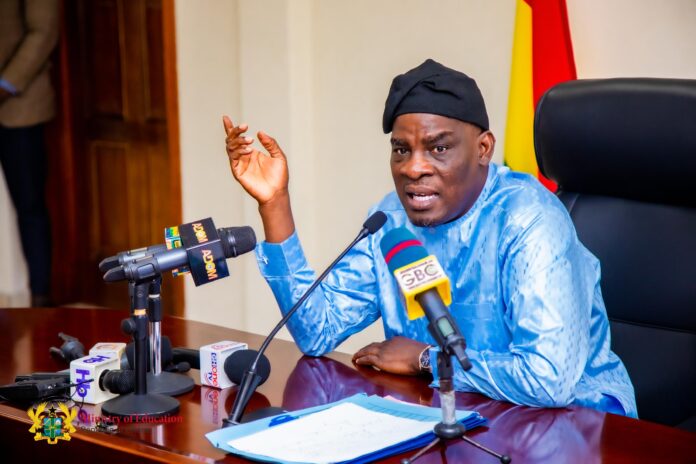

Education Minister Haruna Iddrisu has clarified that the ongoing constitutional review process will not produce a white paper, dismissing what he described as widespread public misunderstanding about the exercise.
Speaking to journalists after a Thanksgiving Service marking President John Dramani Mahama’s first year in office, the Minister explained that the current review, supervised by Professor H. Kwasi Prempeh, is distinct from the process initiated under Article 278 during the administration of the late President J.E.A. Mills.
“Many people, including sections of the media, are still unclear about the constitutional review process. The review under the Prempeh Committee is not the same as one established under Article 278 of the Constitution,” he said, noting that the two processes are often conflated.
Mr. Iddrisu explained that the committee’s report, presented to President Mahama in December, is currently being examined by a team of legal experts to ensure its proposals comply with the Constitution and can withstand legal scrutiny.
Following this legal review, the document will undergo broad consultations involving Cabinet, political parties, and citizens nationwide. President Mahama also plans to establish an implementation committee to steer reforms through entrenched and non-entrenched constitutional provisions.
The eight-member committee, inaugurated in January last year, is chaired by Professor H. Kwasi Prempeh and includes former Supreme Court Justice Sophia Adinyira, Professor Kwame Karikari, former Electoral Commission Chair Charlotte Osei, Dr. Godwin Djokoto, Ibrahim Tanko Amidu, Dr. Esi Ansah, and Dr. Rainer Akumperigeya.
Minister Iddrisu emphasized that expectations of a white paper are misplaced due to the legal basis of the current review. He added that 2026 will be pivotal for governance reforms, with the constitutional review expected to support institutional strengthening alongside efforts to stabilize the economy and advance national development.
ALSO READ:
