
Ghana’s food security could face serious challenges as widespread soil acidity, coupled with low organic matter and carbon content, continues to undermine agricultural productivity, the Council for Scientific and Industrial Research – Soil Research Institute (CSIR-SRI) has warned.
Director of the CSIR-SRI, Dr Collins Tay, said the deteriorating condition of Ghana’s soils was making sustainable agricultural production increasingly difficult.
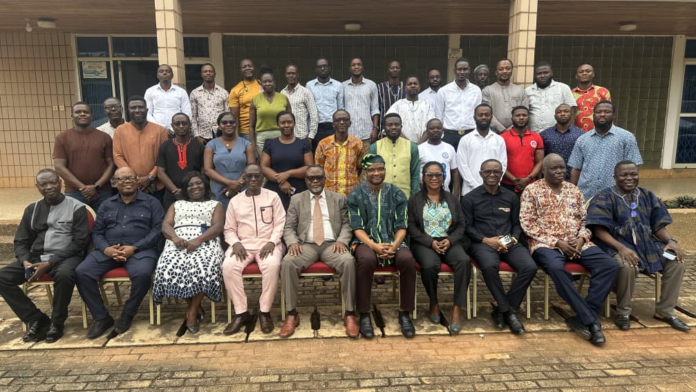
Speaking at the 2026 In-House Review and Research Planning Session (IRREP) of the CSIR-SRI at Kwadaso, Dr Tay said the Institute was concerned about the growing challenges confronting the country’s soil resources.
“Acidic soils are widespread across the country, hampering agricultural activities. There is also low organic matter, low carbon content, among other challenges, so it has been a very difficult situation for us as a research institute to ensure the sustainable management of our soil resources for improved agricultural productivity,” he said.
Fertiliser use
Speaking to JoyNews on the sidelines of the event, Dr Tay also raised concerns about the suitability of some fertilisers imported into Ghana, saying they may not adequately address the country’s diverse soil conditions.
He warned that applying fertilisers without proper soil testing and nutrient assessment could worsen existing soil imbalances.
“Applying fertilizers without proper soil testing and nutrient assessment can lead to imbalances, where soils already rich in certain nutrients receive additional unnecessary inputs,” he stated.
Dr Tay therefore called for stronger collaboration between government, policymakers, soil scientists and other agricultural stakeholders to ensure that fertiliser importation and application are guided by scientific evidence and local soil data.
He said Ghana should consider developing fertiliser formulations specifically suited to the country’s soil conditions.
“As an Institute, what we can do is advise government on the implications of continually depending on external sources for our fertilizer needs when discussing agricultural productivity in Ghana. We must make a conscious effort to develop fertilizer formulations specifically tailored to our soils,” he said.
Funding concerns
Dr Tay also expressed concern over inadequate funding for agricultural research, revealing that although government pays researchers’ salaries, direct funding for research activities remains limited.
He said the situation has left donor agencies as the major source of funding for scientific work at the Institute.
According to him, the CSIR-SRI provides critical services including soil fertility information, land suitability assessments and agricultural mapping to support food production and environmental management.
However, inadequate domestic investment, he noted, limits the Institute’s ability to conduct the field trials and research needed to improve agricultural productivity.
“The Council for Scientific and Industrial Research – Soil Research Institute (CSIR-SRI) is tasked with ensuring agricultural productivity, and all we need is government support or partnership to enable us to go to the field to conduct trials on the fertilizers,” he said.
Dr Tay cautioned that continued underinvestment in agricultural research, combined with limited use of scientific expertise in fertiliser policy, could undermine innovation, reduce crop yields and threaten Ghana’s long-term food security.
He called for a coordinated, science-led approach to soil and fertiliser management, alongside sustained government support for agricultural research institutions.
The two-day IRREP, chaired by KNUST soil scientist Professor Vincent Logah, serves as an annual platform for reviewing research achievements, sharing knowledge and setting priorities for the Institute.
Prof Logah urged scientists to prioritise mentorship and collaboration to promote innovation.
The Vice Dean of the Department of Crop and Soil Sciences at KNUST also called for increased investment in equipment and research resources to enable students, scientists and other stakeholders to maintain healthy and productive soils.