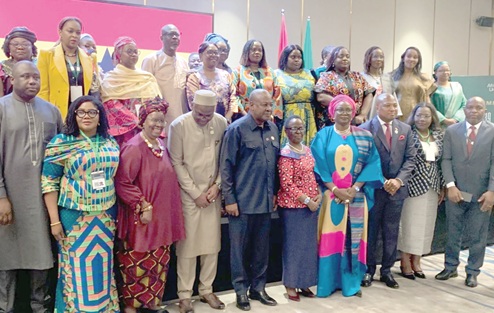

Ghana has had a good year for women’s rights on paper. On 30 July 2026, Parliament ratified the African Union (AU) Convention on Ending Violence Against Women and Girls (CEVAWG), making Ghana only the second AU member state, after The Gambia, to do so.
It’s the continent’s first legally binding treaty dedicated exclusively to ending violence against women and girls, obligating states to criminalise gender-based violence (GBV), fund victim support, and collect the kind of evidence needed to actually address the problem rather than guess at it.
That ratification lands exactly two years after another major gender-rights milestone for Ghana: The Affirmative Action (Gender Equity) Act 2024, passed by Parliament on 30 July 2024 and signed into law that September.
After more than a decade stuck in committee, the act now mandates 30% female representation in public decision-making roles and political-party structures by 2026, rising to 35% by 2028 and 50% by 2030 – a serious jump from the 14.5% of parliamentary seats women currently hold.
Two landmark laws. Same July anniversary, two years apart. That’s a genuinely notable run for a country’s gender-rights agenda.
The public was already there
Here’s what’s easy to miss in the celebration: Ghanaians didn’t need convincing.
Afrobarometer’s Round 9 survey, conducted in April 2022 – two years before either law passed – found that more than eight in 10 Ghanaians (85%) already believed that it is “never” justified for a man to use physical force to discipline his wife.
Nearly two-thirds (64%) already said that domestic violence should be handled as a criminal matter, not a private family affair.
The public consensus that the AUCEVAWG enshrines in continental law, and that lawmakers debated for a decade before passing the Affirmative Action Act, was sitting in the data well before either bill reached a vote.
That’s not a knock on the legislative process – laws take time, coalitions take longer, and both of these took sustained pressure from advocates like the Affirmative Action Coalition and ABANTU for Development to finally cross the line.
But it’s a reminder that Ghana’s gender-rights legislation has largely been catching up to public opinion, not leading it.
The gaps that laws alone won’t close
If citizens were already this convinced, where does the resistance to change actually live? The same survey suggests it’s not in what people believe – it’s in what they’re willing to risk to act on it.
Despite Ghanaians’ overwhelming condemnation of violence, more than four in 10 respondents in the same survey said it is “somewhat” (24%) or “very” (18%) likely that a woman would be criticised, harassed, or shamed for reporting GBV to the authorities.
Only about a third (35%) considered such a backlash unlikely. And this view persisted even though most Ghanaians (86%) already trusted the police to take GBV cases seriously.
Read that again: It’s not that people doubt that the system will respond. It’s that they doubt that their community will forgive them for using it.
That’s precisely the gap no ratification ceremony can close on its own. The AUCEVAWG’s emphasis on shifting social norms – engaging families, communities, and “positive masculinity” alongside legal reform – exists because its drafters understood the same thing Ghana’s own data show: Criminalising violence and building institutional trust are necessary, but they don’t automatically make it safe to speak up.
Two laws, one shared next step
Ratifying the AUCEVAWG and passing the Affirmative Action Act are genuine wins, and they deserve to be treated as such. But both now face the same test: domestication.
The convention needs Ghana to deposit its ratification instruments and translate continental obligations into enforceable national law.
The Affirmative Action Act needs the tools it mandates – quotas, budgeting, enforcement mechanisms – to actually show up inside ministries, political parties, and boardrooms between now and 2030.
Neither of these next steps will generate headlines the way a ratification vote does. Both will matter just as much.
By Maame Akua Amoah Twum
Maame Akua Amoah Twum is Afrobarometer’s communications manager.
Email: maameakua@afrobarometer.org. LinkedIn: Maame Akua Amoah Twum