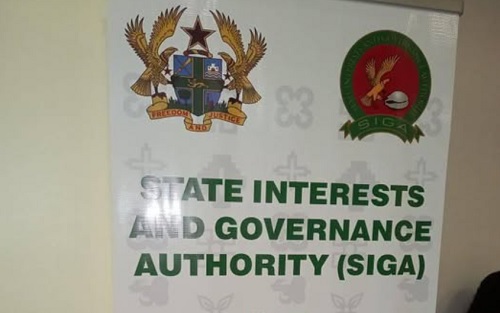

The State Interests and Governance Authority (SIGA) has reported a significant turnaround in the financial performance of Ghana’s state-owned enterprises, with the sector recording a net profit of GH¢19.80 billion in 2025.
The figure represents a major improvement from the GH¢2.25 billion net loss recorded in 2024, marking the end of a four-year cycle of consolidated net losses among State-Owned Enterprises (SOEs).
The development is contained in SIGA’s 2025 State Ownership Report, released on Sunday, August 30, 2026. The report is the tenth edition of Ghana’s flagship assessment of the performance of Specified Entities and the fifth published by SIGA since its establishment in 2019.
The report covers 162 out of 175 approved Specified Entities, comprising 53 SOEs, 36 Joint Venture Companies (JVCs) and 73 Other State Entities (OSEs).
According to the report, total SOE revenue increased by 28.12 percent from GH¢137.64 billion in 2024 to GH¢176.43 billion in 2025.
The growth was driven largely by the agricultural, manufacturing and infrastructure subsectors, which recorded revenue increases of 203.71 percent, 114.74 percent and 92.24 percent respectively.
Profit before interest and tax also rose to GH¢25.49 billion, continuing the sector’s recovery from a GH¢502 million loss in 2023 and a GH¢5.80 billion profit in 2024.
The report also attributed part of the improved performance to a stronger cedi, with SOEs recording net foreign exchange earnings of GH¢11.72 billion, compared with a GH¢12.01 billion foreign exchange loss in 2024.
Finance costs fell by 42.49 percent during the year.
However, SIGA cautioned that significant challenges remain within the state-owned sector.
Five SOEs which are the Electricity Company of Ghana (ECG), Ghana Cylinder Manufacturing Company Limited, GNPA Limited, Graphic Communications Group Company and Ghana Digital Centre, recorded losses in every year from 2021 to 2025.
Six entities, including AirtelTigo Ghana Limited, GIHOC Distilleries and Tema Oil Refinery, also maintained negative equity throughout the five-year period.
Dividend payments to government declined, with only Ghana Reinsurance Company Limited and TDC Company Limited paying a combined GH¢16 million in dividends.
The Joint Venture Companies also recorded improved performance, with net profit rising by 36.55 percent to GH¢3.14 billion, while total assets increased by 25.99 percent to GH¢96.69 billion.
Minority-interest JVCs contributed GH¢1.19 billion, representing 97.12 percent of total dividends received by government from the portfolio.
The performance of Other State Entities was less favourable, with their net deficit widening from GH¢2.18 billion in 2024 to GH¢10.48 billion in 2025.
SIGA said their total liabilities increased by 41.83 percent to GH¢323.17 billion, while accumulated funds swung from a positive GH¢15.47 billion to a negative GH¢41.14 billion.
The report identified the Bank of Ghana’s negative equity position of GH¢93 billion as a major factor behind the deterioration.
SIGA Director-General, Prof. Michael Kpessa-Whyte, described the 2025 report as significant because it captures the first year of performance under President John Dramani Mahama’s second administration.
He said the report would support discussions on improving the performance of state-owned entities and ensuring they contribute more effectively to economic growth and development.
The report also noted an improved macroeconomic environment in 2025, with real GDP growth reaching six percent, while the Monetary Policy Rate declined from 27 percent to 18 percent.
The average lending rate also fell from 30.25 percent to 20.4 percent by December 2025.
Meanwhile, employment across Specified Entities increased by 5.45 percent to 98,724 workers, representing an additional 5,104 jobs.
Women accounted for 30.02 percent of the workforce, up from 29.30 percent in 2024.
SIGA said the 2025 results represented an important recovery but stressed that state-owned entities must now focus on achieving sustainable value creation through stronger accountability, disciplined capital allocation and performance-driven governance.
“The gains of FY2025 must not become a temporary rebound,” the report stated, calling for the recovery to become the foundation for a more efficient, competitive, inclusive and sustainable state-owned sector.
Read the report below: