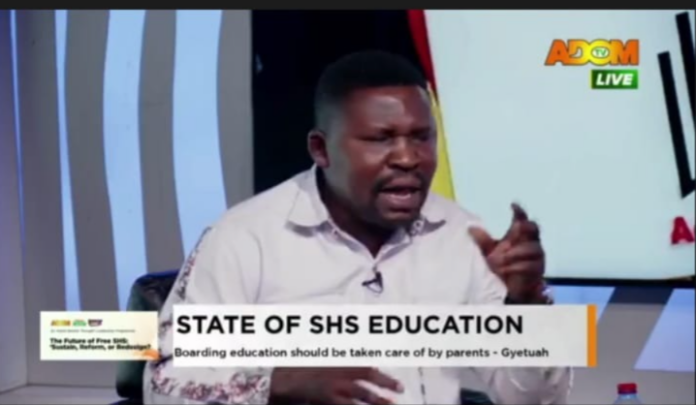

Executive Director of the Ghana National Council of Private Schools (GNACOPS), Obenfo Nana Kwasi Gyetuah has called for boarding education under the Free Senior High School (Free SHS) programme to become fully fee-paying, arguing that the current arrangement unfairly benefits a section of students at the expense of taxpayers.
Speaking on the Adom Brands Thought Leadership Programme on the theme, “The Future of Free SHS: Sustain, Reform or Redesign?”, Mr. Gyetuah said government should maintain free day secondary education while parents who choose boarding facilities bear the full cost of accommodation and feeding.
According to him, it is inequitable for some students to receive additional benefits, including free boarding and meals, while all Ghanaians contribute to funding the programme through taxes.
“It is unfair to have some students benefit more from the taxes we all pay simply because they are in boarding houses, where they receive free accommodation and meals, while day students do not enjoy the same level of support,” he stated.
Mr. Gyetuah argued that making boarding education fee-paying would significantly reduce the financial burden on the state and make the Free SHS policy more sustainable.
He also pointed to Côte d’Ivoire as an example of a country that operates its secondary education system without a widespread boarding school model, suggesting Ghana could adopt a similar approach while ensuring access to quality education for all students.
The education advocate maintained that government should prioritise investing limited resources in improving infrastructure, teaching and learning materials, and educational quality rather than subsidising boarding facilities.
His remarks come amid growing calls from education stakeholders for reforms to the Free SHS programme as concerns over funding, infrastructure deficits and long-term sustainability continue to dominate the national conversation.
The Adom Brands Thought Leadership Programme brought together education stakeholders to discuss practical reforms aimed at safeguarding the future of Ghana’s flagship Free SHS policy.