
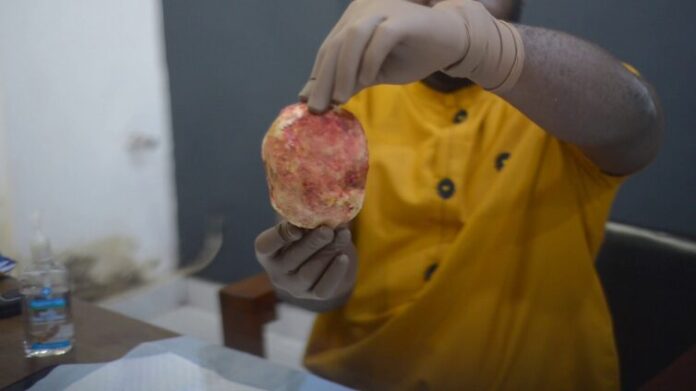

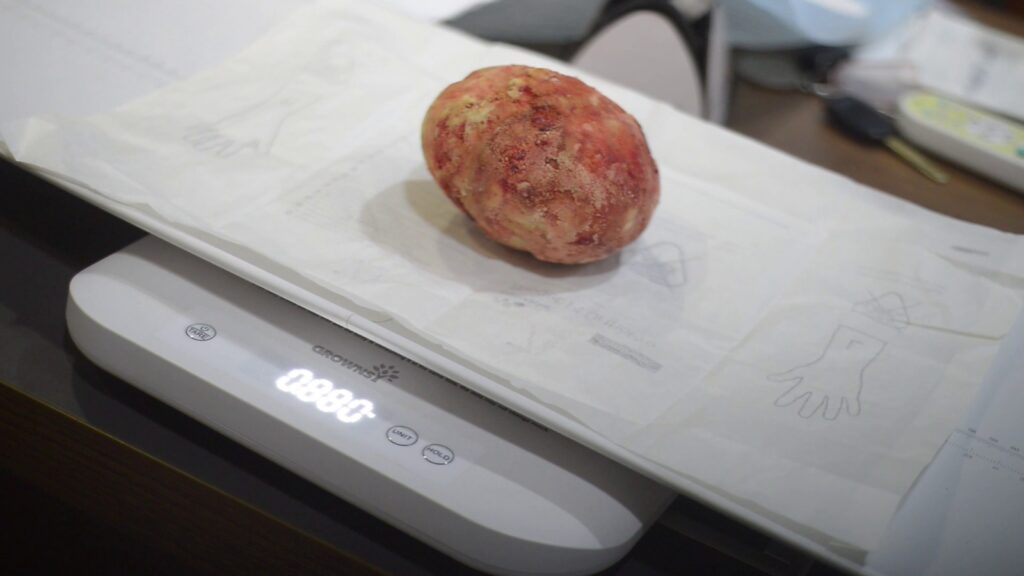
A team of doctors at Kumasi Hospital, a private health facility in the Ashanti Region, has removed an 880-gram bladder stone from a 49-year-old man in what the surgical team believes could be one of the largest such stones ever removed in Africa.
The stone measures 11.8 centimetres in length, 9.5 centimetres in breadth and nearly 8 centimetres in width.
At first glance, it resembles a ball of clay. However, the oval-shaped mass is a giant bladder stone — a hard, crystallised formation that developed inside the bladder of the patient, identified as Akoto, not his real name.
For nearly three decades, he endured pain, urinary difficulties and a gradual decline in his quality of life.
“It was really painful. Not being able to urinate is something I wouldn’t wish for anyone,” he said.
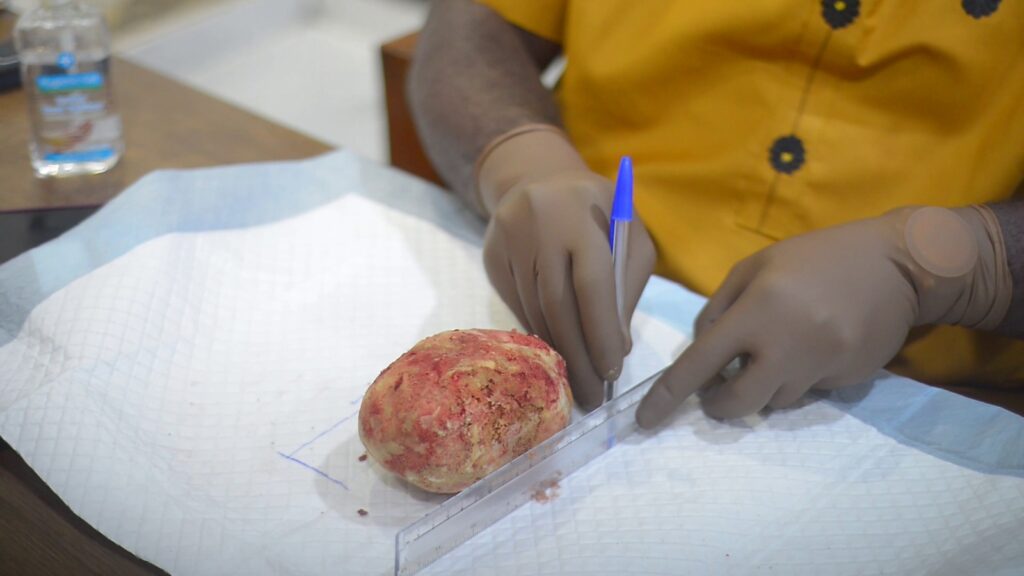
What may have begun as tiny mineral crystals gradually developed into an enormous stone, affecting his health and daily life.
The surgical team believes the stone is arguably the largest bladder stone documented as having been removed in Africa.
“We searched medical literature from the continent, but we couldn’t find any documented and removed bladder stone as big as this one. It was originally 980 grammes. But even after desiccating for over a day, the size is still the largest,” the Chief Executive Officer of Kumasi Hospital, Dr (Med) Samuel Koranteng Asante, told Luv FM’s Emmanuel Bright Quaicoe.
According to Guinness World Records, the largest bladder stone on record was removed from a patient in Brazil in 2003. It weighed 1.9 kilogrammes (4.2 pounds) and measured 17.9 centimetres (7 inches) in length.
Another record-breaking case was reported in Sri Lanka in August 2026, when doctors removed a 3.1-kilogramme bladder stone from a 55-year-old man.
How bladder stones develop
Bladder stones form when urine remains in the bladder for too long, allowing minerals in the urine to concentrate, crystallise and harden over time.
Dr Asante said underlying urinary tract problems could contribute to their formation.
“When one has prostate enlargement and urine consistently stays in the bladder, it can bring about bladder stones. But with this one, we realised there was a stricture in his ureter, which usually comes about when one has a urinary infection such as an STI, and it is not treated well, that can also contribute to bladder stones,” he noted.

Small bladder stones, sometimes as tiny as grains of sand, may pass out naturally. Larger stones, particularly those measuring more than one centimetre, can obstruct urine flow and may require medical intervention.
Stones measuring more than four centimetres are generally described as giant bladder stones.
Beyond the physical pain
For Akoto, the consequences extended beyond physical discomfort. The growing mass disrupted his social life, weakened his health and affected his sexual intimacy.
His experience highlights the importance of recognising urinary symptoms and seeking medical attention before an underlying condition progresses.
Doctors say early diagnosis and treatment of underlying urinary problems are important in preventing bladder stones from growing to such enormous sizes.
Dr Asante also advised people to drink adequate amounts of water to help reduce the concentration of minerals in their urine.
“Drink a lot of water. When you drink water, the urine becomes diluted. This means it will be difficult for the salt to crystallise and form a stone,” he advised.
For Akoto, the operation marks the end of years of suffering. His experience also serves as a reminder of the importance of seeking medical attention for persistent abdominal pain, difficulty urinating or other changes in urinary habits.
Also read: