
The Hall Master of Unity Hall, popularly known as Katanga, at the Kwame Nkrumah University of Science and Technology (KNUST), Professor Richard Kodzo Avuglah, has backed students who protested against what they describe as exorbitant private hostel fees.
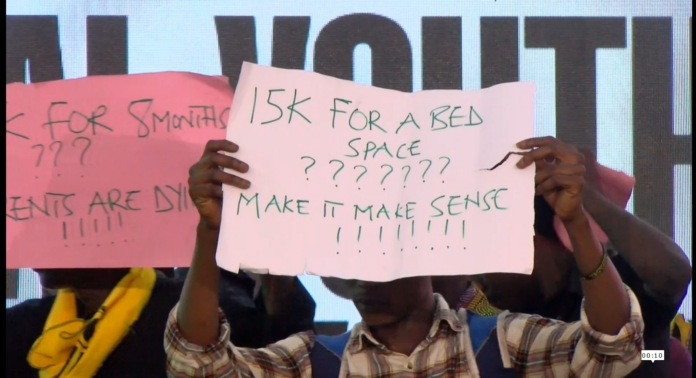
The students staged the protest during the National Youth Conference organised by the National Youth Authority at KNUST, drawing attention to the rising cost of private accommodation around the university.
According to the students, private hostel fees range between GH₵5,000 and GH₵10,000 per academic year, making accommodation increasingly difficult for many students and their parents to afford.
Prof. Avuglah said the concerns raised by the students were justified, noting that some private hostels charge between GH₵6,000 and GH₵7,000 per student, compared to the government-regulated rate of GH₵2,167.80 for traditional university halls.
“The kind of figures some of these private hostels are charging. We are all parents, so we feel it. They are very, very high, very exorbitant. So, I think the students are very much justified. The only thing is that I advise that when they are protesting, it should be a peaceful protestation,” he said.
He added that the issue had become a recurring concern among students and parents.
“The students are always complaining about that, because, like I said, we are also family members, we know how much some of these hostels are charging—very exorbitant,” he added.
Prof. Avuglah explained that the limited availability of accommodation in traditional university halls was also contributing to the pressure on students.
He said students who are required to move out of the traditional halls after their first year often struggle to secure affordable alternatives.
“And this gets to us all the time, and it puts pressure on us in the halls. Puts pressure on us because, just this week, a lot of students will come to you; they are almost finishing their first year, and they want to stay in the hall. But according to university policy, the halls are for only the first year,” he said.
He further noted that traditional hall fees at KNUST, which cover accommodation, utilities, water and internet, have remained unchanged for the past four years because increases require parliamentary approval.
“I have been a hall master this is my fourth year as a hall master, and the fees have not changed throughout my four years as a hall master. We have maintained the fee because, in our case, the fees can only be increased by the Parliament of Ghana. And every year when we make a proposal, we don’t get it approved, you understand? So, we just manage with what we have. And this includes utilities and everything,” he said.
Prof. Avuglah said traditional halls charge an average of GH₵2,167.80 per student for a room shared by four students, with utility costs included.
“In contrast, some private hostel operators charge students between GH₵6,000 and GH₵7,000 per academic year while also requiring them to pay separately for utilities.
“A student pays about GH₵6,000, GH₵7,000 per student, oh. Per student! It’s not like… Some of these figures! And then you look at the facilities being provided, it’s not anything extraordinary, you understand? So, we look at it. And I mentioned that maybe, also, they are charging this fee because of maybe the conditions that the banks give them. So, maybe that’s another angle we have to look at. But generally, the fees are high. The private hostels, the fees are just high,” he said.
He also noted that some private hostels charge for accommodation covering only eight to 10 months of the academic year rather than the full calendar year, further putting pressure on students’ finances.
Prof. Avuglah welcomed moves by the Rent Control Department to sanitise hostel operations and called for measures to address what he described as excessive accommodation charges.
Meanwhile, Minister for Youth Development and Empowerment, George Opare Addo, said the government had taken note of the students’ concerns.
“I want to assure them that as Minister for Youth Development and Empowerment, I will take up this issue. I’ll take up this issue with the Minister for Education and the appropriate authorities that are responsible for controlling rent in this country,” he said.
“We are a country of laws, and we must allow our laws to work. No single individual is bigger or greater than the laws of this country. And so we will make sure that the right things are done. We will have the necessary conversations with owners of hostels, and we will make sure that prices are reasonable,” he added.
ALSO:
Ofankor barrier accident death toll rises to 11
Tension mounts in Tema Community One as Mayor halts TDC-led project