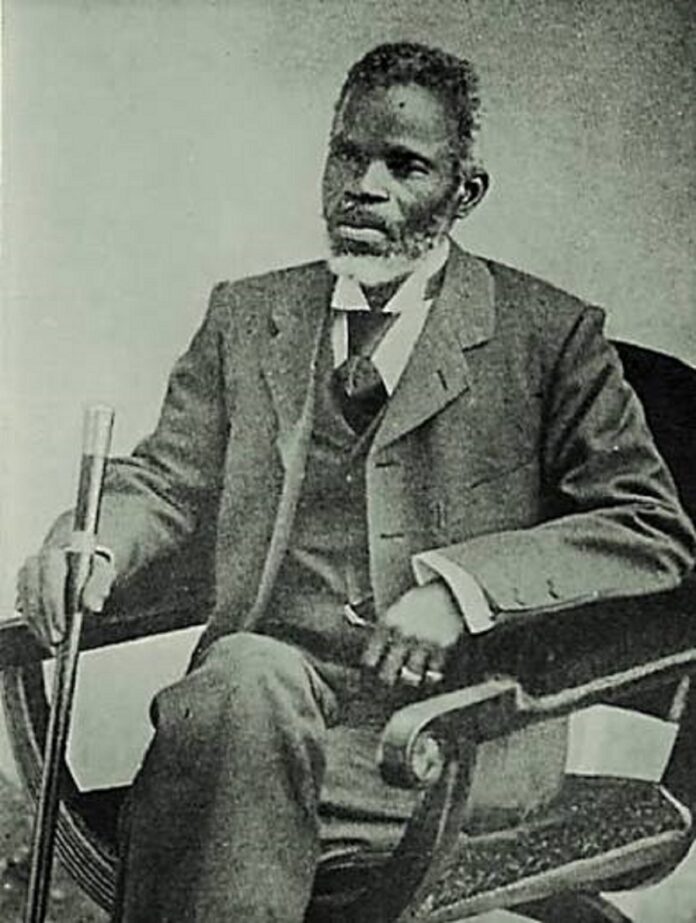

He grew up poor and survived by selling palm wine and carving coffins for a living but after a terrifying encounter with a venomous snake, his story changed.
Jacob Kwaw Wilson Sey became Ghana’s first recorded millionaire, and he didn’t hoard his wealth, but is credited with stopping the British from seizing every acre of unclaimed land in the Gold Coast.
Sey was born on 10 March 1832 in Asafura-Biriwa, a fishing village near Anomabo, to a carpenter father and a farmer mother. He had no formal education and grew up doing any work that paid.
Whether it was tapping palm wine, making coffins, or producing palm oil, he did it wholeheartedly. His jovial nature earned him a nickname that stuck for life — Kwaa Bonyi — because people who heard his jokes assumed he wasn’t a serious man.
The story of Wilson Sey’s transformation has been described by his biographers as “closer to folklore than documented fact”.
The best-known version says he climbed a palm tree one night and came face to face with a snake, causing him to lose consciousness. While in that state, a voice told him to “wake up and go in peace” and use whatever he found to help the needy. When he came to, he found gold nuggets and pots of gold hidden nearby, which he smuggled home over time.
Though this story has not been verified, one thing is clear: his fortunes changed, and he went from selling coffins to becoming the most influential person in his time. Jacob Kwaw Wilson Sey is Ghana’s first recorded millionaire, and he had enough to fund a national cause almost single-handedly.
His story didn’t end with becoming rich; one can say that was rather the start.
Saving Gold Coast’s lands
By the 1890s, the British colonial administration attempted to bring all Gold Coast lands under Crown control by introducing some legislation — the Crown Lands Bill of 1894, the Public Lands Ordinance of 1896, and the Lands Bill of 1897 — which would have stripped indigenous communities of traditional land rights and vested unused land in the colonial government.
Despite being unable to read or write, Sey understood exactly what was at stake and opposed it by co-founding the Aborigines’ Rights Protection Society (ARPS) in Cape Coast in 1897. He became its first president, pulling in Western-educated allies including John Mensah Sarbah and J.E. Casely Hayford.
With backing from chiefs across the Central Region, the ARPS prepared a petition and sent a delegation to London to appeal directly to Queen Victoria. This mission was fully funded by Sey.
He hired the ship Alba to carry the delegation, which included Thomas Freeman and Cape Coast merchants Edward Jones and George Hughes, to London.
In London, the delegation met the Colonial Secretary, Joseph Chamberlain, at 10 Downing Street, and they succeeded. They returned to the Gold Coast with an official letter from the Queen revoking the bill, along with a bust of Victoria that was later installed at what is now known as Victoria Park in Cape Coast.
Some scholars have gone as far as calling Sey the “first real architect and financier” of Ghana’s eventual independence.
A fortune spent on others
That London mission wasn’t the only time Wilson Sey spent his wealth for the betterment of others.
When Sekondi began pulling business away from Cape Coast, he bought houses to shelter professionals and families relocating for work.
Together with Mensah Sarbah, he pushed for a railway line to boost Cape Coast’s cocoa trade.
As a devout Methodist, Sey provided funds for church organs, clergy salaries and building restorations.
He is also credited with giving a portion of his estate toward founding Mfantsipim School, now one of Ghana’s most prestigious secondary schools. The hill it sits on is still known as Kwabotwe, a contraction of “Kwaa Bonyi ne Botwe” (Kwaa Bonyi’s Hill).
He also used his wealth and standing to support the return of traditional rulers who had been exiled by the colonial administration.
Death and a quiet legacy
Jacob Kwaw Wilson Sey died on 22 May 1902, aged 70, and despite his role in one of the most consequential land-rights victories in the country’s colonial history, he remains a relatively unknown figure in Ghana’s history.