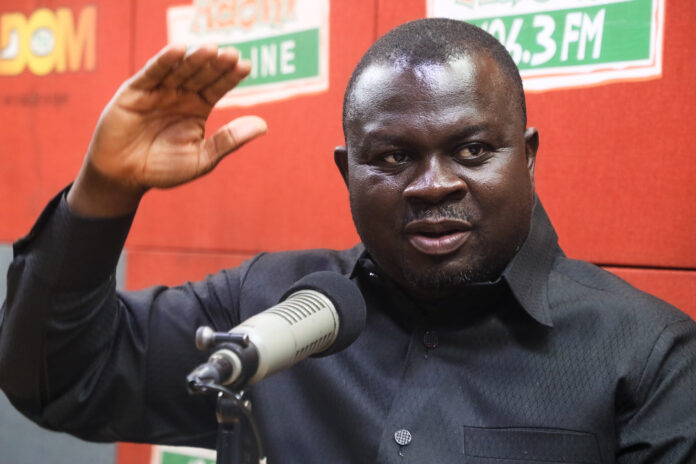

The Ghana Journalists Association (GJA) has given the Central Regional Chairman of the National Democratic Congress (NDC), Richard Asiedu, a seven-day ultimatum to publicly apologise, compensate Obaatanpa Radio, and report himself to the police over the invasion and temporary shutdown of the Kasoa-based radio station.
Addressing a press conference in Accra on Thursday, GJA President Albert Dwumfour described the incident as a serious attack on press freedom, saying the association’s investigations point to what he called an act of intimidation and lawlessness that has no place in Ghana’s democracy.
According to Mr. Dwumfour, information gathered by the GJA indicates that on June 25, 2026, a group allegedly led by Mr. Asiedu, together with the Awutu Senya East Municipal Chief Executive, Seth Banini, and the Constituency NADMO Coordinator, Nyash Nyande, stormed the premises of Obaatanpa Radio shortly after 10 a.m.
He alleged that the group assaulted the producer of the station’s morning show, Bernard Mireku, forced staff out of the building and locked up the station after discussions on the programme touched on an internal NDC matter involving the regional chairman.
The GJA said members of the group allegedly declared that they were “now in power,” accused the station of bias and warned staff that the incident was “only the beginning.”
Mr. Dwumfour said normal operations resumed only after the Central Regional Police Command, led by DCOP Francis Nchor, intervened, retrieved the station’s keys and reopened the premises.
He added that the assault case has since been transferred to the Criminal Investigations Department (CID) Headquarters in Accra for further investigations.
Citing Articles 21, 162 and 163 of the 1992 Constitution, the GJA President stressed that Ghana’s Constitution guarantees freedom of expression, editorial independence and protection against censorship, adding that public office does not give anyone the authority to shut down a media organisation over unfavourable reportage.
He therefore demanded that Mr. Asiedu publicly acknowledge that his actions undermined press freedom, render an unqualified apology to Obaatanpa Radio and compensate the station for the losses it incurred.
Mr. Dwumfour warned that should the demands not be met within seven days, the association would officially declare Mr. Asiedu “an enemy of press freedom” and pursue both criminal and civil action against him and the other persons allegedly involved in the incident.
He also called on the national leadership of the NDC to publicly condemn the actions of its Central Regional Chairman.
The GJA further expressed concern over what it described as the growing use of Strategic Lawsuits Against Public Participation (SLAPPs) to intimidate journalists, citing the case involving Larry Dogbey, Managing Editor of The Herald, as an example of the emerging trend.
According to Mr. Dwumfour, the association will begin consultations with Parliament, the Attorney-General, the Ghana Bar Association and the National Media Commission on introducing anti-SLAPP legislation to protect journalists from what it describes as abusive and retaliatory lawsuits.
“If journalists must constantly fear that every difficult story may be followed by a crushing lawsuit, then public-interest journalism will suffer. If editors must weigh not only accuracy but also the possibility of being dragged through the courts repeatedly, then the public loses an essential watchdog.
“If media houses must spend scarce resources defending themselves against legal harassment, then they are being punished for serving the public. The chilling effect is real. And it is dangerous,” he said.
Touching on the recent floods that affected several parts of the country, Mr. Dwumfour commended President John Dramani Mahama for his leadership in the national response and also welcomed the appointment of Brigadier General Forster Okae-Yeboah to head the nationwide flood mitigation exercise.
He, however, called for a long-term national flood resilience strategy, urging government to prioritise regular drainage maintenance, strict enforcement of planning regulations, protection of wetlands, and sustained public sanitation campaigns.
According to him, Ghana’s recurring floods should no longer be viewed as a seasonal challenge but as “an institutional problem” requiring coordinated and lasting solutions.
Also read: