
Twenty-one Ghanaians die every day from problems a working tap and a safe toilet could prevent
Ghana loses about 21 people a day — nearly 7,635 in 2019 alone — to preventable illnesses caused by unsafe water, poor sanitation and inadequate hygiene, editors and journalists were told at a WASH roundtable in Accra this week.
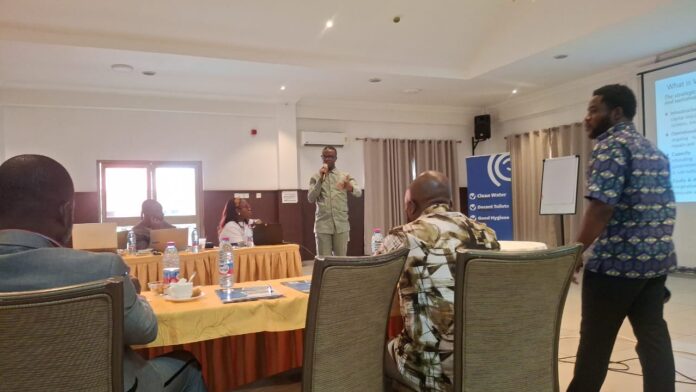
Officials from WaterAid Ghana presented the figures at back-to-back sessions held on September 8, 2026 laying out the scale of the country’s water and sanitation problem and, more urgently, the price tag for fixing it.
A sector still playing catch-up
Head of Strategy, Policy and Campaigns at WaterAid Ghana, Ibrahim Musah, opened by reframing WASH not as a technical afterthought but as a foundation for national development.
Inadequate water, sanitation and hygiene services carry serious consequences for health, wealth and dignity, he told the gathering, and the deficits are not evenly spread — they fall hardest along lines of geography, gender, income and education, producing what researchers call “health inequities.”
The health toll is well documented. Improved sanitation cuts diarrhoea cases by around 25 percent, and clean drinking water by 62 to 75 percent, while better hand hygiene reduces diarrhoea by roughly 30 percent, according to research cited in the presentation.
Beyond diarrhoea, poor WASH is linked to cholera, typhoid, dysentery, and childhood stunting and wasting. Globally, inadequate WASH was blamed for nearly 2 million deaths in 2016 alone.
Progress on one key indicator — open defecation — has been slow. Ghana Statistical Service data presented at the roundtable show the share of households practising open defecation fell from 20.1 percent in 2000 to 17.7 percent in 2021.
But because Ghana’s population has grown steadily, the actual number of households without toilets rose over the same period, from about 700,000 to 1.5 omillion — a reminder that percentage gains can mask a growing crisis on the ground.
Water enough, but in the wrong places
Ghana is not, strictly speaking, short of water. The country’s surface water systems — the Volta basin, the South-Western rivers (Bia, Tano, Ankobra and Pra) and coastal basins including the Densu and Ayensu — provide enough water in aggregate, but it is unevenly distributed across regions. Groundwater use for homes, farming and industry currently draws on just 5 percent of the average annual recharge in most basins, suggesting room to expand — if the investment and infrastructure follow.
That water is increasingly under threat. Illegal small-scale mining, known locally as “galamsey,” is polluting major water bodies, including the Pra River, driving up the cost of treating water before it is safe to drink.
Climate change compounds the problem: seawater is intruding into coastal groundwater, extreme weather is damaging WASH infrastructure, and — in a less obvious but no less serious consequence — climate-driven resource scarcity and displacement have been linked to a rise in domestic violence, according to research shared at the event.
The price of fixing it: $1.7 billion a year
The second presentation, delivered by Mutala Abdul-Mumin, WaterAid UK’s WASH Monitoring and Financing Senior Advisor, put a number on the problem: Ghana needs an estimated US$1.7 billion in annual investment through 2030 to achieve universal, safely managed water, sanitation and hygiene under Sustainable Development Goal 6.
Sanitation absorbs the largest share of that need — about $800 million a year, or 47 percent of the total — yet it remains the most neglected part of the sector. Urban water supply, largely the responsibility of Ghana Water Limited, needs another $420 million annually to replace ageing pipes and expand networks strained by rapid urbanisation; more than 59 percent of Ghanaians now live in cities. Rural and community water supply needs $350 million, while hygiene promotion and sector governance each require a comparatively modest $60 million.
Despite the scale of need, WASH struggles to compete for government attention and money.
Citing World Bank Global Director of Water Practice Saroj Kumar Jha, the presentation noted that developing countries typically spend just 1.2 percent of national budgets on WASH, compared with 12 percent on transport and 20 percent on energy.
Ghana spends about 1.7 percent of GDP on the sector, according to the country’s 2022 WASH Accounts — evidence, WaterAid argues, that political will has not caught up with need.
Six fixes on the table
Rather than simply calling for more money, the WaterAid team outlined what it called a shift from financing “projects” to financing “systems.” Their recommendations included:
Lifecycle financing that covers not just new pipes and toilets but ongoing operations, maintenance and eventual rehabilitation of ageing infrastructure — the “hidden costs” of service delivery that are often ignored once a ribbon is cut.
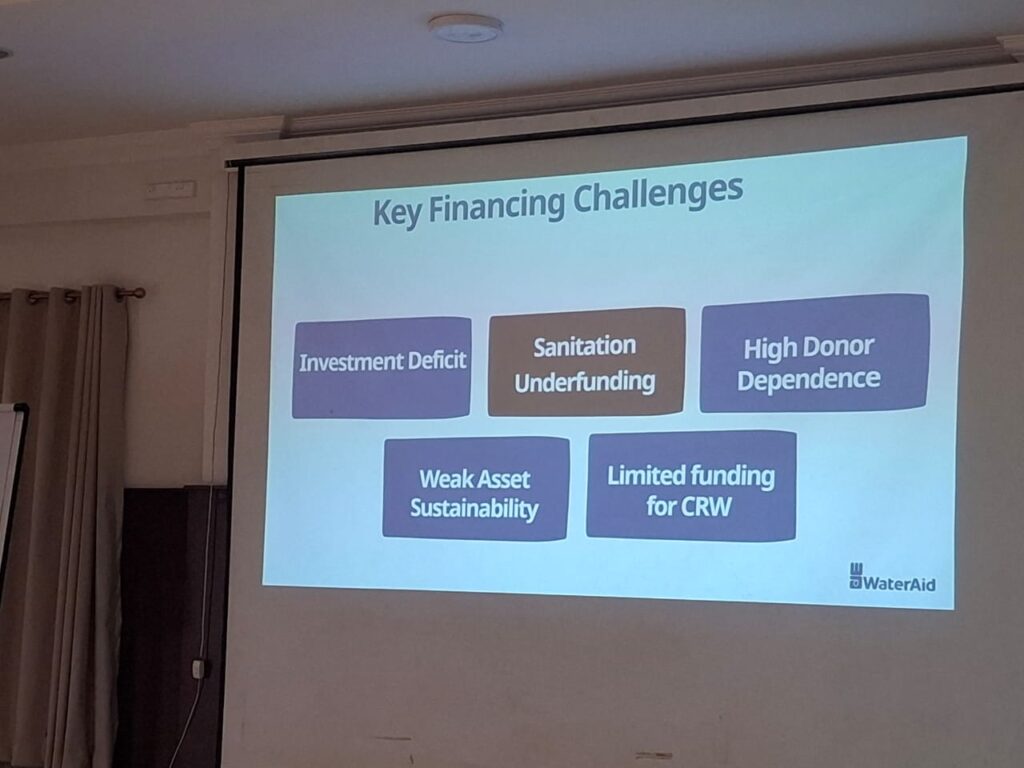
Reducing donor dependence, currently estimated at around 90 percent of sector financing, by scaling up domestic public funding.
Operationalising the National Sanitation Fund and putting the existing Sanitation and Pollution Levy to work funding fecal sludge treatment.
Blended finance — combining tax revenue, concessional development loans, climate grants and private capital — to de-risk investment by private operators.
Predictable district-level transfers, including a rethink of how the District Assemblies Common Fund (DACF) supports WASH.
Explicit climate-resilience financing for drought and flood-proofing, watershed protection and groundwater recharge.
A complicated chain of command
Part of the sector’s struggle, presenters argued, is structural. Responsibility for WASH in Ghana is scattered across at least five government bodies — the Ministries of Water Resources, Works and Housing; Environment, Science, Technology and Innovation; Local Government, Chieftaincy and Religious Affairs; Education; and Health — alongside regulators, utilities, development partners, civil society and traditional and faith-based institutions.
Without a clearer lead agency or coordinating mechanism, the sector’s own diagnostic documents point to low priority for institutional strengthening, an overemphasis on expanding access rather than sustaining service delivery, inconsistent financing, and persistent gaps in reaching the poorest communities and public institutions such as schools and clinics.
Why editors were in the room
The choice of audience was deliberate. WaterAid’s presenters framed the media’s role in explicitly political terms: public concern shapes the media agenda, the media agenda shapes policy conversations, and policy conversations — when sustained — shape actual changes in law and budgets.
In a sector competing for attention against roads, energy and other visible infrastructure, sustained press coverage was described as one of the few levers capable of moving WASH higher up the national priority list.
The message editors left with was blunt: Ghana is not lacking in water resources, technical knowledge or global commitments — it is lacking in sustained investment and political prioritisation.
Closing that $1.7 billion annual gap, presenters said, will determine whether the 21 preventable deaths recorded each day become a shrinking statistic or a permanent feature of Ghanaian life.
Sources: “Ghana WASH Sector Overview,” presented by Ibrahim Musah, Head of Strategy, Policy and Campaigns, WaterAid Ghana, Editors Roundtable, WAG Conference Room, 8 September 2026; “WASH Financing, Why It Matters and What Sustainable WASH Financing Should Look Like,” presented by Mutala Abdul-Mumin, WASH Monitoring and Financing Senior Advisor, WaterAid UK/PSK, Editors Roundtable on WASH, Mensvic Hotel, Accra, 8 September 2026. Data cited from WHO/UNICEF Joint Monitoring Programme (2025), WHO (2019), Ghana Statistical Service (2023), Ghana WASH Sector Development Programme (GWASHSDP, 2023), WASH Accounts (2022) and NDPC (2023).
Feature By: Martha Crentsil Acquah