
Donald Trump strutted onto the White House Rose Garden and announced to the world that 2 April 2025 would forever be known as ‘Liberation Day’ in the United States of America.
In his speech, he declared that ‘reciprocal tariffs’ would be imposed on almost all countries, whether friends or foes.
He spent virtually the rest of the speech justifying this action, notably with the aid of a visual chart.
By the time he left the Rose Garden and headed back to the West Wing of the White House, one thing had become abundantly clear: there had been a radical change in the global affairs.
This significant shift in global power dynamics was not sudden. The signs had been there for almost a decade before this historic announcement.
From the rise of Trump in 2016 and his ‘America First’ agenda to ‘Brexit’ and the powerful wave of far-right politics and protectionism that swept across the West and South America.
This movement produced leaders such as Jair Bolsonaro of Brazil, Javier Milei of Argentina, and Marine Le Pen of France.
Donald Trump’s tariff impositions can thus be described as a manifestation of this change in global affairs because the entire world, especially long-standing allies of the U.S in the West, learned that day that the U.S is no longer a reliable partner.
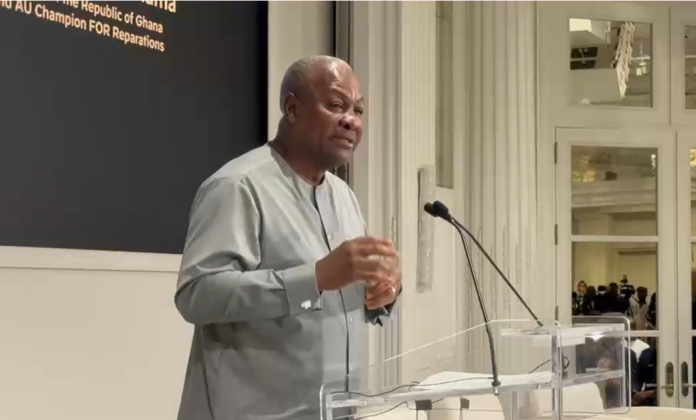
This is why President John Mahama, in his inaugural speech following his swearing-in as President, highlighted the changes in international affairs and Ghana’s potential place within it.
Nearly two years into his term, he is taking steps to position Ghana within this mutating geopolitical space.
BRICS is an international organisation made up of eleven countries. It is important to note that the name BRICS is itself an acronym formed from the first letters of the founding nations of the organisation: Brazil, Russia, India, China, and South Africa.
Economist Jim O’Neill is credited with coining the acronym ‘BRIC’ in an article he wrote in 2001 about the emerging economies he believed would shake up the global status quo in the near future.
The agenda of BRICS focuses largely on economic issues, such as facilitating trade among member nations and partner countries, as well as combating the dominance of the U.S dollar in the current international financial architecture.
Consequently, countries such as Ghana that choose to join the organisation look forward to enjoying its aforementioned economic benefits.
Although BRICS, as an organisation, has decided to move beyond its economic-focused mandate to embrace ‘non-controversial’ issues such as climate change and the fight against terrorism, the fact remains that any country that applies to become a member of the organisation is deemed to be taking a firm geopolitical stance against the West, particularly the United States of America.
This is because of the ongoing tussle for geopolitical supremacy between the United States of America and China.
There is also the added fact that Russia and China, both founding members of the organisation, are regarded as adversaries of the U.S.
This position is further reinforced by the fact that Iran, a country with which the United States is currently at war, also became a full member of BRICS in 2024.
In essence, Ghana is seeking to join an organisation that includes the country rivaling the U.S in economic and technological might (China); the country with which the U.S spent almost the entire twentieth century engaged in a Cold War (Russia); and the country with which it is currently at war (Iran).
This must also be considered in light of the fact that the current occupant of the Oval Office is a capricious man who has threatened genocide multiple times and abducted the president of another country.
A counterargument to the above is that, as a sovereign country, Ghana is free to join whichever organisation it pleases.
Additionally, Ghana’s decision to join BRICS does not mean that it seeks to sever its relations with the U.S and the other major powers in the West.
Indeed, China, in particular, maintains very cordial bilateral relations with prominent Western European countries such as France, Germany, the United Kingdom and Italy.
This is evident in their collective membership of the Asian Infrastructure Investment Bank (AIIB), which was founded by China and is headquartered in Beijing.
Moreover, despite the well-documented issues between the U.S and China, ranging from trade practices and territorial disputes to technological rivalry, an argument could be made that tensions between the two countries have been sensationalised.
This is evident in the fact that, just about a month ago, President Trump literally rolled out the red carpet for President Xi Jinping, beginning on the tarmac where his plane landed.
China’s president was not only greeted at the airport by Donald Trump but was also serenaded by the US military band and entertained with a ceremonial flyover by two U.S military jets.
Following this display of pageantry on the tarmac at Joint Base Andrews, Xi Jinping and his wife were treated to a state dinner at the White House.
The dinner brought together top American political and business leaders, who fraternised with China’s first couple, as well as the delegation accompanying them.
Russia’s Vladimir Putin has also been a recipient of the pomp and pageantry displayed by the United States.
Just last year, he, too, had the red carpet rolled out for him in Alaska, along with a tarmac reception hosted by Donald Trump.
These examples clearly demonstrate that the geopolitical landscape is far more complex and sophisticated than most people perceive it to be.
It must be noted that Ghana’s decision to join BRICS comes with a number of potential benefits. One obvious benefit is the opportunity to access financing from the New Development Bank.
The bank finances projects in countries affiliated with BRICS on favourable terms compared with those offered by the International Monetary Fund and the World Bank.
It also provides the government with additional financing options if it needs funding to implement its policies.
There is also the added benefit of reducing the dependence on the U.S dollar by using the cedi for trade. China, India and Indonesia, which are members of BRICS, are three of the most populous countries in the world.
This gives Ghanaian businesses an opportunity to access a much larger market.
The organisation can also serve as a vehicle for advocating reforms in institutions such as the United Nations, particularly its Security Council.
The last two Presidents of Ghana have advocated for an African country to be included as a permanent member of the United Nations Security Council.
President Mahama is also on record as having complained about the stringent conditions attached to loans received by African nations from institutions such as the World Bank and the International Monetary Fund.
BRICS provides a platform through which the Global South can pursue these objectives and potentially achieve them sooner rather than later.
Elections have consequences, and the fact that Ghana is gearing up to join BRICS under President John Mahama’s tenure is no coincidence.
The President is a member of the National Democratic Congress (NDC), a left-leaning political party. He is also an avowed believer in the ideals of Dr Kwame Nkrumah and is courageous enough to call out the ills of the West.
This is evidenced by the op-ed he wrote in defence of South Africa when Donald Trump made unfounded claims about the country, as well as his ‘subtle’ rebuttal of the US President’s threat to commit genocide.
His advocacy for the lifting of sanctions against Fidel Castro’s Cuba and his strong insistence on Palestine’s right to self-determination reveal him to be a true left-leaning politician.
Additionally, the fact that BRICS is led by Russia and China, two countries known for practising extreme forms of left-wing politics and governance, undermines any assertion that the President’s personal biases played no role in this decision.
At the end of the day one thing that is clear is that the geopolitical landscape has well and truly changed. And just like it is with every other country, Ghana has to take decisions that she believes would be in her best interest.
The decision to join BRICS has already generated debate and the pros and cons of joining this organization have already been outlined.
Regardless of how this decision plays out, history is going to remember this period as the time a leftist politician from Bole staged a stunning political comeback and then proceeded to take one of the most consequential foreign policy decisions in Ghana’s history.