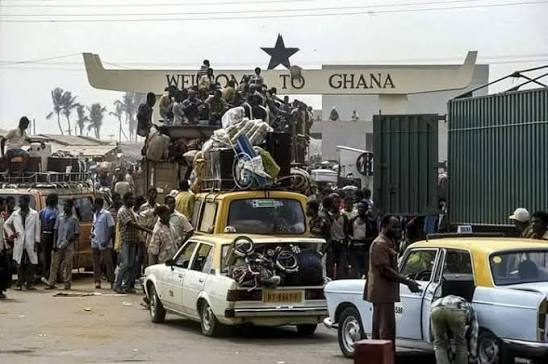

Decades later, a troubling history is repeating itself in South Africa.
In January 1983, Nigerian President Shehu Shagari issued an order that would reshape West African memory for generations: all undocumented migrants had two weeks to leave the country. The order affected nearly two million people, more than half of whom were Ghanaians.
A massive boom in the oil industry transformed Nigeria into an attractive economic hub in the 1970s.
During the same period, Ghana was grappling with political instability and severe economic hardship, driving many to flee the country. Most people made their way to Nigeria in search of better opportunities, where they eventually built comfortable lives for themselves and their families in cities across the nation.
However, barely a decade later, falling oil prices turned these established residents into unwanted guests.
Rising unemployment rates, rampant inflation, and growing public frustration led the Nigerian government to turn against foreign workers.
Families who had spent years building their lives in the country were forced to pack whatever they could carry into cheap, striped plastic bags, the very bags that would give the crisis its lasting name: Ghana Must Go.
The journey back home wasn’t as smooth as one would have expected. Ghana’s border had been shut following a recent coup attempt, and Togo also closed its border to prevent a sudden influx of refugees. As a result, thousands of returnees found themselves stranded, travelling on foot through Benin and Togo with nowhere to go.
Ghana Struck First
What many people don’t remember is that Nigeria’s 1983 order wasn’t the first move but rather payback.
Fourteen years earlier, in 1969, Ghana’s government had done almost the same thing when three million foreign nationals, largely Nigerians, were ordered to leave Ghana under the Aliens Compliance Order signed by Prime Minister Kofi Abrefa Busia. This happened at a time when Nigerians were said to make up roughly 20 percent of the country’s population.
History Repeats Itself, This Time in South Africa
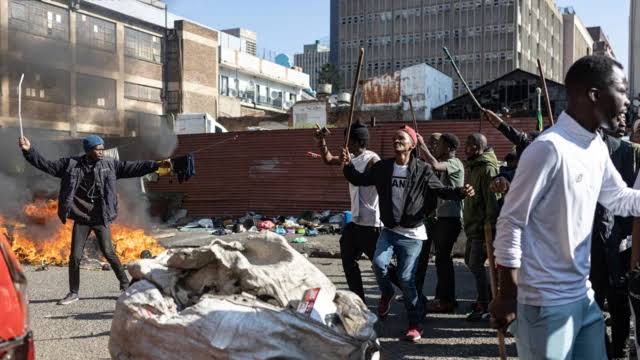
More than four decades later, a similar story is unfolding, not between Ghana and Nigeria, but in South Africa.
While the 1969 and 1983 expulsions were state-led, the situation in South Africa is being driven by a citizen movement calling itself March and March.
Also, the situation in South Africa is part of a recurring pattern of anti-migrant sentiment spanning nearly two decades.
Since April 2026, the group has organised demonstrations against undocumented migrants across major cities, including Pretoria, Johannesburg, and Durban, often with violent and fatal consequences. Foreign-owned shops have been looted, and families have been forced from their homes, with several migrants alleged to have been killed in the unrest.
A Ghanaian national was reportedly killed on June 30 during the demonstrations, and the ongoing violence has already forced roughly 1,000 Ghanaians to return home, with many more registering for repatriation.
The diplomatic fallout has been swift and sharp. Ghana turned down a state visit request from South African President Cyril Ramaphosa. Meanwhile, President Mahama publicly stated that South African authorities are failing to address the attacks with the seriousness they demand, allowing those inciting the violence to operate with impunity.
Healing Old Wounds: The Path Forward
What makes the “Ghana Must Go” story worth revisiting today is not just the shared trauma, but what came after.
Ghana and Nigeria did not remain locked in resentment. Today, both nations view each other as vital strategic partners.
Just recently, when Nigeria’s new High Commissioner-designate presented his credentials in Accra, Ghana’s Foreign Minister, Samuel Okudzeto Ablakwa, reaffirmed that the two nations share a unique historical bond built on common values, regional solidarity, and a joint commitment to peace and prosperity in West Africa. The Nigerian envoy echoed these sentiments, calling the relationship between the two countriesan enduring, fraternal bond that plays a vital role in regional security and development.
This friendship extends beyond diplomatic speeches into concrete action:
Maritime Cooperation: Both nations recently signed a maritime agreement aimed at boosting trade, enhancing security, and advancing the blue economy across West Africa—with Ghana’s Maritime Authority leveraging Nigeria’s expertise in ship registration and regulation.
Economic Integration: Both governments are actively working to deepen trade under the African Continental Free Trade Area (AfCFTA) by removing cross-border trade barriers.
Cultural Ties: On a lighter note, the famous online rivalry between Ghanaians and Nigerians remains a testament to their closeness, a banter-filled “love-hate” relationship that other African nations rarely cross, knowing the two countries always reconcile.
The Lesson for Today
The history between Ghana and Nigeria proves that relationships strained by mass expulsions and mutual suspicion can evolve into strong partnerships within a generation. Achieving this required honest reckoning, sustained diplomacy, and a mutual realisation that both countries are stronger together than apart.
South Africa and its African neighbours are currently facing a similar test.
Whether those relationships heal will depend on whether South Africa addresses the current violence decisively, choosing the path of regional unity over the legacy of “Ghana Must Go.”