
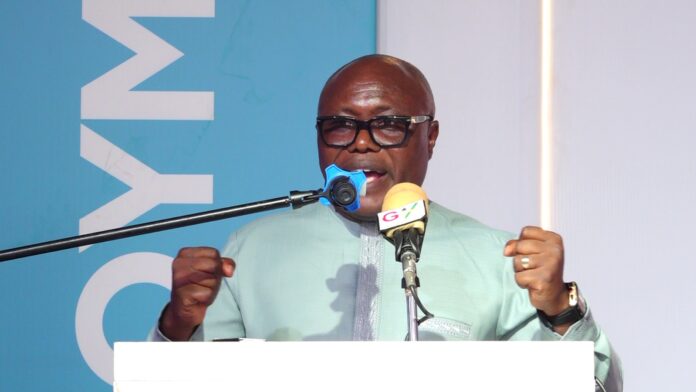

The Director-General of the Ghana TVET Service, Engineer Dr. Eric Kofi Adzroe, has called for a major shift in Ghana’s approach to Technical and Vocational Education and Training (TVET), saying the country’s industrialization drive depends on a skilled and competent workforce.
He said Ghana could not achieve sustainable industrial growth, expand manufacturing, modernise agriculture or create quality jobs without equipping its workforce with the technical and occupational skills required by industry.
“Ghana cannot industrialize sustainably without a skilled workforce. We cannot build competitive industries, expand manufacturing, modernise agriculture, accelerate digital transformation, or create quality jobs without people with the right technical and occupational competencies,” Dr. Adzroe said.
He made the remarks at the TVET Policy Dialogue organised as part of the Ghana TVET Week 2026 celebrations, held under the theme, “Resetting TVET, Empowering Ghana’s Industrial and Economic Transformation.”
The dialogue brought together policymakers, government officials, industry representatives, development partners, academics and other stakeholders to discuss reforms needed to align technical and vocational training with Ghana’s industrial and economic development priorities.
Dr. Adzroe said the country must move beyond discussions about the relevance of TVET and focus on making it a central pillar of national economic transformation.
“The question, therefore, is no longer whether TVET matters. The question is whether we are prepared to position TVET at the centre of Ghana’s economic transformation,” he stated.

Calls for stronger industry partnerships
The Director-General identified stronger collaboration between training institutions and industry as one of the key measures needed to improve the delivery of TVET in Ghana.
He said institutions must respond more quickly to emerging technologies and changing labour market demands to ensure that graduates acquire skills that meet employers’ needs.
“We must strengthen the alignment between training institutions and industry. We must ensure that sectors respond faster to emerging technologies and changing labour market demands. We must deepen work-based learning, apprenticeship and industry partnership,” he said.
Dr. Adzroe also called for increased investment in modern training infrastructure, equipment and instructor development, alongside improved pathways connecting skills acquisition to employment, entrepreneurship and productive enterprise.
According to him, these measures would help produce graduates who are better prepared for the workplace and capable of contributing meaningfully to productivity and economic growth.
TVET must become a national development priority
Dr. Adzroe stressed that technical and vocational education should no longer be treated solely as an education-sector concern but as a national economic development priority.
“Most importantly, ladies and gentlemen, we must move from viewing TVET primarily as an education-sector issue to recognising it as a national economic development priority,” he said.
He explained that the transformation of Ghana’s economy required a coordinated effort involving government, industry, training institutions, development partners and other stakeholders.
The Director-General said the Ghana TVET Service remained committed to supporting the transformation but noted that the scale of the task required a broader national commitment.
“Ghana TVET Service is committed to playing its part in this transformation. However, the scale and complexity of the challenge require a whole-of-government and whole-of-economy approach,” he stated.

Stakeholders urged to produce practical outcomes
Dr. Adzroe urged participants at the dialogue to engage in frank discussions and develop practical recommendations capable of influencing policy and improving skills development.
He challenged stakeholders to examine whether training institutions were adequately equipped to deliver the skills needed for industrial growth, how TVET financing could be strengthened and what more industry could do to support training and apprenticeship programmes.
“I encourage us to make this dialogue practical and forward-looking. Let us ask the difficult questions,” he said.
He further emphasised the need to ensure that resources invested in TVET translated into measurable improvements in productivity, employment, innovation and economic value.
“The outcome of this dialogue should not end in this room. They should inform policy, strengthen partnership and translate into measurable actions,” Dr. Adzroe added.

Ghana TVET Week 2026
The Policy Dialogue forms part of the Ghana TVET Week 2026 celebrations, which seek to highlight the importance of technical and vocational education in developing the skilled workforce needed to support Ghana’s economic transformation.
Dr. Adzroe acknowledged the contributions of government officials, members of Parliament, the Ghana TVET Service Council, and principals of technical institutes, industry representatives, development partners, academics and the media to the advancement of the TVET agenda.
He called on stakeholders to strengthen existing partnerships and renew their commitment to positioning technical and vocational education as a key driver of industrialisation and economic growth.
“As we celebrate Ghana TVET Week 2026, let us therefore use this platform to reset our thinking, strengthen our collaboration and reposition TVET as a powerful engine of Ghana’s industrial and economic transformation,” he said.
The call comes amid growing emphasis on skills development, industry-led training and technical education as essential components of Ghana’s efforts to build a competitive economy and expand employment opportunities.
READ ALSO:
Minister challenges CSIR scientists to find alternatives to plastic packaging
Education Minister hopeful university administrators’ strike will end by Friday